
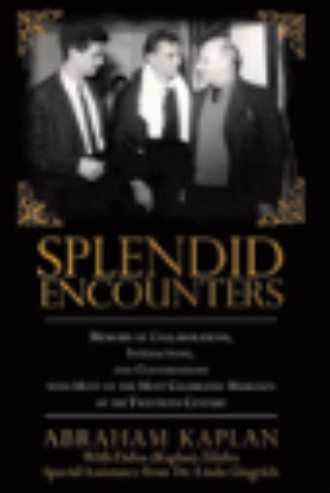
Splendid Encounters
Memoirs of Collaborations, Interactions, and Conversations with Many of the Most Celebrated Musicians of the Twentieth Century
by
Book Cover & Preview Text
LEONARD BERNSTEIN “Musical down to his bone marrow.” Both my father and grandfather used that expression when they encountered someone extremely musical. From the first moment I met Leonard Bernstein, the phrase immediately entered my mind. The man was music incarnate. First Collaboration During the summer of 1961, I was appointed Director of Choral Music at the Juilliard School. Prior to the beginning of the school year, I received a call from Mr. Bernstein’s secretary, Helen Coats. Hearing of my appointment, Bernstein wanted to know if the Julliard chorus would be interested in collaborating with him and the New York Philharmonic in a performance of Bach’s St. Matthew Passion at Carnegie Hall. I must tell you that the rest of my colleagues didn’t look at Bernstein as the legend that he turned out to be—but I was already in awe of his genius, and was exhilarated at the thought of working with the Maestro. I responded that I would be honored to work with Maestro Bernstein, but that I would need to first check with my new bosses at Juilliard. To my great surprise and amazement, the dean actually rejected the request! To this day I do not understand his rationale – but since I had not even started my job there yet, I did not ask for an explanation. Nevertheless, I found a way to work on the project. During that same summer I had also been selected as Director of the Collegiate Chorale, a group that was started fifteen years earlier by Robert Shaw. The community chorus took its name from the venue in which it had originally rehearsed, the basement of the Marble Collegiate Church of New York. I decided to use the Collegiate Chorale in order to fulfill Mr. Bernstein’s request, despite one significant challenge: this group, prior to my appointment, had dwindled from one hundred and fifty singers down to only fifty-seven—which would not be enough to perform the St. Matthew’s Passion. To be honest, fifty-seven is an overstatement, if it means that all of the members actually showed up at every rehearsal. Never to be dissuaded in those years, I had enough Israeli chutzpah and youthful naiveté to think, “Bernstein’s invitation is for the second part of the season – by that time, I can restore the Chorale to its original strength.” I called back Helen Coats and told her about the Juilliard situation, and then about my other chorus, with which I would be happy to meet the Maestro’s request. Perhaps it was fate - Mrs. Bernstein had been a member of the Chorale years earlier, and so Ms. Coats was aware of the group. Word had gotten out about the group’s shrinkage though, so with a bit of surprise, she asked, “Is the Chorale still in existence? How many singers are there?” I boldly stated that the group was a hundred and fifty members strong (I had an instinct that whenever I was asked such a question, I always said “yes,” and scrambled to find a way to make it so.). Luckily, many of the people who sang with Robert Shaw came back when they heard that I was appointed as a permanent director, and we happily started the season with a hundred and twenty-five to a hundred and fifty singers. We were well prepared by the concert date, and that was the beginning of a delicious, sixteen-year musical partnership with Bernstein. During our first piano rehearsal with Maestro Bernstein, I enjoyed one of my most rewarding experiences as a young conductor. Bernstein decided to “test” the Chorale on that particular day, and did something that showed me immediately he had an understanding for conducting choruses (sadly, I cannot say this for all orchestral conductors). Bernstein told the Chorale when he stood in front of them, “I’m going to do an experiment. We will sing the chorale on page 191, but I will conduct it capriciously, arbitrarily changing the tempo.” I knew right away that he wanted to see if the group could follow him. Even in those days, I used to rehearse choruses at varying tempi, so that they would be attentive to the conducting rather than drifting into autopilot…but I had never tested them at this level! When the Maestro got on the podium, he conducted the music with the most dramatic and erratic tempo changes, trying to throw the singers off track. Much to my delight they were absolutely perfect, and stayed with his every move. When it was over, the Maestro rewarded the group with an exaggerated hand gesture, as if he was trying to wipe glue off of his hand…as if to say, “all right already, you win!” Needless to say, I was beaming with happiness, and could not wipe the silly grin from my face. Years later, after preparing choruses for so many other conductors, it became a significant part of my mindset and routine to prepare the singers at the broadest range of tempi possible for a piece. The final rehearsals for the Passion were in Carnegie Hall, and as the day grew nearer, Maestro Bernstein became more and more excited about the concert. When the performance was only a few days away, he suddenly asked me if I would do for him what he called a “big favor,” which to me was a privilege. “You know,” he said, “my father is an orthodox Jew. I have tried for years to get him to come and listen to the St. Matthew Passion, but he would never come. In years past, in Lawrence, Massachusetts, where he lived, he remembered the Irish Catholics in his neighborhood getting out of church at Easter time after hearing the Passion story, and stoning some of the Jewish-owned businesses.” His father didn’t want to hear the story that he thought was responsible for provoking such anti-Semitic behavior. “This time,” continued Bernstein, “I told him that I had an Israeli preparing the choruses who shared my passion for the music…I told him that you would sit with him if he would just come and listen.” To make a long story short, I met Bernstein Senior in the conductor’s box, and there he confirmed for me his son’s explanation. He was an absolutely delightful man with a wonderful sense of humor. He was moved not only by the music, but also by the story, which he had never heard before. At intermission, he leaned toward me and in Yiddish said, “even though it’s a lie…it’s a beautiful story.” A recording was made of that performance by Columbia Records, and is now available on compact disc through Sony.
Formats

Book Details
About the Book
From world premieres with Leonard Bernstein to a once-in-a-lifetime collaboration with Frank Sinatra at Madison Square Garden, Splendid Encounters offers a glimpse into two of the century’s most exciting decades of classical music. Renowned choral conductor Abraham Kaplan provides a fascinating look at his association with more than forty talented musicians who touched his life with their genius and accomplishments.
In some instances, Kaplan crossed paths with these musicians momentarily, and in other cases, he had the privilege of working intimately with some of the world’s great maestros. In all, Kaplan collaborated with twenty-eight world-renowned conductors, nine internationally famous composers, and other celebrated personalities—from William Schuman to Igor Stravinsky and Vincent Persichetti—whose vignettes are delivered in this compilation.
Splendid Encounters, stories of great musicians told by a great musician and storyteller, is both infectious and inspirational, and demonstrates that these legendary musicians are indeed real human beings. This music biography revives the living, breathing experiences of a generation of musical legends who should not be forgotten.
About the Author
Abraham Kaplan is a renowned choral conductor whose work includes choral and symphonic compositions, performances of well-known twentieth century pieces, and instruction to many of today’s finest conductors. Kaplan splits his time between Tel Aviv, London, New York, Los Angeles, and Seattle, concentrating on composition work, guest appearances, and family.