
KONGLISH
The Ultimate Survival Guide for Teaching English in South Korea
by
Book Cover & Preview Text
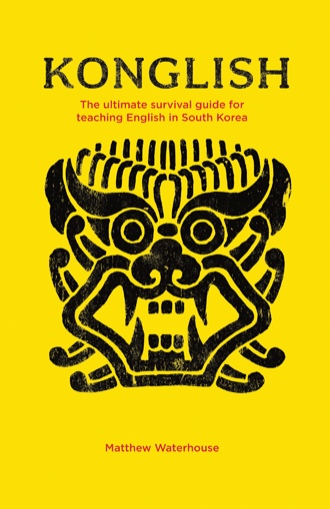
If you’re taking the time to read this introduction and aren’t in one of those funky bookstores that encourage you to lounge around for hours, then you’ve probably just purchased Konglish or are thinking about doing so. Congratulations on having the foresight and good taste to invest in your future and my mortgage.
Teaching English in South Korea is one of the most exciting, rewarding and downright incredible things you’ll ever do. It’s not however the easiest job, and the unique challenges that accompany it are compounded by the fact that the people who live there possess a culture that’s often at right angles to wherever you’re from. This can be a source of frustration and despair but it’s also what makes it so damn interesting.
Hospitable inhabitants, fiery cuisine, imposing palaces, excellent infrastructure, Confucian customs, ancient arts, vibrant cities, shamanistic rituals, hi-tech industries, marvelous mountains, acres of orchards, beautiful temples and a recent history that includes monarchy, assassination, invasion, occupation, civil war, dictatorship, democracy and unprecedented economic growth are just some of the factors that make this tiny nation a complex and intriguing option for both teachers and tourists alike.
While this book was written with prospective teachers in mind, much of its content addresses Korean history, culture and customs, and will be of use to anyone seeking to know more about living and working in this fascinating country.
The structure is simple and follows a natural and intuitive order. It starts by questioning your sanity and quickly moves on to help identify who your ideal students might be and where you should base yourself. After this come simple things like finding the perfect job, acing the interview, negotiating a favorable contract and securing the coveted E-2 visa.
The next section deals with things you should know before you depart. These include, amongst other topics, accommodation, cross cultural communication, social faux pas, home sickness and what to pack for a bag that weighs less than your mother.
Further on are a number of chapters dedicated to the different needs of your various students, everyone from nearly newborns to ancient artefacts, plus a section on the illegal pleasures of private tuition. These are followed by a host of other erudite scratchings, covering everything you could possibly ever need to know about the culture and customs of South Korea—including the stuff nobody wants to discuss.
I wrote Konglish because I was dissatisfied with the quality of information available on the subject. Most of what I read was out-dated, incomplete or as boring as bat shit. Some of the printed publications were nothing more than tarted up ESL handbooks without a single shred of social context, while others were so politically correct that they failed to provide the reader with any meaningful advice on the hard realities of living and working abroad.
South Korea is an amazing place, brimming with smart students, fantastic food and vibrant traditions, so it should come as no surprise that the many writers are content to stick with safe subjects like lesson plans, barbequed beef and Buddhist temples. I however, wanted to create a book that while addressing these fundamentals would also take a look outside of the box. I wanted to write about the other Korea that teachers experience, in order to prepare potential teachers for the drunken businessmen, racist remarks, vomit strewn streets and aching bouts of loneliness and dislocation.
As the full title implies, the purpose of Konglish is to ensure that the reader possesses the knowledge necessary to survive the challenges of teaching English in South Korea. I feel that this is vitally important, in that each year hundreds of new teachers quit their jobs after only a few months because they aren’t adequately prepared for the intensity of the experience. But survival doesn’t mean just scraping by, it’s knowing how to successfully cope with the inevitable lows of the job in order to appreciate the mind blowing highs that come with this incredible country.
I honestly believe that if an individual arrives in South Korea armed with the right attitude and information, he or she will have an enjoyable time and be a better teacher regardless of what life throws at them. I also feel that the best way to pass this knowledge on is through honesty and humor. Honesty because I think we all want to be warned about the potential pitfalls in our path, and humor because it’s always easier to accept advice if we’re laughing with the fool who’s already stepped on the banana skin.
Though no text is perfect, this one has turned out better than I dared imagine. At just over thirty five chapters, I feel that Konglish strikes the right balance between fact, fun, anecdotal evidence and serious subject matter.
Choosing to live and work overseas is a significant decision and not one to be entered into lightly. That said, teaching English in South Korea was the one of the best things I’ve ever done. I met my wife, made great friends, helped thousands of people improve their English, learned a second language, experienced a unique culture, saved some money, found a vocation and gained a deeper understanding of myself and the world I inhabit. I have no doubt that you’ll find it equally rewarding. I hope this book meets your expectations and helps you succeed in your journey. Have a pitcher of lemon Soju for me and don’t forget to try the squid.
Formats

Book Details
About the Book
Everything you ever wanted to know about teaching English in South Korea but were afraid to ask is contained within this book.
Funny, fact filled and always informative, Konglish provides the necessary knowledge you need to make the right decisions. Jam packed with practical information, Konglish addresses all of the topics and taboos a prospective English teacher needs to know, from finding the right job and negotiating a favorable contract to individual chapters dedicated to the specific learning needs of different students.
While other books focus solely on educational concerns, Konglish explores life outside of the classroom, providing you with an in-depth and often hilarious guide to Korean culture. Food, friendship, drinking, dating, religion, health and history are just some of the subjects discussed in detail. Konglish also goes where others fear to tread, exploring the underbelly of the Hermit Kingdom.
Last but not least, Konglish looks at the embarrassing realities of life abroad, offering realistic advice on things like culture shock, social faux pas and learning the local language. As an added bonus, you’ll learn how to order dog soup, avoid squat toilets, and say no to lice-infested accommodation.
Written by Matthew Waterhouse, a qualified elementary teacher who’s been through the belly of the beast, Konglish is an irreverent and insightful survival guide for anyone brave enough to try their hand at teaching English in incredible South Korea.
About the Author
Matthew Waterhouse was born on October the second, 1972, due to a spirited New Year’s Eve party in Toronto nine months earlier. Raised in a loving environment which included lots of books and animals, he went off to university where he spent most of his time daydreaming in the library and playing with his neighbors’ cat. After a short stint as a circus strongman, his friends got him a job teaching English in South Korea and the rest, as they say, is history.
The author now lives in the Rocky Mountains outside of Calgary, where he helps his wife manage a rehabilitation center for criminally inclined black bear cubs. He teaches elementary school and writes whenever the muse makes him. When he’s not in the land of the maple-flavored munchies he can be found on his parents’ wombat farm in eastern Australia, where he manages to consume vast amounts of imported cheese and avoid any form of manual labor.