
Judaism and Christianity:
A Contrast
by
Book Cover & Preview Text
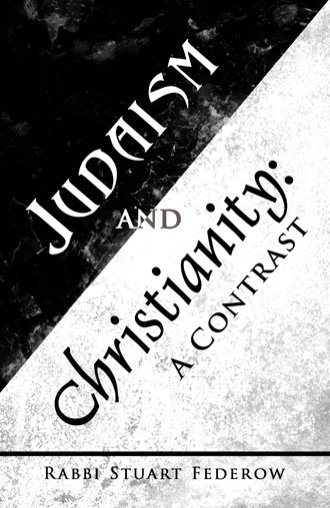
From the Preface: So much in our society blurs the lines that distinguish between Judaism and Christianity. At present, the greatest friends of Israel in the United States appear to be the Evangelical Christian community. If “politics make for strange bedfellows,” even members of the Jewish community, in order to ingratiate themselves to the new political bedfellows they have found in Evangelical Christians, choose to ignore the differences between Judaism and Christianity and emphasize our shallow similarities. With the rise of the Christian missionary groups calling themselves Messianic “Jews,” and the successes of the Jews for Jesus organization, the lines between Judaism and Christianity are becoming less and less distinct. This loss of distinction is used to make it easier to convert Jews to Christianity, for if they are not so different after all, then why should it matter if one is a believer in one faith and not the other? Orthodox rabbis are writing books calling Jesus a rabbi, while other rabbis appear in the media showing a complete lack of understanding of what Christianity believes and what is found in the pages of Christianity’s’ New Testament, and how this contrasts sharply with the Bible and the beliefs of Judaism. There is more and more talk about the “Judeo-Christian Tradition,” even by Jews who do not understand that, from the Christian perspective, the Jewish aspect of it refers only to that part of Judaism which led up to Christianity. It does not include Rabbinic Judaism that has defined Judaism for virtually the last 2,000-plus years, and which informs every branch of Judaism today. In many churches today, Jewish rituals are utilized in the service of Christian celebrations. Many churches, be they Evangelical or Liberal, are holding Passover Seders and celebrating Sukkot, the Festival of Tabernacles. There are Ketubahs, Jewish marriage contracts, being used in Christian marriage services. There are Christian children who are having “Bar Mitzvah” celebrations. All of this blurs the lines between Judaism and Christianity. More and more people believe that the only difference between Judaism and Christianity is that the latter faith accepts Jesus as the Messiah, while the former does not. They do not know why Jews have continued to reject Jesus as the Messiah, as a savior, and as the son of God. Many Jews, whose knowledge of Judaism is shallow at best, can only say that we Jews do not believe in Jesus because he fulfilled none of the requirements to be the Messiah. Unfortunately, the only requirement they know is that the Messiah will bring peace. They do not realize that there is a whole theology that one must accept first, to believe in Jesus as the Christian Messiah. They do not know that, from Judaism’s perspective, this Christian theological foundation is unbiblical and diametrically opposed to what the Bible states. If one believes that the Bible holds truth within its verses and since Judaism better reflects the theology and beliefs found in the Bible, then Judaism is superior to Christianity in the sense that it holds more of that Biblical Truth. Neither Christians, nor even Jews, are used to hearing any Jew saying that Judaism is a superior faith to Christianity. However, the Jews hear the opposite, subtly or blatantly from Christians, that Christianity is superior to Judaism. Many Jews, especially those who have been the target of Christian proselytizing, have heard the insult to our faith, that to become a Christian is to become a “completed Jew.” Many Jews, if they know nothing else of Christianity, know that to the Conservative Christian, those who reject Jesus as their personal savior are damned to hell. Many Christians may seem to have learned not to say aloud that their New Testament replaces the “Old Testament.” They may hesitate or dodge the subject when asked directly if they feel Jews are damned to hell, but the Christian missionary movement continues to believe this. Judaism has never believed that only Jews go to heaven. “The righteous of every nation has a share in the World to Come,” the Talmud teaches us in Sanhedrin 105a. This distinction between the two faiths is also neglected by many Christians. Jews have been trained since birth to keep a low profile; to be Jewish Uncle Toms. What do I mean by a “Jewish Uncle Tom?” I mean a Jew who is afraid to be outwardly, openly, proudly Jewish. A Jewish Uncle Tom is a Jew who, for example, converses at a normal tone in public, but when the subject shifts to a Jewish topic this person lowers his or her voice. It is a Jew who very willingly wears to Jewish gatherings a Chai or a Star of David on a necklace, or a T-shirt with something Jewish on the front, but who would never think of wearing the Jewish jewelry or a Jewish T-shirt when entering a public place where the majority of others may not be Jewish. I have been with those who will stuff their Jewish jewelry inside their shirts as we entered a mall. The back of my car has Jewish bumper stickers and a Star of David. I get more negative comments from Jews who are aghast that I so boldly proclaim that the driver of my car is Jewish. They ask me, “Aren’t you afraid that a Christian will shoot at you?” These are only a few examples. Jews are simply trained to keep their mouths shut, to not rock any boats, even if it means not rocking the very same boats that were sent to destroy us through conversion, or through the blurring of the lines that distinguish Judaism from Christianity. We are taught to be passive, almost invisible, especially when it comes to emphasizing our differences from the majority around us, a common malady of members of a minority. As the lines between Judaism and Christianity are more and more blurred, this Uncle Tomism may become suicidal. Furthermore and unfortunately, many Jews have been raised to believe that our faith is just as good as any other faith. We are told self-defeating things, like “every faith has its own room in the mansion of God,” or, “there are many paths that all lead to the same God,” or that “we all worship the same God.” There is only one God. However, if another faith worships someone as God who was not and is not God, then they are committing idolatry. Traditionally, Judaism has believed that only Jews are required to worship the One, True God, and therefore it is not idolatry for Christians or other faiths to worship false gods, but this does not change the fact that the god they worship is not God, and is therefore idolatrous. It is just that, for non-Jews, it is not a sin. They are not committing the sin of idolatry, but what they do worship is, in fact, idolatrous. If our faith is only as good as the others, if our faith is only as reasonable, only as beneficial, if our faith is not more right than the others, then why would any Jew want to be so different, a part of so very small a minority? Why not just convert to another faith, if, indeed, Judaism is only just as good as and not better than another faith? If we don’t believe our faith is better than all other faiths; if we don't believe our faith is more right than all other faiths; if we don’t believe our faith is truer than all others then why bother struggling so hard to remain different? Why not just join the majority around us if our faith is only just as good as and not better than all others? This attitude also contributes to the assimilation and eventual loss of Jews to Christianity. So much in our society blurs the lines that distinguish between Judaism and Christianity. This book brings into focus these distinctions.
Formats

Book Details
About the Book
Many people focus on the similarities between Judaism and Christianity, but the religions are quite different—and it’s not just because one accepts Jesus as the messiah and the other does not.
The rise of Christians calling themselves messianic “Jews,” the successes of Christian missionaries, Jews ingratiating themselves to Evangelical Christians because of their support for the State of Israel, the overuse of the term “Judeo-Christian,” and the increasing use of Jewish rituals in Christian churches, blur the lines between Judaism and Christianity.
Develop a better understanding of the irreconcilable differences between Judaism and Christianity, and where the two faiths hold mutually exclusive beliefs. You’ll learn how
• Their views differ regarding God, humanity, the devil, faith versus the law, the Messiah, and more; • Both faiths read the same Biblical verses but understand them so differently; and • Missionary Christians use this blurring of the lines between the two faiths, and other techniques, to convert Jews to Christianity.
Real interfaith dialogue begins when those engaging in it not only speak of how they are similar, but also where they differ. Real understanding begins when the topics discussed are in areas of disagreement. Judaism and Christianity: A Contrastwill help you understand the Jewish view of these disagreements.
About the Author
Rabbi Stuart Federow hosts a live call-in talk show with a minister and a priest on Houston radio and AShowOfFaith.org. Raised a Jew in a very Christian environment, he is a passionate student of comparative religion. He has been the rabbi of Shaar Hashalom, Houston, a conservative congregation, since 1995.