
Safe Harbor
by
Book Cover & Preview Text
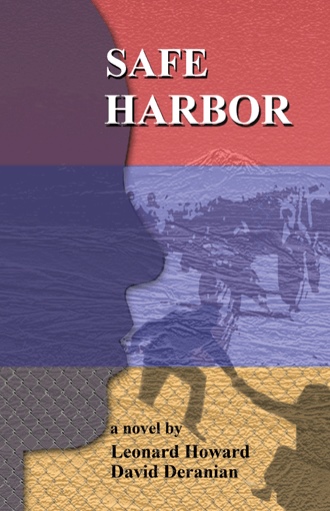
Safe Harbor - That of a harbor or haven, which provides safety from attack. - Wikipedia “Mama, you can’t die” the little boy's voice kept pleading.“ His mother could hardly breathe now. “John, go quickly. Please ... take care of your sister”. These were the last words from her when she succumbed to her wound, by the side of the dusty road, amidst the chaos of the killing that was the fate of the Armenian people. Just hearing the word Armenia would take John back to his mother’s side in that terrible year, 1915. John was only eight at the time, but right then, at the moment of his mother's death, he had just become an adult. There was no time to think about it. With her arms wrapped tightly around his neck, John's six-year-old sister Anna was holding on for dear life. They had to run. How could I leave my mother? The remembrance of that day still haunted John. “Faster Anna, faster”. He yelled to his sister as he held on to her skinny little hand. John had the barbed wire fence in sight as they weaved their way through, trying to dodge the Turkish soldiers. The fear was overwhelming. John Avedisian and his sister Anna had been part of the horrific fate dealt to the Armenian people, which was the Turkish Ottoman Empire’s determination to exterminate the Armenian race from their ancient homeland of 3000 years. They had lived in the Sasun province of the Ottoman Empire. Sasun was located in the fabled Armenian plateau, a highland of rugged mountains and beautiful valleys between the Caucasus Mountains to the north, the Iraq and Syrian deserts to the south, Iran to the east, and Turkey to the west. The remnant of a once large and powerful nation, Armenia, because of its geographical position made it a point of contention for all the great Near East Empires. The Romans had fought with the Persians over Armenia. This was followed by the Byzantine Empire battling against the ever-present Muslim conquest of the Near East, starting with the Arabs. Having converted to Christianity in 301 AD, the Muslim conquests put Armenia under religious pressure that increased with the invasion by central Asian hordes of Mongols and Turks from the east beginning in the 10th century. Armenians held fast to their Christian faith but it was not without cost. The Sasun province, as part of the Ottoman Empire, circa 1915, consisted of a federation of some forty Armenian villages. The Armenian people living there called themselves Sasuntsis. Fierce Muslim tribes, to whom they were often forced to pay tribute, surrounded them. When they could, Sasuntsis would defend themselves to maintain a semblance of autonomy. It was against this historical backdrop that John watched his mother die. An older boy had run past and stopped beside John. “The Turks are coming ... run”. About 10 Turkish soldiers had fast approached. John had not only been scared but also confused. His confusion came from thoughts of a family friend named Ahmed that happened to be Turkish. How different he was from Turks that had killed any Armenian in sight. Almost every day Ahmed would come into the family bakery to buy some bread. He always had a word about how good a baker John's father was. No wonder, as the smell of fresh baked bread, even from the outside, was something impossible to resist. Ahmed and John's father were as close to good friends as any two men in this world could be. The politics of the day could make such friendships difficult but as John saw it, Ahmed had been a good man. Ahmed would always be ready to play a game with John. “Add 23 plus 32 plus 29” or asking him to add some other simple numbers. “Eighty four“ or the other answers came very quickly to John. When John got it right, which he nearly always did, Ahmed would smile, give John a small coin, and encourage the boy to study hard so that when he grew up he would earn not just a small coin but a large fortune. It was advice that John would hold dear in the years to come. The last time John saw Ahmed, this kind man had tears in his eyes as he watched Armenian men being shot dead in the street and Armenian women being raped in open daylight. Ahmed cried out to John. “Oh my poor boy ... please do not curse all Turks for what is being done here. This is not the Muslim way.” Two Turkish soldiers hearing Ahmed's words had laughed as they hit Ahmed on the head, knocking him to the ground. John ran away before the Turkish soldiers had a chance to notice him. As he ran he had thought about Ahmed's statement, that it is not the Muslim way. For John the idea of religion was then vague at best. He knew that Armenians were Christians and the Turks were Muslims. John knew to pray to Jesus every night but didn’t know whom the Muslim children prayed to at night. Did they also pray to Jesus or was it someone else? All he really knew was that Ahmed, a Muslim, was a kind man. Ahmed's call to Muslim kindness could only be a plea in the face of newfound nationalism that ran through the Turkish political elite. By the start of the 20th century, the Armenians were a casualty of this nationalism. A Christian people ruled over by Muslim Turks for some 500 years, the Armenians, by the end of the 19th century, were reduced to some three million people. This however was but a prelude to near extinction in 1915. The reason this time was not so much religious as it was nationalistic, specifically a Turkish Pan Nationalism movement that envisioned an empire of Turkish speaking peoples stretching from Istanbul in the West to China in the East. Armenia was set directly in the path of this empire. The result: 1.5 million Armenians dead and the rest mostly scattered in a worldwide diaspora. John's mother would be part of the 1.5 million Armenians killed. She could not know at the time that her children would be part of the remaining Armenian diaspora. Armenian children would often be taken from their families to live with Turks or local Kurds. At times this was an act of benevolence. Many times though, it was a horrific experience, the result of parents being killed in front of their own children. Such was the case for John and Anna. Their father had died quickly from a gunshot to the head when Turkish soldiers had descended on them. A brutal rape, then left for dead, was the fate of their mother. John and his sister ran in the direction their mother had told them “Run west ... to America ... there you will be safe.” John took his mother's words to heart as he and Anna ran in the direction of the setting sun. Their mother had not spoken again. They had seen a fence. People were climbing through it. Soldiers were everywhere. John could hear his sister crying. This was something they didn’t understand. They ran towards the barbed wire fence. A Turkish soldier began pursuing them. As quick as a John could, he squeezed through the fence with the intention of helping his sister through. John tried to grab his sister's hand but the Turkish soldier was faster, grabbing Anna just as she was trying to get through. Anna had cried “John don’t leave me.” John had tried to get back through the fence but more people were coming through now, knocking John down. He got up and suddenly his sister had disappeared. Then he saw his sister being led off by the soldier. John had watched tearfully as the Turkish solider took Anna away. Feeling utterly hopeless because of the loss of his sister, only fear now drove him to continue. He began to travel west in the direction of the Mediterranean Sea. ”There are French ships ready to help you get away ...” someone had said. “Go to Musa Dagh.” That was his best chance for freedom. John had run fast until coming upon horrific scenes he could never have imagined.
Formats

Book Details
About the Book
“Mama, Please don’t die.” were the last words John Avedisian spoke to his mother.
All John could do was hold on tight to his little sister Anna and run, into the midst of death that had befallen the Armenian people. Trying to escape the Ottoman Turkish soldiers, John lost hold of his sister. He would never forgive himself for this.
John had tried to find Anna, but it was only when he was introduced to a man called Kerkin, that he would, after nearly thirty years had passed, have a chance of finding her.
Safe Harbor traces Kerkin's search for John's sister, traveling through England, Spain and finally the eastern parts of Turkey, circa 1944, at a time when the world was in the throes of war.
Having seen the ruin of his beloved homeland, John had always worked to recreate Armenia, especially the area known as Karabakh. Relying on the dedication of his grandson David, and leaving his accumulated wealth to him, would be John's legacy.
The Turkish Secret service had other ideas. They would seek to deny any assistance to Karabakh, using whatever means necessary.
About the Author
Leonard Howard (Nom de Plume for Len Rodkoff) is an engineer currently living in California. He is the author of various short stories. His interests, which include the history of the Caucuses and the Ottoman Empire, inspired his enthusiasm for writing Safe Harbor.
David Deranian, PhD (Nom de Plume for Robert Deranian) is a physicist currently living in California. An author of various articles concerning Armenian issues, he is also a student of history. It was the intersection of history with Armenian issues that motivated his writing for Safe Harbor.