
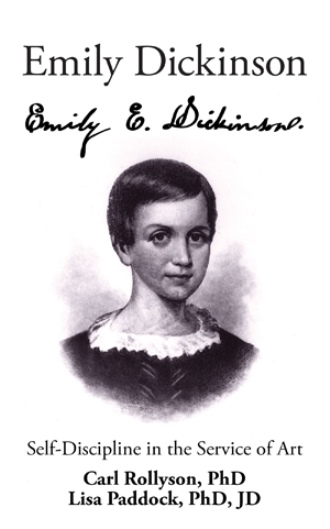
Emily Dickinson
Self-Discipline in the Service of Art
by
Book Cover & Preview Text
CHAPTER 1
“The Birds That Stay”
Emily Dickinson was born, lived, and died in the same house. Although she did visit Washington, D.C., Boston, and Philadelphia, she rarely traveled, spending most of her life in Amherst, Massachusetts, a college town that in the first half of the nineteenth century consisted of some 3,000 people. She was named after her mother, who was then a full participant in the life of Amherst, winning cooking contests and doing her part to aid the poor and perform other charitable services. The younger Emily had a narrow but stimulating circle of friends--many of them important writers and prominent citizens. She liked to stay at home. Home was her natural habitat, and she had no urge to migrate to other places. Neither did her older brother, Austin, or her younger sister, Lavinia, with whom Emily always lived. As Emily put it in one of her poems, “We are the birds that stay.”
Emily Dickinson’s retirement from the world had . . . a tradition behind it . . . it has always been a possible way of life for New England spinsters and widows . . . .--George Frisbie Whicher, Emily Dickinson biographer.
Significantly, the home Emily was born in was called the Homestead. It was one of the grandest houses in town, an imposing brick structure that looks--and still looks--almost like a government building--the kind you might see in Philadelphia if you visited the Liberty Bell and the Independence Hall area. The house and the atmosphere of the town could easily make Emily feel that she lived in an important place. Ideas and religious beliefs were taken seriously in Amherst. Emily’s father, Edward Dickinson, was as imposing looking as his house. His approach to life was equally formidable. In his proposal to his wife he wrote: “My life must be a life of business, of labor and application to the study of my profession.” Educated at Amherst College and Yale University, he became one of Amherst’s most prominent lawyers as well as a member of the United States Congress.
The village of Amherst was famous for having more ministers per capita that any other town in the United States.--Jay Leyda, a scholar of Dickinson’s work.
Emily respected her father, but relations between father and daughter were rather strained. Edward Dickinson may not have known what to do with his bright, imaginative daughter. There was little place in 19th-century America for independent-thinking women. Women were expected to marry and to raise a family. Those who did not became spinsters, single females usually supported by their families. A few women had careers, but they were definitely not to be found among the citizens of Amherst. Of her father Emily observed: “He buys me many Books--but begs me not to read them--because he fears they joggle the mind.” It is a revealing sentence. Edward realized that his daughter deserved an education, yet he held the notion, a common one for that time, that too much study might rattle a woman’s brain, which was thought to be smaller than a man’s. No one knows for sure what Emily thought of her father’s rather confused attitude towards her, but her comments suggest she kept some distance from him--as she did from most males who treated her as an inferior. She was not rebellious. But she did not fear exercising her mind or finding a way to her own beliefs. With words she could take the measure of anyone, and the precise use of words became a kind of daily discipline for her. Emily’s father’s imagination could not stretch as far as her own. In a letter she observed: “Father says in fugitive moments when he forgets the barrister and lapses into the man, says that his life has been passed in a wilderness, or an island. . . .” In other words, when Edward Dickinson was not being a man of the world and accomplishing things, he lapsed (briefly) into a rather grim view of existence that isolated him from other people. Emily may have shared some of her father’s sense of isolation, but she had wit and an empathy for others that made her life anything but sad or lonely. She knew all about human society, and if she participated in it sparingly, she did so by choice. Emily’s father sent her to Amherst Academy, which was founded by her own grandfather, Samuel Fowler Dickinson, and Noah Webster, the author of one of the first American dictionaries. At Amherst Academy, Emily studied four subjects, which she called “Mental Philosophy, Geology, Latin, and Botany.” She also went to Mount Holyoke Female Academy in South Hadley, Massachusetts, where she stayed for one year. For her time, she was well educated--particularly for a woman--and she did much studying beyond the basic subjects she took at school. Emily thought of herself as pretty. At fourteen, she told a girlfriend, “I am growing handsome very fast indeed! I expect I shall be the belle of Amherst when I reach my 17rh year.” The one existing photograph of her was in fact taken when she was 17 years old, but it conveys an impression of plainness. Both Emily and her brother objected that it did not do her justice. The photograph shows her to have an oval face, rather full lips, and dark, inquiring eyes. She once gave this flirtatious description of herself to a male correspondent: “I am small, like the Wren, and my Hair is bold, like the Chestnut Bur--and my eyes, like the Sherry in the Glass, that the Guest leaves.” Clearly, Emily felt closest to birds. Their quick movements and darting flight find their counterparts in her delicate but bold writing. As a bird that stays, she customarily reserved her high spirits for her poetry and for her friends. As one critic of her work says, she thought of poetry as the house she lived in. She felt safe, comfortable, and courageous when she was writing. Poetry is what rooted her in Amherst, and Amherst in turn grounded her poetry. Points to ponder
• Emily Dickinson led a quiet life, but this did not mean that for her there were no adventures. What do you think makes life worth living for a stay-at-home poet?
• Emily Dickinson used the language of poetry to acquire self-discipline. What was it about using words precisely that helped her lead a fulfilling life?
Formats

Book Details
About the Book
Emily Dickinson exemplified the virtue of self-discipline. She wrote poetry largely for her own pleasure and to exercise and increase her creative talents. Very few of her poems were published during her own lifetime, yet we know that she wrote consistently--perhaps every day--over several decades. Poetry was her way of knowing herself and understanding the world. She could control and express her ideas and emotions through poetry, perhaps the most demanding form of writing.
What does it mean to be a disciplined poet? It means writing and rewriting poems until they seem to be as perfect as possible. Dickinson left behind many drafts of her poems--sometimes including alternate wordings, as if to acknowledge that her writing was still seeking perfection.
Dickinson’s discipline was self-imposed. She met no publishing deadlines. She did not write for a patron who sponsored her creative efforts. She did not expect the world to acknowledge her poetry as soon as it was written. Yet now she is considered one of the greatest poets ever to have written in the English language. She valued the labor and the results of a job well done. Emily Dickinson is a model not only for writers, but for anyone who wishes calmly and determinedly to pursue a goal, even without the prospect of an immediate reward.
About the Author
Carl Rollyson is the author of several iUniverse biographies, including MARIE CURIE, LILLIAN HELLMAN: HER LIFE AND LEGEND, NORMAN MAILER: THE LAST ROMANTIC, and REBECCA WEST: A MODERN SIBYL. Lisa Paddock has published FACTS ABOUT THE SUPREME COURT and the FACTS ON FILE ENCYCLOPEDIA OF NINETEENTH CENTURY AMERICAN LITERATURE. Rollyson and Paddock have co-authored HERMAN MELVILLE: A TO Z, and THE BRONTES: A TO Z.