
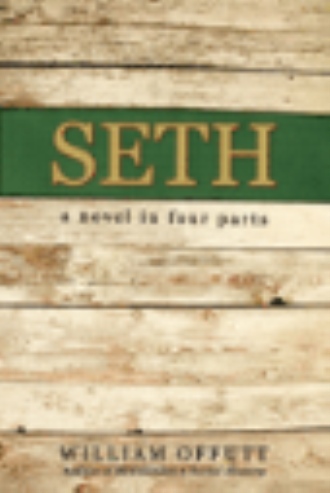
Seth
a novel in four parts
by
Book Cover & Preview Text
A shadow moved across the hard-packed red clay in which the large jackknife quivered. “Very nice,” said a soft voice, and Seth looked up into the bearded face of a man who was leading a dusty horse. He had not heard him approach. “Spare some water f'me and my critter?” the man asked, and Seth, for reasons he could not name, decided that the stranger was a soldier. Maybe, the boy thought, he's a deserter from one army or the other. The man was not armed as far as Seth could see, and he wasn’t wearing anything like a uniform, blue or gray or butternut either. The clothes that hung loosely on him were worn and sweat-stained, but his boots looked almost new. He stands like a soldier, Seth thought, like the men who took down our fence, like the ones who stole our horse and our mule, like the men who took my uncle away. Those soldiers in blue, who wore the same uniform as my brother, the ones that made my mother cry in anger and frustration, who made my uncle and aunt howl in fear; that’s what he looks like, a soldier. “Come on, boy,” the man said a bit louder and a shade harder. He licked at the corner of his thin mouth and wiped his cracked lips with the back of his thumb. “We’re more’n a little thirsty. Damn dry hereabouts.” Seth jumped, realizing that he had been standing and staring. He reached down, retrieved his knife and wiped it against his pants. He carefully folded the blade into the handle and then gestured with the closed knife. “Our well’s back there, mister, and you’re welcome to the water. It’s good water, too, deep and cool.” “Thanks.” The dusty stranger smiled, yanked on the reins and led his tired mount past the place where the fence had stood and across the shaded side yard with its border of yellowing iris. Seth followed and saw the brand on the horse’s rump. A nice looking little chestnut, thought the boy, but he sure hasn’t had much care lately. Grit rose from the horse’s hide when Seth patted him, and his tail was matted and tangled. Maybe he’s a horse thief or a cavalryman running away from the war and taking his horse with him. At the well the man spat out a glob of yellow-brown and asked the boy to pump for him. Seth worked the noisy handle up and down steadily with short, even strokes wishing he had oiled it as his mother had asked. The iron links creaked and complained. The horse bobbed his head and drank from the leaky trough, and the man slurped from his cupped hands until Seth handed him the battered tin cup that hung there on a piece of twine. “Obliged,” said the hard-eyed man with a bigger smile as the water scribed tracks on his dusty face. He drank a half-dozen cups of water and let it overflow his mouth and run through his brown beard until it glistened in the morning sun and stained the front of his colorless shirt. He poured a cup of water over his head and shook like a dog before he filled his blanket-covered canteen while Seth steadily manned the pump. Creak-clank, creak-clank. Another clue, decided Seth, that wooden canteen. Finally the man ducked his head under the iron pump’s gushing flow and rubbed his hands through his rough-cropped hair. He wiped his face with a faded kerchief. “That feels a lot better. Sure is good water. I’m s’prised y’all have any, dry as it is `round here. Whole blamed country looks like it’s burnin’ up. Now, my friend,” he said while he retied his wet handkerchief around his corded neck, “would you have any oats `bout the place? Old Mac here’s a mite on the famished side as you can see by his ribs, and I’m clean out’a feed. Your sun-dried Maryland grass jes’ don’t seem to suit him.” “Nope, sorry,” said the boy. “Haven’t kept any since them New York fellers took our horse back before Sharpsburg, couple of years now.” “Y’all Secesh?” the man asked, raising an eyebrow and spitting again, more like a ball of cotton this time. Seth didn’t answer. He looked down at his bare feet and squished some mud near the horse trough. It rose between his splayed toes like gritty lava. Seth wanted to tell the stranger that he dreamed of wearing the gray and serving in Lije White’s Maryland cavalry or with Mosby’s fabled rangers, but he was not sure who or what this fellow was or which side he favored. You have to be awful careful these days, as his uncle often warned him. “Guard yer tongue, boy,” that was his uncle’s motto. The man went right on as if he had not expected an answer. “Here,” he said, “hole my horse a minute while I go see a man about a dog.” He handed the boy the cracked reins and went off toward the privy that stood at the end of a row of roughly whitewashed outbuildings behind Seth’s home. The horse nibbled at the wet weeds and coarse grass, flicked his ears, swished his tail and eyed the boy. Seth thought about the question the man had asked. What am I? An out-and-out rebel, a Confederate sympathizer like most of my friends and much of my family, maybe a copperhead which some thought worse, a lot worse? Or a Unionist like my brother, a Lincoln man, a blue belly? The question seemed so simple. Choose a side. Rebel or Union, us and them. But which was us?
Formats

Book Details
About the Book
Encompassing a century of one family’s life in Montgomery County, Maryland, this novel is a series of four connected tales starting with a boy’s adventure in the Civil War and ending with his youngest grandson’s struggles in the 1950s.
Seth, the hero of the first story, is unwillingly caught up in Jubal Early’s attempt to capture the Capital in the summer of 1864. The boy, who often dreamed of becoming a Rebel hero, finds his beliefs tested and his loyalties divided when faced with very grown-up and dangerous choices.
Caroline, the central figure of the second story, marries Seth’s older brother after the Civil War and then, after his sudden death, weds Seth himself. She faces joy and despair, tragedies and triumphs, happiness and sorrow as each brother’s lover and helpmate.
Sammy Williams is Caroline and Seth’s youngest, and he isn’t sure what life has in store for him until a pretty young woman decides to marry him. He survives trench warfare in France and, almost accidentally, become a successful storekeeper and the father of a large family during the Depression.
And Bud, Seth’s grandson and namesake, is a rather footloose and carefree young man who takes a long time to grow up as Sammy and Polly’s last child. He marries young, loses his wife and children, has trouble holding a job and eventually figures out how to live responsibly.
About the Author
Bill Offutt is a native of Montgomery County, Maryland, where his family has lived since about 1715. He is a retired public school and community college teacher and a lecturer for the local historical society. Offutt has published a very successful local history, BETHESDA A Social History and is the co-author of Montgomery County Centuries of Change, of a county history for young readers and numerous newspaper, magazine and journal articles. He and his wife of 55 years live in Bethesda.