
A Moment In Time
A Journey of Faith, Hope, and Love
by
Book Cover & Preview Text
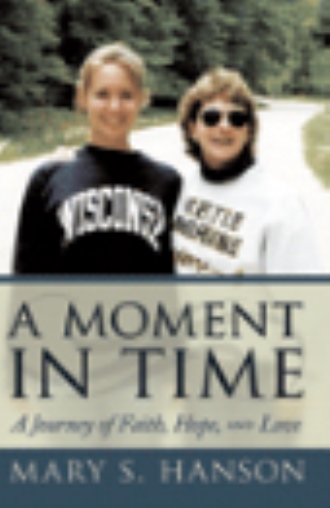
I'm not going to start with the dreams I had for my daughter—of getting married, having children and becoming a teacher. All mothers have those dreams. I'm going to begin instead with the night all of those dreams were shattered, the night of my daughter's accident, when, in one moment in time, her life, and the lives of every member of our family changed forever.
It was a Friday. My husband and I were exhausted from the week. Our youngest son Justin had just completed football season. Jaime, our oldest, was on his own and had a good job. Laura was in college, and life was beginning to slow down a bit. It was still a hectic fall, much of it our own making. We had joked about keeping the car running, taking Justin to band practice, piano lessons, orthodontic appointments and confirmation classes. It was a good life, but we were looking forward to a quiet weekend.
Laura was at the Kettle Moraine Ranch. She was the resident assistant for her dorm and had organized a hayride for the students on her floor. My husband and I had fallen asleep. An hour later we were awakened suddenly by two policemen standing at the front door. They asked if we owned a red Toyota Tercel. We said yes. They proceeded to tell us that our daughter was in a serious accident and that she had been flown by Flight for Life helicopter to Froedtert Memorial Hospital in Milwaukee. They gave us their card, wrote the address of the hospital on the back of it, and left.
Was this a dream? Would we soon wake up? We needed to get to the hospital. Our daughter needed us. I called Jaime, and he met us in the emergency room at Froedtert. We were greeted at the door by a social worker who escorted us immediately into a small, private waiting room. She asked if she could get us anything, water, coffee? It was surreal. I asked for a chaplain. We waited and stared at each other in disbelief. The trauma surgeon entered the room. He explained that our daughter was in critical condition with serious head injuries. She was in a coma. He used numbers to explain her condition. On the Glasgow coma scale of zero to fifteen, she was a one. Below that she would be considered brain dead, and below that—I could not listen anymore.
Another doctor entered the room. He was a neurosurgeon. He explained to us that our daughter was going to be taken to intensive care. CAT scans indicated there was bleeding in one of the ventricles. They were going to insert a tube into her brain and drain fluid in order to allow for swelling. I asked if we could see her. They took us into the emergency room. I overheard one of the nurses say, “Sh, that's the family.” She was lying on a cart. Her arms stretched inward as we spoke. We assured her that we loved her and that everything would be okay. I learned later that her gestures were a sign of the seriousness of her brain injury. The doctors called it posturing. I called it hanging on to life.
We were then led down a seemingly endless corridor and ushered into a larger waiting room. It was dark, except for the dim lights of the distant corridor. We again waited in silence. The chaplain arrived, and we began to pray. We had no words. The chaplain guided our thoughts. We held on to each other, asking with all of our hearts to spare the life of our daughter.
A nurse entered the waiting room. She was comforting, but could not answer the only important question our hearts were asking, “Will Laura be all right?” She led us into the intensive care unit, which specialized in brain injuries. When we next saw our daughter, there were tubes everywhere. She was hooked up to machines monitoring her pulse, her heart rate, her blood pressure. There were fluids being pumped in and fluids being drained out. Her head was partially shaved and her beautiful blonde hair was all matted together. A breathing tube hung out of her mouth. There was a constant beeping of monitors and shuffling of equipment as the medical staff moved quietly but vigorously to save her life.
We were again led into a small room where the neurosurgeon explained to us that the procedure to drain spinal fluid from her brain went well. X-rays showed that her pelvis was fractured in four places and that she had also fractured her arm. He told us to prepare for the worst and hope for the best, then go home and get a little sleep. It was 5:00 am. We were handed a bag of blood stained clothes that were cut off of her at the scene of the accident and told to look through them for valuables. Most people, we were told, then threw them away.
Throw them away? Valuables? How could anything be more valuable than my daughter's life? Sleep? Prepare for the worst? How does a parent do that? All of her life we've been preparing her—for school, for prom, for piano recitals, for college, for life. We didn't know how to prepare for anything but the best for our children. I took a picture of our family from my wallet and laid it on her heart. I wanted her to know that we were not far away. I also wanted the medical staff to know that this was not just another patient. This was Laura: my daughter, my love, and my best friend.
We went home, but we couldn't stay there. We made a few phone calls, cleaned up, and returned to the hospital to wait and pray. People arrived throughout the day: Hanns, Jenna, Sally—Laura's friends—the Hanson's, Mark and Jean, our minister. The doctors did everything humanly possible to save her life. But there was nothing they could do to save her future. That was in the hands of God, and he would let us know in time.
The next few days were a blur. She had survived the first twenty-four hours. That was a miracle. We were told that the next three to five days were critical. The brain would swell considerably during that time. Again she beat the odds. At one point, when our family was praying at her bedside, she quivered. We had never seen anything like it before or since. I knew it was a sign from God, and she was responding to prayer. She was going to make it. She was going to come back to us.
Many people arrived at the hospital. They prayed with us and cried with us. Many sent cards and food and did what they could to lend support. But Laura remained in a coma. We kept recreating the scene over and over, trying to make sense of what had happened, how it could possibly have happened. But it didn’t make sense. Laura was in the prime of her life. She did everything right. She was concentrating on her driving. She wasn’t speeding. She was just on a hayride with students from her dorm. What if I had called her that night? I would have told her I’d see her the next day and we’d go out to lunch together. What if we hadn’t bought her that car? It had dual air bags and was supposed to be safe. What if we had started her in kindergarten a year later? She wouldn’t have been an RA and organized the hayride. What if, what if, what if? Life just doesn’t seem fair. If only I could drive into that tree. But what if she wakes up and I’m not there?
Formats

Book Details
Recognition Programs

About the Book
On an autumn day in 1998, college student Laura Hanson is in the prime of her life. One moment she is driving back to school after a hayride; the next moment she is paralyzed, deaf, and comatose after her car strikes a tree.
Shared through the eyes of a mother’s heart, this poignant memoir of a traumatic journey into the little known world of brain injury is an incredible story of love lost and love endured — of heroes determined to overcome insurmountable obstacles — and of a family as it struggles to cope with the loss of their daughter. Mary Hanson chronicles her searing personal experience from the moment her daughter is carried on to the flight-for-life helicopter at the accident scene through a hospital’s trauma center to the brain injury units of two others, and finally to a group home.
In this amazing story of how a young woman and her family survived incredible odds, there is one clear message — that through faith, hope, and love the human spirit will triumph over the most difficult of circumstances.
About the Author
Mary S. Hanson earned a BS in English and an MA in CI/Science from the University of Wisconsin. She has taught English and science for over thirty years in the Milwaukee Public School District. Mary and her husband, Jerrold, have three children and live in the Kettle Moraine State Forest in southeast Wisconsin.