
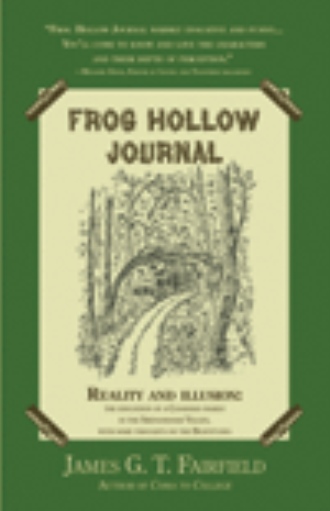
Frog Hollow Journal
Reality and illusion: the education of a Canadian family in the Shenandoah Valley, with some thoughts on the Beatitudes
by
Book Cover & Preview Text
Frog Hollow would be a lot bigger if it was ironed flat. Texans brag about big. But our neighbors in the hollows of the Appalachians swear there's more land in the mountains of the Virginias than a crow can fly over in Texas. Mountain bikes iron it out a little. We acquired a pair of 15 speed bicycles, although most pedaling in our area is uphill, so we only use the lowest gears, with an occasional modest incline to remind us what flatlands could be like. Once we took the bikes in the back of our pickup to a nearby airport so we could ride on the level for awhile. Like Manitoba, it was flat as old soda on a plate. Shep likes to go with us. Bring out the bikes and he skitters around like a pup, his tail going in circles. He might even bark if he figures we're taking too long to fill the water bottles and check our tires for air. But as soon as we get on the bikes, he's on his way. Norma is first after Shep down the lane. Three old apple trees grow on the fence line, their branches arching over the roadway to give us deep shade in summer; their leaves are falling now. Underneath, blackcap raspberry canes reach through the fence; they will offer their delicate fruit again next spring. Shep shoots out onto the road at the bottom of our lane, heading up past Ivy Moyer's toward the Brethren Church. Like any sensible dog, he heads uphill while he's fresh. Still coming down the lane, I follow in third place, ducking the quail Shep stirs up in his race to get the first half mile behind us so we won't change our minds. Shep likes to range ahead, combing the roadside with his nose for the latest situation report. This morning it's good he hustles on ahead. Norma stops at the culvert carrying the spring branch under our lane. She has a finger to her lips, then points to the bank of the branch. A muskrat is cooling himself, legs astraddle the damp mud. He watches us calmly; we push our bikes quietly through the open gateway onto the road. We leave the gate open except in fly time, then close it when our neighbor's heifers get fractious and try to outrun the horseflies. Fences take a hammering in fly time, and we'd have a yardful of restless beef if we did't shut them out. But fly time is behind us now, so the gate's open. Shep would be embarrassed if we told him he missed the muskrat, so we don't mention it. He chases one of Ivy's guinea hens under her fence; it's safe there with Ivy's pet turkey. Nothing on feet frightens that bird, as he's all too willing to prove; the thing's a menace. But between the guinea fowl's warning screams and a guard turkey, Ivy is strategically defended. The turkey has never shown an inclination to attack bikes, and with mixed frames we can get off them quick as the need arises. Which can be very quick sometimes. We keep an eye on David Reedy's dog as we pedal past his porch. Shep and the little off-white bitch circle one another on stiff legs; Shep has been neutered, but he's got a good memory. Up on the hill by the Brethren Church we hit hard top. The little white clapboard building commands a view of the valley as far as Massanutten Mountain on the horizon. It's worth a stop today, a quiet moment with morning mists making islands of the hill meadows and fields. The red ball rising over the Massanutten ridge will burn away much of the mist, but now the serenity of this familiar scene fills me with its enduring peace. Shep snuffles at a groundhog hole in the ditch. We drift down the slight grade toward the deep oak woods at the corner, and Shep reluctantly gives up his diversion; there will be others. The grade's decline shifts into a gradual rise through the woods; autumn leaves show the soft russets of white oaks against the richer wines of the black oaks. As we turn the corner, the hill drops away in a breathtaking plunge that will take us a half mile before we need to pedal again. Shep's ears are flying back, his claws clicking as he hurtles along beside us. We take it slow to keep him company. A squirrel suddenly breaks across the road and races for the trees, and Shep at full speed veers to cut him off. Shep doesn't see the fence until he hits it with his shoulder; the squirrel is safe, but Shep is limping now. That's why Shep isn't with us on our next cycling jaunt; he is still nursing a bruise, and we leave him fretting in the corner of the basement. We don't tell him we're going on a bike ride, but he knows. Cycling lets us share the life around us. Birds can cope with our sedate pace; there are no reckless attempts by a robin to fly through a windshield. We can hear the warblers if we can't see them, be moved by the cathedral-echo song of the veery in the deep woods as we pedal silently by. I’ve often wondered what the old timers think of us as we cycle past, going nowhere in particular. As Norma and I pump our way in low gear up beside Willard Shiflett's garden, the sun-dried old man leans on his hoe to watch us. "Nice morning for a little exercise," I offer, feeling guilty I'm not on the way to work. But Willard isn't going to bail me out and agree with me. He waves his hoe at the rows of old vegetation he is clearing out for next year's planting. "This is exercise." His nod takes in our slow moving efforts to climb his hill. "But that looks like a lot of work for nothing to me." Around the corner the hill flattens out to a gentler grade past Leonard Dove's place. Leonard delivers mail along the rural routes, but he's taken a few days vacation to put his garden to bed for the winter. I am pleased to see his big black and tan hound is securely chained to an old post by his rhubarb, but just to be safe, I call out to Leonard as we stop. I'll have to take the squeak out of the brake pads on my bike. Or maybe it was my voice, dry and scratchy after the long uphill climb. Or maybe Leonard stood up so quick his dog figured something was wrong. Whatever, the hound took a long leap at me and pulled the old pole out of the ground like a straw out of a milkshake. I jumped off the bike on the lee side and pushed the wheel toward the dog, his oncoming fangs looking as big as Sicilian stilettos. Leonard hollered and dove for the post as the dog dragged a swath through a stand of old corn stalks. When Leonard caught the post and reared back, I didn't think he'd made it in time. But then the black and tan changed ends, his head stopped short while his hind legs kept coming and he bounced his butt off my front wheel. Leonard didn't know what to say and I was still focusing on those fangs, so Norma carried the conversational ball. Leonard's garden looked clean and did he get a good crop of beans this year? It had been too dry since last spring; we could use some snow this winter to end the drought. Leonard's eyes began to see again and with his dog reeled in, he started to relax. He agreed some rain right now would be timely. He liked bush beans and had canned some Top Crop, nothing like a mess with some bacon to make a favorite winter meal, and how did our melons do? On the way home Norma remembered Shep. "If he'd been along, there would have been a fight," she pointed out. "He would have defended us." "And that big hound would have eaten him alive," I replied.
Formats

Book Details
About the Book
Frog Hollow Journal is a colorful memoir – peopled with vividly drawn neighbors, family members, and a beloved dog. It is the story of one family’s quest to carve out a more authentic life amid the demands of modern society.
With self-deprecating humor and the telling detail of a born raconteur, James Fairfield traces a path from his childhood on the Canadian prairie to his transformative experiences on a small farm in Virginia’s Shenandoah Valley. James, like many of us, felt overwhelmed by responsibilities, credit limits, and rush hour traffic. After moving to Virginia, however, he began to yield to the countryside’s slower cadences and realize that life doesn’t have to be so hectic. His musings along the way, and the lessons learned through exploring the Beatitudes, trace his spiritual journey as well. Anyone, he proposes, can learn to live “Frog Hollow style,” practicing integrity, neighborliness, and indomitable faith.
Here is an affectionate account, roaming from the pick-up ball games and lively escapades of the author’s youth on the plains of Manitoba, Canada, to the honorable inhabitants and timeless traditions of the Shenandoah Valley. His experiences, often humorously humbling and spiritually challenging, are illustrated by Norma’s drawings.
About the Author
James G. T. Fairfield has written in many genres, including a syndicated newspaper column; articles for naturalist publications; and books on conflict resolution, theological studies, and biography. He and his wife, Norma (a gardener, vegetarian cook, and illustrator) live in a century-old farmhouse near Frog Hollow. They have been married for sixty-three years.