
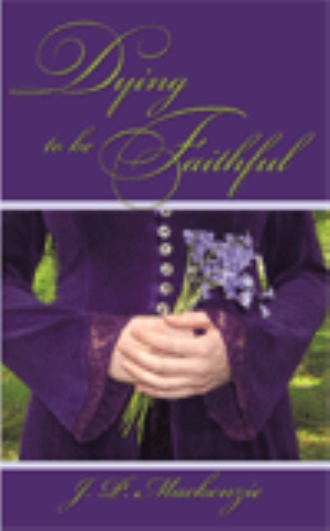
Dying to be Faithful
by
Book Cover & Preview Text
The unrelenting fierceness of the sun, accompanied by the roaming of the flies on and around Sebastian’s head, caused him to stir. At first, he lay still. The sound of the waves and the faintest touch of a breeze were all that he could distinguish over the noise of the flies. Then fear, as if being in a nightmare and realizing it is real, gripped him with a thousand hands. His eyes shot open. A pain in his head like being struck by lightening caused him to grimace and close his eyes tightly, as when smoke from a fire fills them. He sighed greatly and turning his head he clasped it with both hands. The pain in his head faded, but further horror from this action caused his hand to tremble. As he released his right hand from his head he noticed the hair was warm, sticky and matted. He brought his hand into view and it emerged before him shaking, stained with blood and mingled with sand. With his hand directly in front of the sun the blood looked almost black. He placed his hand once more on the back of his head, closed his eyes, and again, lay still. A recollection of Sebastian’s last conscious moments slowly found their way back to him. Forcing himself to sit up with some considerable effort, he saw his sword trodden into the sand by his side. The hand that held his head now reached for the sword, and the weathered blood-stained hand found the remnants of strength in gripping this old friend and the veins on his arm became more prominent. Sebastian dragged the sword close to his body and sought its aid in trying to stand. The heat and loss of blood made him feel faint as he stood propped up against his sword, he looked more like a man that was about to fall down than a man who had just struggled to his feet. He managed to breathe some full deep breaths, but in lifting his eyes over the landscape his breath momentarily stopped; the monastery was destroyed. Wisps of smoke faintly danced into the air as the blackened stones stood desolate against the vibrant blue sky. The Men of the North had come. Sebastian stood there motionless apart from his mouth, which moved as if he was speaking but no words could be heard. He would have cried if he had had the energy. The comparison of the beauty of the monastery as it once stood and the present heap of ash and rubble caused Sebastian with a fixed stare to stand on that small island in bewilderment. ‘Was it really gone?’ he thought. The old grey stone building, its arched doorways and stone windows, the secluded courtyard now open and bare, forced to share its privacy with all of nature. Its cool porches exposed to direct sunlight, darkened corners flooded with illumination, now just blackened masonry, a demonic sculpture of a paradise lost. Only the left wing and its stone columns stood almost intact, for there was little wood used in its construction and its wall were thick. Sebastian realized that the ordinary everyday activities of the last two years, once taken for granted, were all now memories of which none would ever be re-lived. This saddened him to the very core of his being, and he stood there still, the sea air blowing his dark brown hair across his eyes. Those eyes, once full of contentment and peace were now fixed, piercing and filling with anger. Before he could think of questioning why all this should happen he remembered the artifacts that had adorned the chapel. Gold: that was probably the reason to the question ‘why?’ ‘Or more likely,’ he thought, ‘man’s insatiable desire for gold; greed, and greed enough to destroy even that which is good.’ The very thought of this last sentence sent a chilling sensation straight through his whole body. ‘The others,’ he cried, ‘where are the others?’ All this time (in reality it was only a few moments) his thoughts had been occupied with the monastery. ‘How could I forget the others?’ he kept saying to himself. He was about to turn around when he involuntarily paused. A whole range of images flooded his mind’s eye like a rush of blood to the head, his eyes opened wide - the images were grim. ‘Were they all dead?’ he thought. ‘Am I alone?’ In steadying himself he found the courage that good men have to do what is needed in the face of horror or loss. He gripped the handle of his sword tightly. His knuckles were as white as his face. He closed his eyes. ‘Give me strength O God,’ he prayed as he turned away from the ruin of the monastery to the beach on the West behind him. It looked as though he stood there praying, but it was fear that prevented him from action. He opened his eyes. He fell to knees. He stared. With both hands on the helm of his sword he bowed his head and just as the first tear began to fall he cried out such a groan of anguish the whole island was aware of his sorrow. The gulls screeched and flew out to sea. The breeze which blew the pale green grass on the windswept dunes gave the appearance of a myriad of arms outstretched to heaven, swaying violently at the injustice of the scene of carnage before the wounded Sebastian. The brothers had been slain. The dark contorted bodies strewn across the idyllic beach made the horror of their murder all the more unseemly. The beautiful fine white sand ran down from the grass covered dunes into the turquoise water, which deepened to a midnight blue, now entertained the bodies of dead men. Murder was a foreigner to this island, until now. Now the blood of innocent men seeped deeper into the sand, a union nature was helpless to prevent. Sebastian found it hard to breath, yet he found it harder to move, and mainly because he knew he had to. ‘What if there are others like me,’ he said to himself, ‘wounded but not yet dead?’ He moved among the dead seeking life. There were thirteen monks at the monastery on the Island of Ness and it looked to Sebastian that the other twelve had given up their gift of life, or more aptly, it had been taken from them by those of whom it did not belong. All hope of finding someone else alive was fading fast and that which remained would soon be gone, and Sebastian’s hand would play an unwanted part. Brother Rastko laid face down half across a rock and half across the sand, his sword still in his hand. Rastko was easily recognizable due to his size. He was thick set and of an impressive stature and his sword was broad. Sebastian loved Rastko like a brother, not just in name but also in nature. They often enjoyed the other’s company in work, in prayer, in rising early and walking across the island and along the beach. He was a friend in the truest sense of the word and Sebastian marveled at his approach to life, for whatever he found himself doing, he put all of his effort to that task. Rastko prayed longer and more earnestly than any of the other monks; he also fought harder. Although the monks were pacifiers by vocation, they were neither pacifist in belief, nor practice. Sebastian turned Rastko over and beheld his brother’s broken body, for something heavy had fallen hard upon his left shoulder near to the neck and an arrow had caught him under the ribs. Sebastian leant upon him in despair thinking Rastko was dead, but the pressure on his chest caused Rastko to cough. Blood and saliva caught Sebastian’s face as he looked down in amazement. Rastko’s blue eyes rolled as he tried to focus on Sebastian’s face, his blond hair shining so bright in the sun. Rastko lifted his right arm and placed his hand on Sebastian’s face. Sebastian closed his eyes and felt the tender embrace of his dear friend; the touch was so weak Sebastian knew Rastko was dying. More coughing and spluttering caused Rastko’s arm to drop to his stomach. Sebastian looked into his eyes and all mercy on earth cried out from them for help. Sebastian slowly shook his head but Rastko nodded faintly and tried to hold a smile through the coughing; his teeth and mouth speckled with blood. So much was said without a word being spoken as one friend knelt before the other. Rastko’s breath was so deep he wheezed each
Formats

Book Details
About the Book
Sebastian was a man who always kept his word. After he experienced the death of his dearest friend as he lay in his arms, Sebastian vowed never to kill again. But when the king of Greenhaven requests that Sebastian protect his beautifal daughter at all costs, as the country is plunged into war, Sebastian feels bound to do his duty for his country. His vow before God never to kill again and his vow to the king to protect his daughter cause an internal struggle which not only leads to a loss of peace but potentially the loss of the future Queen of Greenhaven or Sebastian's life. Should Sebastian honour his word, his King, his God or the woman whom he has come to love?
About the Author
As an academic in theology, I have written numerous essays and dissertations and am currently completing my PhD thesis. Alongside this, I have written for Journals of theology and teach theology. My story is drawn from a number of theological themes and set within the harshness that life can bring. I have written this book for my two young children, who I hope will enjoy it when they are older.