
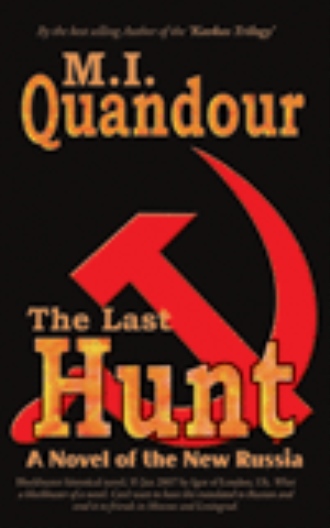
The Last Hunt
A Novel of the New Russia
by
Book Cover & Preview Text
Jim Thorne had not been surprised when Alex called him from Moscow two weeks earlier to set up the safari. It was short notice for such a trek. He was not even surprised when he knew the object of the safari. Tukumbala was the ultimate trophy of the Zambezi basin, the largest bull elephant currently alive, with two mighty tusks, which would enrich the home of any hunter who took that prize. Tukumbala was also known as a man killer, an elephant who, when confronted, was as likely to charge and kill his tormentors as he was to turn and run. That made him the most dangerous animal in Africa. It was universally agreed that elephants were the largest land animals, probably the most intelligent, and when angered potentially the most dangerous alive. Tukumbala was all of these and more. Even he, the professional African hunter who had seen it all and done it all, felt an unusual excitement at the prospect of tracking such a cunning and dangerous prey… again. Alexander only half listened to his hunter friend. There was something about the acquisition of the great beast’s spoor that took him to other hunts, in other places. The Kabarda Mountains of his youth in the Caucasus was one such place. A place as different from this tropical jungle as mother Russia was from Africa. He remembered with pleasure the cool mountain passes, the alpine meadows in the spring and summer, the clear, sweet tasting streams and of course the robust Balkarian mountain women, strong and clear headed who could work, or hunt a man into the ground. Alexander remembered his first hunt. He had been just eight years old and his father had lead him into the mountains just before sunrise with the twin Enfield .308 rifle his great grandfather had taken from the Great War. There was a stillness on the forest floor that could be scooped out with the hands and brought to the lips like a cool draught of a mountain stream. Of course that was back in the late twenties, long before the ‘revolution’ had chewed up the mountains for their timber and minerals, but still such places and silences could be found, even in today’s world. Alexander wondered a little about how things might have been had different paths been taken, by him, by his father, by his mother, by the ‘Party’. Of course, now there was little point in such retrospection; the past is the past. Occasionally though, the past can visit the present in its remarkable similarities. Such as now, at the moment when the spoor of the prey is taken up and brought to the face, to be seen, to be smelled, then to be followed. Then it was a mountain deer, an old timer whose antlers were said to stretch to the height of a tall Kabardian woodsman, with more points than could be counted on both hands. His father had stopped him with a quiet hand to his chest, pointed silently at the forest floor. Alexander could see nothing in the pre-dawn gloom of the forest but his father quietly squatted and pointed to two spots on the forest floor. On one were several dark round beads stacked in a rough pyramid; on the other a depression in the soft earth, shaped like a large, deep V in the ground. Alexander knelt by the knee of his father who reached out and took one of the dark round beads in his hand. He did likewise and was surprised at its warmth and moisture; it looked so solid. When his father sniffed at the bead he held, Alexander followed suit, noting the vegetative, not entirely unpleasant, barnyard odour similar to that of the goats. His father gestured to look at him and in a sign language that Alex understood instantly, indicated that the great buck was near and apparently oblivious of their presence. He picked up some humus from the forest floor and sifted it through his fingers, watching as it drifted behind them. They were downwind of the animal and therefore their scent would not give them away. The hunt, only a conception, an idea and a goal minutes earlier, was tangible reality, a thing with a real quarry and a real result, either win or lose, the animal or them. One would win; one would lose. He made up his mind at that moment that he would do whatever his father told him to do to make sure that they won and the animal lost. After all, they were the hunters and the great buck was the prey… This was not the last of Alexander’s hunts with his father. They hunted the Kabarda Mountains in the spring, summer and autumn from then until the commissars had come into the mountains with a Soviet Army detachment. The detachment gathered up all the families to attend the organising of the Nalchik Soviet and the assignment of all the adults to one or the other of the ‘great enterprises’ to which the Soviet was to be devoted. The people of the village were not given a choice as to what these ‘great enterprises’ were to be. Rather, the commissars, the political officers from Moscow, broke the village up into communes. There were three: a farm commune that was delegated to produce wheat, potatoes and cattle; an industrial commune that was to mill lumber that would be produced by the third commune; and a logging enterprise that would begin to harvest the great forests of the Caucasus Mountains for building materials. At fourteen, Alexander was assigned to the lumber mill, while his father was assigned to the logging camps. His mother was assigned to the dairy operation on the farming commune. Every family was obliged to deed their small plots of land and live stock over to the Soviet in order to create a ‘Kolkhoz’ or ‘Sofkhoz’ so that collective decisions could be made for production. Villagers were allowed to keep their houses but all able-bodied men and women were herded together in large barracks at the farms and were not allowed to leave the property of the Kolkhoz for a month at a time. Some mothers would disappear from the barracks in the middle of the night, taking with them stolen grains to feed their children, and would then return to the barracks before dawn. Those caught were severely punished. The people of Kabarda were in for some hard times. The infamous trudoden (working day) system was established whereby each given day was marked down for each member of the kolkhoz, who were promised food equivalent to the number of days worked. If one got sick then he or she was out of luck. The produce was the property of the collective farm and was shipped into Russia proper or to whatever destination the Party directed. The workers were given meagre provisions at the end of each month equivalent to the full days worked at the farm. It was never sufficient to feed families with children or elderly and the population suffered from malnutrition. Alex’s grandparents were in their nineties and needed to be fed and looked after, so it was inevitable that his mother would steal away at nights and walk the ten kilometres to her village to feed them. This was a particular hardship in the middle of winter with snowdrifts rising higher than the roofs of some of the houses in the village. “How is this any better than what the Tsar demanded of us?” Murad Bakirov had stood up at one of the Kolkhoz meetings to ask. “It is better because the Soviet represents your ownership, comrade Bakirov,” Commissar of Agriculture Valery Stepanov replied. Then he turned and whispered to the uniformed Soviet Army officer who stood next to him. In the morning, when everyone gathered again to receive housing assignments, Murad Bakirov and his family were not present. There was a conspicuous silence among the gathering that expressed itself only in furtive whispers. That evening, when Alex and his mother and father had moved their meagre belongings out of their cottage and into the collective barracks, where only a thin, wooden wall separated their bedding quarters from those around them, Alex’s father took him aside and whispered to him. “Never question the commissars, Sasha,” he said. “They have replaced the Tsar’s secret police. If you want to survive, follow the programme, work hard
Formats

Book Details
About the Book
This is the story about the rape of Russian industry and wealth by the few powerful, well-positioned old apartchiks of the former Communist regime. An African safari becomes the battleground for the Russian oligarch's conflict for power and the Hunt itself turns into the catalyst for resolving hatreds, rivalries and ambitions.
About the Author
About the author M I Quandour worked in business management with multinational companies in New York and in London for some thirty five years as a management executive and/or as a consultant. In the early seventies he spent four years as a screen-writer and film producer/director in Hollywood. He has written several non-fiction works and 13 published historical novels including the best selling ‘Kavkas Trilogy’ and ‘The Last Hunt’. Quandour is also a classical composer; several of his compositions are performed in Russia, England, Japan and other countries. On 31 May 2005 Quandour was awarded the coveted Medal of the Golden Cross (Vozrajdeneiye Rossii) in Moscow for his contributions to ‘Culture of the Fatherland’. He was also awarded the title and medal, “Author of the People” (Narodni Pesatl) on April 5, 2008 in the Russian Federation. He travels extensively every year, doing research for his novels but lives with his wife and two children in Windsor England.