
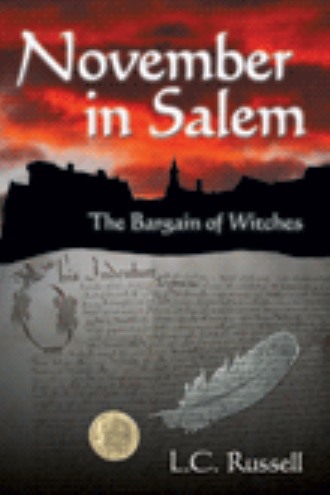
November in Salem
The Bargain of Witches
by
Book Cover & Preview Text
The Bargain Salem Village, Massachusetts November 11, 1701 The moon was in its last quarter in the house of Gemini. This would prove to be important on another such night in Salem Village. But on this night, six solemn-faced men sat round a rough-hewn table, in the tiny rectory of the Meeting House, arguing over the neatly penned words of an ominous document. Their raised voices drowned out the sound of the rising wind that shook the windows and blew sparks from the flue of the woodstove in the corner, and the sudden howling of the neighborhood dogs, that echoed into the cold night. The strong gusts of frigid night air were forceful enough to move the heavy brass bell hanging in the tower. Its iron clapper sounded eight times as the men continued to pound the table and shout before the door to the Meeting House flew open, causing them to jump to their feet in surprise. Two figures, one tall and wide as the door frame, the other half his size, stood just inside the threshold. Time seemed to stand still as all sound ceased both inside the building and out. It could have been an instant or an eternity that held each man in the room frozen in the posture he’d assumed just as the door was flung wide. The giant figure, wrapped in a deep purple cape, broke the spell by striding into the meeting room, his footfalls making an odd tapping sound as if he wore hobbled boots. “Good evening, gentlemen. It appears there are some concerns regarding our...agreement.” His whispery voice matched the sounds of the brittle autumn leaves that had blown through the doorway behind him and his companion, and were now scuttling across the dusty, pine floorboards. Once inside the circle of light thrown out by the large oil lamp, he pushed back his hood and an intake of breaths could be heard round the room. Except for the elderly man seated at the head of the table, none of the others in the group had ever met the two strangers with whom they were about to seal the most important deal of their lives. But even at his advanced age and with all his worldly dealings, he had never noticed the strange shape of the big man’s pupils before, as they reflected the flickering lamplight. Almost vertical, they seemed to have the power to immobilize. The newcomer nodded to his assistant who produced a razor-sharp quill from beneath his own cloak and laid it atop the vellum document on the table. Rubbing his hands as if to warm them, the large man indicated the pen. “Gentlemen, I believe we have business to tend to.” Outside, a sudden snow squall had come up, the fierce wind whipping the heavy white flakes until they resembled sheets flying on a clothesline on a black, blustery day. The snow collected quickly on the frozen ground and window sills of the sleeping village. At this hour no sensible man was anywhere but beneath several layers of goose down quilting. So no one in the village saw the white stuff pile deeply everywhere except on the roof of the Meeting House, where it hit the glowing cedar tiles like drops of water on a flame. And much later, no one but the large brown and gray hawk riding out the storm in the belfry saw the shadow of a figure bury a wooden box beneath a sapling in the churchyard. Chapter One A hospital structure—plain and simple but complete in all of its appointments—shall crown Hathorne Hill, with its wealth of pure water and purer air and its broad landscapes of beauty stretching out on every side. —Clement Walker, medical advisor, State Lunatic Hospital, Danvers, Massachusetts (1875) Danvers, Massachusetts November 8th, The Present “So what do you think they’re going to do with the old insane asylum?” Jeff asked as we walked down Maple Street past the gargantuan boarded-up structure. On this dark afternoon, the deep burgundy buildings making up the main complex sat shuttered and guarded, like a group of moody old trolls—nasty, dirty, and dangerous. “Tear it down and make condos,” Hawk replied as he fiddled with the adjustment buttons on the “Dune Buggy,” his nickname for his wheelchair. I walked along behind him, holding onto the handles because Aunt Marsha had asked me to make sure he went slowly down the steep sidewalk, especially because there was still snow on the ground. I wasn’t sure I was the best choice for the job, because I’d always had this weird kind of feeling when I was around someone in a wheelchair—like I was a kind of jinx or something. Besides Hawk, there had been only two occasions when I’d been close to someone in a wheelchair—and both times that someone had died. Oh, I was assured each time that it wasn’t my fault. But I knew that if I had been more attentive—a better daughter, a better granddaughter—things might have turned out differently. “Where’d you hear that?” Jeff pulled me back to the present by picking up a stick and throwing it over the temporary chain-link fence, erected to keep out the vandals and homeless people. I tightened my grip on the chair’s plastic handles. Well, it wasn’t going to happen again. I glanced down at the back of my cousin’s head. Hawk, apparently satisfied with the speed of the wheelchair, looked up at the asylum. “Heard Mom reading it to Aunty Gin from the paper this morning. You know, that place was originally called the State Lunatic Hospital when it was built in 1875,” Hawk said. “Here we go,” Jeff said over his shoulder. “The rolling encyclopedia is going to give a lecture.” “Lunatic hospital is not exactly a politically correct term,” I said as I helped steer Hawk away from a high pile of plowed snow. “No, but that’s exactly who it was built for,” he continued. “Insane people—lots of them. Guy by the name of Kirkbride built it to test his new theory of beautiful surroundings and fresh air as a cure for mental illness. It’s 300,000 square feet and sits on over five-hundred acres. That’s why we can see it from so far away.” I looked up at the forbidding exteriors of the three-story Gothic buildings. They gave the impression that a vampire bat might fly down from one of the steep eaves at any moment. “Beautiful surroundings?” I muttered. Hawk heard me. He had the hearing of a cat. “Well, it didn’t always look like that.” He waved his hand toward the buildings. “I’ve seen pictures of the original structures on the Internet, and it was really pretty nice back in the day. It’s the perfect example of Victorian Gothic.” He really did sound like an encyclopedia. “So what happened?” I asked. I couldn’t help but be intrigued. We usually didn’t take this route home, but the sidewalks on the other side of Maple were too icy for Hawk’s chair. Although the buildings were far off in the distance, the fact that they sat on top of a hill made the sharp roof lines visible almost all over town. “The place was abandoned in 1992, and it’s been vacant ever since.” Hawk was just getting warmed up, and we listened patiently as he prattled on about the architect who built it and the statistics surrounding its size and design.
Formats

Book Details
About the Book
Abandoned, neglected, and sitting atop Hathorne Hill, Danvers Asylum for the Insane towers above modern-day Danvers, Massachusetts. When November Atwood and her twin cousins, Jeff and wheelchair-bound Hawk, discover a strangely-marked wooden box long-buried in the asylum’s shadows, they unwittingly set in motion events leading to the culmination of a diabolical pact signed more than three hundred years ago—when Danvers was Salem Village and witchcraft was a hanging offense.
The cryptic clues on an old vellum document, along with a curious gold coin found inside the box, prompt the trio to venture into the tunnels beneath the asylum, where Jeff is struck by elf-shot, abducted, and replaced by a changeling.
With the aid of a gnome called Dynnis, the pair embark on a journey through the treacherous tunnels and into the Hill of Hathorne. They encounter Hob, the keeper of the Room of Rings, an enormous portal that carries them back in time to Salem Village, current date 1701. Can November summon the courage to bargain her soul to spare the souls of those hanged for witchcraft in 1692? For she is the only one who holds the key in November in Salem: The Bargain of Witches.
About the Author
L.C. Russell currently teaches writing at University of Phoenix. She has also worked as a librarian, and published several short stories. She lives in southern Arizona with her husband and daughter and is working on the sequel to November in Salem.