
Hitler's Spy
A Novel of Deception
by
Book Cover & Preview Text
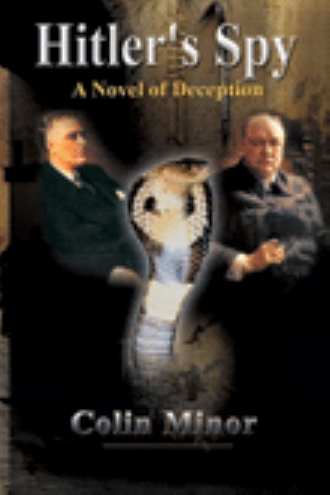
Prologue Monday, January 24 A Country Estate outside of London Evening broke full of light snow and gloom, matching the appearance and spirit of the crowd congregated outside the massive iron gates of a large estate in the English countryside. The sad, discouraging news emanating from the enormous house just beyond the gates had spread quickly among the somber group, a frosty cloud of breath rising like a ghostly balloon from its midst. Some people had walked the uneven road from the nearby town of Lullenden, many had driven the twenty-five miles from London, and others had come from neighboring farms and villages. A few once had met the owner of the estate and shook his small, spongy hand, many had voted for him, some even had regarded him as the devil incarnate, but most knew he single-handedly had saved the nation and the world at their darkest moments. Regardless of what they believed, they all felt an urge to pay this final homage. Steam rose from a large, silver coffee urn a stern looking butler and two pretty young maids, all attired in solemn black, had carried out earlier from the great house and placed on a table covered with beautiful linen and sheltered by a green, lawn umbrella erected by the gardener. An ample supply of delicate china coffee cups and saucers placed on the table were, for the most part, unused. Several Scotland Yard Bobbies mingled but their presence was more out of respect than any need to maintain order. Through the gates, in the fading light of dusk, the crowd could see the gentle, rolling hills whitewashed with a thin sheet of fresh snow and some, more familiar with the grounds, pointed out the lakes the owner had created by building dams. An old man in well-worn coveralls and scarlet plaid shirt spoke softly of how he had helped the owner construct the many brick walls dotting the landscape. “He’s a damn fine bricklayer,” the man muttered sadly, mostly for his own satisfaction but most were silent, lost in their own thoughts and heads bowed in prayer, knowing his death would signal the passing of their last great leader. The large house was an odd assortment of shapes and angles and construction materials, obviously the site of a series of additions over the years, with a peculiar pyramidal design crowning all the exterior walls. The wintry branches of a naked vine snaked up one long wall like a giant spider’s web and Christmas lights still dangled incongruously on a beautiful evergreen towering almost as high as the house. The tall brick chimney puffed a thin line of gray smoke streaming northward. Inside the mansion, a multitude of floral bouquets gasped for oxygen as the pungent smell of kerosene lamps permeated the already stifling air of the master bedroom, its heavy oak paneling adorning the walls adding to the oppressive feel. A dozen people gathered around the bed, some whispering but all concentrating on the fitfully breathing man, once a giant among men, now dwarfed in his massive, dramatic deathbed. A coterie of family and friends surrounded the old man, dressed in his favorite, gray quilted housecoat and resting comfortably on over sized pillows. Through half closed eyelids, he noticed the heavy, dusty curtains drawn over the tall windows to darken the room. His lips, through which passed some of the greatest oratory of the English language, were now cracked and desiccated. He could hear voices; someone moved closer to him, tenderly taking his hand. Randolph, his son, placed a gentle kiss on his shriveled hand and Winston, his young grandson, stood like a stiff and solemn soldier. He could smell the alcohol on Sarah, his daughter, leaning unsteadily over him. In the dim light, he could barely make out Mary at the foot of the bed. Lord Moran, unfailingly faithful after all these years, even with his extraordinary medical skills, could not save him now. And, of course, his wonderful Clementine. He realized his long and momentous journey delivered him now to where those full, black curtains of death would soon draw tightly and forever around him. He was ready, his body near death but his mind vibrant and clear and vivid memories washed over him like a gentle wave. His beautiful mother, Harrow, Cuba, the haunting death of his brilliant but volatile father. His mind swirled, full of rushing images — the suffocating heat of the Khyber Pass — his capture and spectacular escape in the Boer War — politics, elections, opposition, Government — then the ignominy of defeat at the polls by an ungrateful people — the Dardanelles, writing, Hitler, war. He could hear a voice over him; surely, that was his beloved Clementine speaking to him. Not long now, my darling. And, sweet Jesus, what is this … a minister giving him the last rites, too late for all that nonsense now. His mind moved along. His dear friend Franklin and his wonderful wife, Eleanor. And then Casablanca. He thought of the painting he did at La Saadia in Marrakesh, the only one completed during his lonely, titanic struggle against Hitler and the Nazis. He had persuaded Franklin to spend a few relaxing days there after the chaos and terror of Casablanca. Only after the President and his entourage departed for the long journey back to Washington did he begin to paint. Occasionally, as he walked the long hallway at Chartwell, he would study it, a well-crafted portrait of a delicate, beautiful woman, a woman he never met but who had haunted him for almost half a century. Guests would occasionally question him about her identity but he would just smile and change the subject. And then suddenly, the blackness of that room. The blood flowing across the floor. Herbert. Oh God, poor Herbert. And Franklin. The deeds committed that night can never be told, not even to Clementine. And now, to his grave, he will soon carry them just as Franklin did. What’s today? Late January. Could it be that date? His ominous prediction to Franklin on that very night in Casablanca now echoing down through the decades. He inhaled a deep breath and smiled. Life was good. They can say what they want. And frankly, he did not give a damn! His has been a charmed and full life. One more sweet breath, a slow exhale, and then the grand old lion died. * * * University Campus in New England “Churchill’s dead!” the student blurted out, rushing into the military history class located in an auditorium style lecture room at Boston College. “Churchill’s dead!” All heads turned as Chris Tabler bounded recklessly like a jackrabbit down the steps, two at a time. “Professor, I just heard on the radio Winston Churchill is dead,” he exclaimed, catching his breath. “Chris, settle down,” suggested the youthful looking professor, turning away from the chalkboard, the class snickering as Tabler blushed. “First of all, you’re almost a half hour late for class,” he chided. “I was listening to the radio, Professor.” “We all appreciate your diligence to current events,” said Matthew Baldwin. “Now, for our benefit, tell us what you know about Churchill.” Frowning, Tabler spoke to the twenty students of the History 320 graduate level class. “Well, Churchill is most famous as the leader of England during World War II. As power slipped from the bungling hands of Neville Chamberlain, Churchill formed a Coalition Government. He was renowned for his great oratory…”
Formats

Book Details
About the Book
January 1943, the darkest time for the Allies, Nazis are swarming over Europe and northern Africa. It is Ramadan in Morocco, an exotic land of mystery and strange customs. The souk is bursting with sounds: the chant of beggars crouching in the corners, prayers arising from the mosques, shouts of the merchants, the aphrodisiac persuasion of Arabic music, the haunting wail of the muezzin and the curious cacophony of roaming animals. Casablanca is also full of shadows and much danger as Roosevelt and Churchill gather for a secret conference.
Matthew Baldwin, a talented American, bored with bureaucratic work, wants to be part of history. Kate Tyler, a gifted analyst, is assigned to Churchill’s staff. Hitler has dispatched his elite, ruthless spy, Josef Mach, aka Joseph Turnbull, codenamed Cobra, on a murderous mission.
Hitler‘s Spy tells of how their lives entwine at the Conference. These characters plus Patton, Eisenhower, Hopkins, Kay Summersby, and Elliott and Franklin Roosevelt Jr come alive in Hitler’s Spy, moving effortlessly from Wyoming to London to Washington to Hitler’s Eagle Nest to Casablanca. And finally to one shocking night where, amid explosions and chaos, in a heart-stopping climax, the unthinkable occurs: assassination!
About the Author
The author has always loved books and reading —a fondness inherited from his parents. With a Bachelor of Arts degree and two years of graduate studies in English and American Literature from the University of Regina, he retired after twenty-five years as an executive in the television and film production business. This is his debut novel of a series he is writing based on historical events. Colin resides in Edmonton, Canada, has been married for over thirty years, and is blessed with five daughters. Please visit him online at www.colinminor.com.