
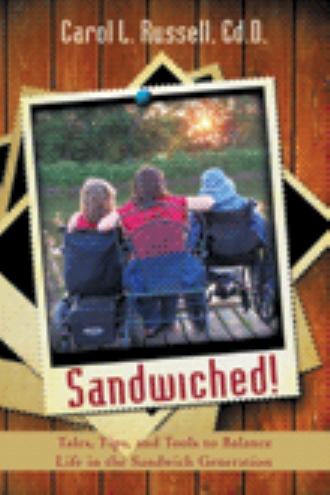
Sandwiched!
Tales, Tips, and Tools to Balance Life in the Sandwich Generation
by
Book Cover & Preview Text
COMMITMENT – with a CAPITAL "C”
Our family and response to life’s events:
Fletch and I have long had a strong commitment to family. Before we were married, Fletch’s Mom was very ill. He took a semester off from college his senior year to go home and work a night shift so he could be at home with his Mom during the day. I observed him with my nieces and nephews, and knew he would be a wonderful Dad. When we first were married, and soon off to graduate school, we were committed to wait to have children until we had more time to focus on our children (if we were blessed to have them). We observed many fellow graduate students with children who had to squeeze in time for their children amidst the toil and perils of graduate work. We also decided that once we had children, whoever was making more money would continue to work, while the other would stay home with our children. We were delighted to have our first baby, Cassie (Cassendra Monique), when we had moved to South Dakota where I had my first university teaching position. Fletch had various part time jobs, and was an at-home-Dad. We welcomed Mikelle (Mikelle Eve) into our lives. She was born 2 ½ years later. Fletch continued to be the primary caregiver. I had a flexible schedule, and was also able to enroll both Cassie and Mikelle in our university preschool program, where I was coordinator. We LOVED being parents and delighted in every milestone.
Two years later, we became stronger and more committed parents. Our parenting was tested when our youngest, Tally (Tally Love) was born. She faced with many challenges with spina bifida, hydrocephalus, Arnold Chiari Malformation, using a wheelchair, and various other significant medical issues. She had three surgeries the first week of her life, and has had a total of twelve over the years. Medical issues were major, hospital visits frequent, and doctors visits a way of life. We struggled with the school district and special education. We forged through several due processes, mediations and complaints through the years, advocating for inclusion and support services. We became stronger parents and committed our lives to special needs awareness, advocacy and inclusion. Because much of this content related to my profession, teaching at universities in the field of early childhood special education, I was able to offer both my personal and professional “hats”. We presented information at conferences, sometimes including the whole family on various issues of inclusion, sibling issues, accessibility, advocacy, parent rights, etc.
We moved to Kansas in 1996 for a better university teaching position for me, improved special education for Tally, less snow, and closer to some family. Within three years, we built an accessible home in the country when Tally, our youngest daughter was 11, Mikelle was 13 and Cassie was 16. This move was a huge step towards freedom, accessibility and independence for Tally. After living in Kansas for 9 years and having built an accessible environment for Tally, assisting my parents with their situation was a natural challenge and one that we already had experience with of sorts. Although the systems and issues are a bit different for a younger person with special needs, there are many similarities with caring for our aging parents. Accessibility issues, problem solving, thinking “outside the box,” inclusion, offering choices, need for flexibility are very similar.
We have always tried to face challenges viewing the glass half full, and seeing the positive. Challenges are frustrating, but also are opportunities for learning. We have taught our children to surround themselves with positive people. We have learned from our mistakes, and we are the first to admit we have made them. We try to creatively problem solve. We have taught our children that every problem can be solved – in one way or another. No doesn’t always mean no. There is always a way. It is not a matter of “if” but “how” something might be done. Our response to life’s happenings has formed our philosophy. We learned what we had control over / what we didn’t; what we could change / what we couldn’t. We couldn’t change that fact that Tally has spina bifida, but we could make a difference in her world to make a more accessible, accepting environment. We couldn’t change the fact that our parents were getting older, running out of money, and were more dependent; but we could make their world safe, caring, and grant their wish to not die in a hospital or nursing home. We have been sincere in our efforts. More aspects of our philosophy are detailed below. This may explain our commitment, why and how we do what we do.
- COMMITMENT – You Cannot Do it Alone! : In order to make this plan work, we had to believe in the process and be committed to the purpose. You cannot do it alone, you must have others also committed to the cause. You will feel like you’re alone, at times. Again, asking for help is a sign of strength.
- THE BOX: Thinking Inside, Outside and Around THE BOX: Commitment also means constant problems solving about many issues ranging from: How to pay the bills when there is no money; advocating to make change; deciding which problem to tackle first; transportation (e.g. to appointments, keeping the vans running, who has the accessible vehicle on which end of campus – and where is it needed for Tally, especially on rainy days); basically what is needed to be done and who, where, and when will someone do it! It is truly difficult for some to think “outside of the box,” as “THE BOX” is familiar, comfortable and safe. I would refer back to the SODAS problem solving tool (discussed in Chapter 1) and thinking beyond traditional solutions. Plowing new pathways – and making them accessible – is a constant process. Fletch is my “out of the box” thinker, who keeps me grounded and creative – yet productive and somewhat sane.
- NO Doesn’t Always Mean NO – But You Have to Work for It: We have learned, the NO does not always mean NO. It does take some work and educating yourself (e.g. calls about the ADA: American’s with Disabilities Act or IDEA: Individuals with Disabilities Education Act requirements; or even filing a complaint, mediating or due process). It is worth the confrontation and conflict, particularly if it is a priority for equal access or quality of life for your loved one. I do believe that much of it is about attitude. If you approach the conflict or disagreement with a smile, grace, and a positive attitude, you get a lot more done and people may want to work with you. Also, if you’re going to complain, do it to someone who can make a difference. It doesn’t help to complain to a person who cannot make the change. It also helps to surround yourself with positive people, who can help support your advocacy efforts. Advocacy and protection agencies in each state can be helpful. Check the advocacy organizations and resources at the end of the book.
WHAT WE’VE LEARNED:
It’s all about attitudes! Flexibility and communication are keys to most successful experiences. Choices (appropriate and safe ones) are essential for a sense of self-worth and dignity. Respite and a sense of humor can help keep you sane. Also:- COMMITMENT – needs to be with a capital ” C” – in order to make this work, we had to believe in the process and committed to the purpose.
- THE Box: Thinking Inside, Outside and Around THE BOX
- NO Doesn’t Always Mean NO – But You Have to Work for It
- INCLUSION is important – at any age
- CHOICES, CHOICES AND MORE CHOICES: Choices and good care = fewer meds
“Congress cannot change attitudes with a stroke of a pen.”
– Author Unknown
Formats

Book Details
About the Book
It has been estimated that more than 42 million Americans find themselves sandwiched between the needs of their own children and the needs of their aging parents. A common term in today’s world, the Sandwich Generation, refers to those people in their middle years who find themselves attempting to balance their lives (and sanity) between caring for their children and aging parents, while keeping a job, stabilizing their marriage, and having little time to manage the hot flashes of life.
In Sandwiched!, author Dr. Carol L. Russell openly shares her family’s journey as part of the Sandwich Generation and provides unique solutions and arrangements. This guide shares a plethora of information about the blended family roles. It discusses how to address:
- Communication
- Attitude
- Finances
- Organization
- Teaming and collaboration
- Asking for help
- Assistive techniques and technology
- Advocating
- Respite—care of the caregiver
About the Author
Dr. Carol L. Russell, Associate Professor of Early Childhood at Emporia State University, has a doctorate in special education and a master’s degree in human development and family studies. Russell has authored and presented regionally, nationally and internationally on various family, educational, accessibility, and advocacy topics. Russell and her husband, Fletch, have raised three daughters: Cassie, Mikelle and Tally; and now care for Carol’s mother. They have been in the Sandwich Generation for over six years.