
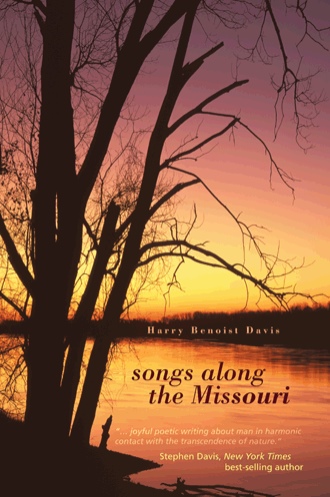
Songs Along the Missouri
by
Book Cover & Preview Text
We have Orpheus and his lyre to blame for lyric poetry, which can present us with a dilemma of definition. Is a lyric a short poem, reflective of a mood or an expression of love? Or is it a poem designed to be sung as music?
In the lyric poetry of the late Rev. Harry Benoist Davis, the answer is surely both, and even more. Clearly his title for this selection, Songs Along the Missouri, tells us that Harry wrote some of these lines to the rhyming and chiming melodies in his imagination. Other verses readily fit into the rhythms and cadences of familiar Protestant hymns. The poems herein are the life’s production of a hard-working Methodist minister who served several parishes and congregations in western Missouri for over five decades. They speak of his profound involvement with community and family—Harry was one of six siblings who grew up in the Great Depression of the 1930s—as well as an almost mystic sense of place: along the wide, often turbulent, always majestic Missouri River, which crosses the state until its confluence with the Mississippi River near St. Louis.
Harry’s intense interface with the natural world is an important part of this work. His passion for landscape, river and cosmos almost equals the strong feelings he describes when he thinks about his parents, brothers and sisters. He is acutely attuned to the moon and stars, sensitive to the inaudible music of the spheres, both prophet and witness to the ineffable beauties of the world. In this he reminds me sometimes of the old romantics of late memory, Blake and Wordsworth, whose joyful poetic writing about man in harmonic contact with the transcendence of nature proves that, often in poetry, simplicity belies subtlety.
Another theme of Harry’s is the blessings and complications of the spiritual life. In this, he is an heir to the meditative early church fathers like St. Augustine and Thomas Aquinas. But I also find a connection to the so-called Metaphysical Poets, the English poetic divines who wrote during, and just after, the age of Shakespeare: George Herbert, John Donne, Henry Vaughan, Thomas Traherne. Like them, Harry Benoist Davis writes of profound religious experience in a way that captures the humanity and sometime doubt of the Protestant cleric, a visionary seeker in the embrace of a God who can be both comforting and merciless.
Which is not to say that Songs Along the Missouri is merely a set of new psalms from the country. Harry is also an “occasional poet” of humor and charm, as in “St. Paul’s Cathedral,” where he grieves during Winston Churchill’s funeral, watched on television in 1965. And the nine stanzas of “The Nixons in China” comprise a sympathetic narrative of the diplomatic encounters that changed the course of post-war history in 1972.
Yet at the end of the day, like the Metaphysicals of yore, Harry Benoist Davis is accepting of, and deeply grateful for, the comfort that comes from the peace beyond all understanding. Faith, hope, and love are the philosophical stars by which he navigates the heaven he finds here, on the earth of his adored Missouri. We hope the reader will discover in Harry’s poems the abiding human affection and manly grace so admired and appreciated by all of us who knew and loved him, during his time in this world.
—Stephen Davis, New York Times best-selling author (Hammer of the Gods and Walk this Way)
RURAL AUTUMN
Hold back, hold back, you flowing winds of time,
Too swift, too swift, the colors lose their prime
As bright October leaves which burn the sky
With crimson, gold, and scarlet soon shall fly
Before autumnal motion, wind and breeze,
And lie in scattered heaps beneath the trees.
One gladdened with a red oak’s deep maroon
Must feel some pain to know that all too soon
This rich mysterious foliage shall be found
Below denuded branches on the ground.
Blow wild, blow wild, you winds of autumn blow!
Rain leaves, whirl leaves, in one majestic show!
Be gone, be gone, the last of summer’s breath
And blow the flowers their first foretaste of death.
Make haste and bring the fruits of harvest in.
Creak, wagons, hauling grain into the bin.
Let be cleaned out and strawed the sheds where sleep
On winter nights the huddled flocks of sheep,
The lordly rams and all their docile ewes
That in chill spring their lambs they may not lose.
The young fowls which once stretched out in the sun
And grew strong wings out in the pasture run,
Let be housed now from storms, enclosed in pens
To scratch beneath their straw-lined nests as hens,
While we within our wind-rocked homes defy
The face-benumbing blizzards of the sky.
NELSON ART GALLERY
I stood in Nelson’s Gallery of Art
And gazed upon a portrait etched in stone
Almost three thousand years before the Christ
And near five thousand years before our own
Showing a husband standing by his wife
Whose more luxuriant hair and finer face
Still bear the imprint on these latter days,
As we and our descendants see her there.
They lived and loved, and somewhere surely live,
And still endure as do their likenesses
Upon this ancient slab of Nile-hewn stone.
LINES IN SWOPE PARK AT SNOWTIME
Wild winter whiteness, covering the park,
Stay hard, freeze hard, for soon it will be dark
And bitter cold will then preserve the awe
Of your pure whiteness from the threat of thaw.
Would we could crush forever to our hearts
This beauty, or preserve it through the arts,
That this horizon clad in crystal trees
And diamond-covered branches we could freeze
And could possess together in some hold
Where summer heat could not destroy the cold.
But since this is impossible, at least
Let us look long upon the fields and feast,
Lest we should in reflection and repose
Lose ever this white treasure of the snows.
JANUARY
Though the sun is farthest south of here
On December twenty-first, the year
Does not receive the full impact
Nor coldest days become a fact
Until around the fifteenth day
Of January, records say.
This is the time we must appraise
The frigid joys of shortened days
And of the early falling dusk.
Now cardinals throw off the husk
Of sunflower seed on window sill,
And titmice flit in for their fill,
Exchanging beauty for a meal
And warming winter with their zeal.
THE DEATH OF ROBERT CHURCH
A plane cleared the Missouri with a loud
Uprising as it soared into the grey
Oblivion of lostness in a cloud
Of Kansas City fog across the way.
I watched, then gazed through rain and boisterous wind
Toward Trinity Hospital in mid-town
Where Robert Church, who long had been my friend
Lay with life’s final curtain closing down.
As through the rain the giant plane soared on,
He left his runway, too, in unseen flight
Into a cloud-obscured and misty dawn
Beyond our help, our knowledge, or our sight.
WALK ON THE MOON
Tonight I look up at a crescent moon
Glimmering golden in the sky of night
And know that men from earth this afternoon
Have landed there, and their astonished sight
Takes in what other eyes have never seen.
They breathe their thanks where no one ever knelt.
On territory silent and serene
They walk a surface no feet ever felt.
Walk on the moon, you men of earth, walk on,
Clad in your bulky, hooded whiteness, walk,
And leave your plaque upon its pitted lawn,
And plant your flag upon those fields of chalk!
For until now in all of time’s vast span,
No walk like this was ever made by man.
Formats

Book Details
About the Book
Coming on the 30th anniversary of the original, this second edition of Songs Along the Missouri introduces over fifty new poems. Like Blake and Wordsworth before him, Harry Benoist Davis’s intense interface with the natural world inspired his life and work. Songs Along the Missouri speaks of the difficulty of being authentically human, of finding the divine in everyday things, the richness of community and family, the ache of loss, and the power of compassion to change the world.
About the Author
Harry Benoist Davis earned bachelor’s and master’s degrees in English from the University of Missouri, and a master of divinity degree from Garrett Theological Seminary. The first edition of Songs Along the Missouri was published in 1981. He lived with his wife and daughters in Missouri, never far from the river.