
Tales of Priut Almus
Participant Observation in a Russian Children’s Shelter
by
Book Cover & Preview Text
It is evening, a quarter to nine. I am sitting at the table in the kitchen nook of my tiny apartment in Priut Almus, located somewhere on the outskirts of Saint Petersburg, Russia. We drove a long way from center city to get here and took many turns. It is like being in Brooklyn or Queens but less exotic. This is to be my home for a couple of weeks. Almus is housed in a former child care center. It later became a Soviet-style communal apartment, a “komumalka.” Now it is a children’s shelter. The long, two-story, brick-walled building is situated in the midst of a towering public housing complex. Each building has a white, concrete facade, now crumbling. But the project is probably not very old, twenty years at most. The Almus red brick structure is, I suspect, newer than the apartment high-rises, as cheaply built but probably in better repair. It is only two stories tall. The kitchen and dining room are on the ground floor along with a medical clinic for the residents. An after-school program was added more recently - also on the ground floor. The children live upstairs. You ring a bell. A concierge unlocks the door with a perfunctory, “Dobroy dyen,” Good day. You walk up the stairs. On the second floor you find yourself in the dormitory, recognizable by children’s drawings taped to the walls. There is none of the vague, musty odor typical for such places, emanating from the brew of sweat, pee and the debris of active lives. Almus is well-scrubbed, but informal rather than pristine. It is well used by its residents. The dormitory is divided by a corridor extending to the far wall in either direction. Children are seen galloping from one end to the other at impressive speed but for no apparent reason. Rooms with two to four beds each line both sides of the hallway. At the center is a small gathering place complete with sofa and miscellaneous chairs. Adjacent is a staff office. A staff kitchen is a few doors down and just beyond is a room large enough for children and staff to meet together. I am given a guest suite that doubles as a storeroom. I am delighted to find not only adequate space for small-group conversations but there is a functioning bathroom complete with a knee-high water pipe useful as a shower. My bed is narrow but firm and comfortable. The bedroom contains a white, Danish-style wardrobe. The walls are adorned with plain white wallpaper. No crumbling plaster is anywhere to be seen. Children for their part live in tidy, two-person rooms. While privacy for them is unlikely, in the generous quarters given to me, there is surprising potential for being alone. The door even has a lock that works with a key both from the inside and the outside. What luxury! I am here in my capacity as mental health consultant to Doctors of the World [“Vrachi Mira”], Priut Almus’ sponsor. But I do not yet know what is expected of me. What is a psychologist anyway according to their understanding and how might he or she be helpful in this context? My own goal is to learn about the children, the program, and see what may be needed. I want to take something of Russian child-care wisdom and craft to America with me. In that I am the opposite of a missionary. I am not here to sell a god (although I do tend to push progressive education and I extol the virtues of electronic cameras and computers). But more to the point even with a doctorate, I am not a doctor. I am incapable of curing anybody of anything, especially malaise of the soul. Perhaps as time passes and I sink into the scene, I will understand enough to play a useful role. I might even discover something of interest to offer the child care staff, the psychologists and the medical doctors. And, who knows? I might acquire a bit of the unfathomable Russian language. This is not the first Russian institution for children that I have come to know. It is the third. Priut Almus was recommended to me by Vrachi Mira as unusually convivial and innovative. * * * Dinner: I devoured a stewed chicken dinner with the kids and staff. It was simple food but tasty and more than ample. The evening consisted of horsing around in the playroom with children. Punching, wrestling and giggling was our common language. I eventually stretched out on the sofa in front of the television set surrounded by kids, all of us staring at the images on the screen, oblivious, and transfixed by nothing in particular. Now and then a staff member came by and smiled benignly. There seemed to be no objection to our rough-housing. Eventually, I padded off to bed. The children are still at the TV set as I write this. * * * Nobody here speaks English so I have not benefitted from formal introductions. But Dr. Alla Pavlovna, Vrachi Mira’s director of medicine, drove me here and stayed for a while. Her command of English is slightly better than mine is of Russian. Between us, I managed to learn some basic background information. There are only eighteen children in residence at the moment. The capacity is greater, thirty or so with much doubling-up. Ages can range widely from about five or less to eighteen. There is a lot of coming and going almost on a daily basis. Children may stay here for a few days or for as long as a year - but, by law, no more … although some of them do remain longer because Makarich is good at battling the powers that be. The director, Mikail Markarovich, “Makarich,” is presently in hospital with a broken leg. I have been led to understand that he is a remarkable man. I am not sure why but I am eager to find out. It is unfortunate that he will not be around during my visit. Perhaps I can visit him in hospital. Or schedule another visit for next year. This feels like a very nice place. It is clean and well staffed with pleasant people ... (although a moment ago that big guy patrolling the halls yelled at a bunch of the children. Maybe it was called for, but his manner was distinctly grouchy). On the other hand, I noticed an earnest vospitatilnitsa [female child care worker] in the television room surrounded by a throng of children. She strummed a guitar while leading them in song. If she is at all representative of staff quality, I expect the ambience to be spirited, merry and warmhearted, Almus stands in stark contrast with the priut for abused children I was taken to yesterday. That one struck me as on the coldly professional side, fully lacking in homeyness. Here there seems to be considerable animated interaction between staff and children. Alla Pavlovna, for example, hugged bunches of kids as we walked in the door. On the other hand, there are forebodings of concerns. Far be it for me to dwell on them. But did I imagine a whiff of alcohol somewhere along the second floor corridor? I did for certain notice the younger of the two Serogias race down the hall with a pack of his friends, all of them giggling and yelling, while he waved lit matches in the faces of everyone he passed and then thrust them, flaming, into his mouth. And did I imagine, as one of the boys showed me around the facility and along the way invited us into his room, the embarrassment on the part of all three boys who stood there awkwardly, the youngest of whom must have been eight or nine years old? It was he who hastily pulled up his pants while the other two guys, a couple of years older, faced him at very close range. They were caught in an act. What exactly was going on? But there is no question that two thirteen year olds, a boy and a girl, walked from one end of the hallway to the other holding hands - hardly a crime and I am far from a prude - but it did make me wonder about the management problems it must signify in a coed dormitory. Finally, no one could escape an awareness of the yelling and running through the corridors after bedtime. Is this place perhaps a bit too open, too free, too loosey-goosey?
Formats


Book Details
About the Book
Thirteen-year-old Serogia was thrown out of his house by his drunken mother after his father died. Eleven-year-old Anya doesn’t have many friends and is always sad; when she looks in the mirror she sees an ugly girl. Her ten-year-old sister Sashinka is shy, tough and fun loving. Their only living relative is their drunken father.
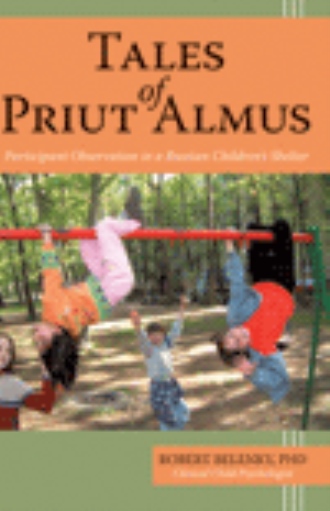
These are just three of the children who were living at Priut Almus, a children’s shelter in St. Petersburg, Russia, when author Robert Belenky began his visits in 1998. He returned many times during the next ten years. In Tales of Priut Almus he presents his interviews with children and staff as he participates in this humane and innovative shelter unusual in that it focused on preparing children to create and live in a democracy. Finally, we meet Almus’ founding director, enigmatic man of the theater, Mikhail Markarievich, who provided the courageous vision.
The fifth in a series of books focusing on raising children whose lives have not been easy, Tales of Priut Almus describes how this home has become a monument to the spirited and humane ways to raise children who are in need. Priut Almus is a model of what may be possible for the United States in the realm of education and child care.
About the Author
Robert Belenky earned a PhD in clinical psychology from Columbia University and a post doctoral fellowship in Child and Family Psychology at the Judge Baker Child Guidance Clinic. He taught at the Harvard Graduate School of Education, Boston College, Boston University, Concordia University, and Goddard College. He had a private practice in a wilderness retreat. Belenky lives in Vermont with his wife, Mary.