
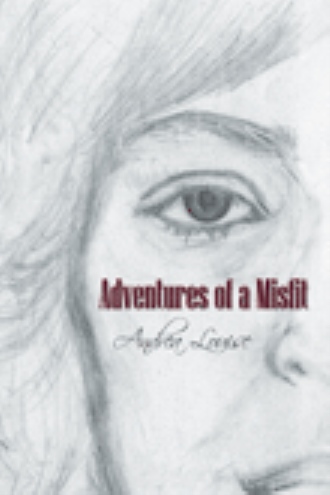
Adventures of a Misfit
A Memoir
by
Book Cover & Preview Text
CHAPTER FIVE WEIRD AUSTRIAN MOM When I first heard the name “Ingeborg,” it sounded as magical as “Cinderella” or “Repunzel.” It could have been the name of a fairy princess or a delicate flower growing high in the Austrian Alps. But this magical name rightfully belonged to my mother, a woman whose thick dark hair, slender nose, and high cheekbones could have won her the role of a stunning beauty in any fairy tale. “Mema” was the name that I chose for her. It meant my loving, precious mom, for it was she who brought my childhood into completion. I called upon Mema many times to pack my lunchbox, to comb the tangles out of my hair, to protect me from the ghost whose lucent eyes glared at me from the darkness of my closet. And as she was a natural-born storyteller, I was always awaiting my next adventure. I learned of the mean wolf that, once upon a time, had his belly sewn full of rocks. And get this: devils once followed Mema through the streets when she was just a young girl. That one was pretty neat, but the really gruesome one was about the wicked stepmother who actually put an earwig up her stepdaughter’s nose as she slept, hoping it would devour her brain. Egads! But good or bad, I enjoyed her stories, especially the ones of her own Austrian youth, her wonderful yet trampled-on youth. She grew up in a fairly poor family in a small village in Tirol, Austria, with a passive father, an aggressive, neurotic mother, and a sickly little brother. It was during authoritarian times, when children were slapped and beaten in lieu of a firm scolding and sadistic nuns ruled the classroom with cruel and unusual punishment. By the time she reached her teens, the tide of the Third Reich had already washed ashore with the annexation of Austria in 1938. The Fuehrer himself passed through town one day, and as the clever Hitler always made sure to be seen doting over children, he reached out of the window of his train compartment in view of a curious crowd and shook hands with a small boy. That boy was my Uncle Herbert, age five. Andreas and Hedwig Kruckenhauser were actually against Hitler, so they kept their only daughter, Inge, from attending the Nazi Youth Organization. They got away with it too, that is until one of the wicked sisters of our almighty Christ, and of Hitler too, caught her. “You haven’t been attending the Nazi Youth meetings!” she scolded. Thus began the young Inge’s attendance. That was the story I learned the day I saw pictures of my mom and her cousin, Irma, dressed in crisp white blouses with little ties, resembling my Campfire Girls uniform. By then I’d also heard enough evil-nun stories to turn my stomach for good. They beat Inge’s knuckles with rulers and made her squat down in the corner of the classroom for a solid hour, her joints throbbing and her circulation nearly cut off. One day one of them pulled her ear so hard, she came home with her hat soaked full of blood. After the war, the whole village was just a shade away from starving—lots and lots of stories about being hungry, especially about her selfless parents giving their rations to her and her brother Herbert. Those were the desperate days as seen in the dwindling bodies of the villagers. Some ate slugs off the ground; others were forced to eat their very own pets. Inge had to devour her beloved pet rabbit, though it was far from enough. I guess that’s why she turned into such a glutton later on in life. Whenever we went out to eat, she insisted on eating the leftovers off our plates. “We can’t let food go to waste,” she’d say while stuffing herself long after her pouches were already full. I never saw her thin except for in photographs. She was proud of her extra cushioning. It was a status symbol; it meant she was healthy and had money. To me it meant she was foolish and unconcerned about her health. Of all her stories, the most dramatic were of bombs flying towards the ground while she and the villagers hid in shelters inside the mountains. “Whe-e-e-e-e-e-e-w!” she’d whistle to mimic the sound of an approaching bomb. Then she’d describe the horror of not knowing where it was going to land. Her war stories always ended with the occupation of various troops, putting the entire village in an upheaval. First came the Americans, units of the forty-second (Rainbow) Division, to be precise. They gave the Kruckenhausers maybe a half hour to move to the house next door. That’s how she met that stunningly handsome man, now my dad, who was no doubt impressed with this innocent, young girl and her bashful smile. CHAPTER SIX SANCTUARY After the exile of Richard’s comics, I was an absolute wreck. “I’m bored! I’m bored!” I whined at Mom. “There’s nothing to do!” I griped again as I chewed my fingers and paced the halls of the pretty orange house. “Read a book,” she suggested one time, knowing I couldn’t stand to read. “Why don’t you go swimming?” she said another time as she walked away to shine the kitchen counters. Baloney. I needed Richard’s comics. And who wanted to go swimming with me anyway? Who wanted anything to do with such an unattractive and awkward girl? Unattractive was right. Some shape-shifting alien had crawled inside my tender young body just a short time earlier, causing me so much shame that I didn’t even want to go outside. Even the bathroom mirror was embarrassed by the shy little buds that were popping out of my chest. So was everyone else. Art and Daryl preferred their shrieking, card-playing compadres to boring “Sis.” As for Richard—well—whenever there was a thud against his bedroom wall, it meant he was doing a yoga headstand, his face turning red, his veins popping out, his neck being compressed beneath the weight of over two hundred and fifty pounds. That’s when he wasn’t tied up in a knot somewhere or stretching his eyeballs to the floor. The girls who lived behind us also suddenly became unavailable. “Go away!” my favorite friend hollered out her bedroom window one day as she saw me approaching. “I don’t want to be your friend!” That was three strikes and I was out—out of ideas, out of my mind. I should have observed the ways of Richard A. Kraus. I should have asked myself what it was about the “blubber belly sapsucker” that made him so strong. He should have been writhing on the floor, screaming from comic-book withdrawal, begging to read just one more as his last dying wish; but Richard would have made your house burning down look easy. Richard was magic. He could fire a pencil-sharp beam of concentration at anything he desired: a rich chocolate cake, a game of chess, any calculus problem that crossed his path. And Richard always knew what he wanted. This time it just happened to be yoga, something that came as natural to him as eating frosting off a fresh-baked cake. Richard had simply moved on, burned the bridges to his past, and devoted all but his enormous appetite to yoga. Those were the opposing forces that brought Richard and me together one autumn day: my aimlessness, his focus. My stagnation, his growth. Oh, and one more thing: two brain cells in Richard’s head got lonely. We found a spot in the basement on a dirty old carpet next to the famous bomb shelter and its hairy spiders, where we were able to spread out and practice. Then up and down our arms flapped like two bird-people on drugs, inhaling the musty air that had been trapped in the basement for years. It was all a bit strange to a newcomer like me, yet I felt comfortable with the cuckoo Richard—the same misfit blood that flowed through his body, flowed through mine. The basement was where a pair of rejects like us belonged, trying out our bodies in unconventional ways as unconventional people. In just a matter of weeks, we could displace our limbs into the shapes out of a child’s imagination. Richard was a pretzel, a teeter-totter. I was an arch, a boat. In a way we felt as if we had special powers, but Richard honored the serious side of yoga as well.
Formats

Book Details
About the Book
Haunted by her hellish past as the “school leper” and the distraught daughter of a war-bitten Austrian mother, Andrea leaves home to find the happiness she knew as a young child in the flowering meadows of Iowa. She is confronted with people from drug dealers to escaped convicts to beggars, with the black of night as she huddles up against her car seat in abandoned campgrounds, with countless jobs working with the elder, the mentally ill, animals, and cancer patients. And along the way, she dives head first into the flip side of the physical realm. Did she really take a walk with her guardian angel? It’s the world of trance channeling, psychic readings, and past lives as an unconventional woman seeks answers in an unconventional way. Still, the problem remains: she is trapped in a condemning world. She leaves again and again, each time angrier than the time before. Her head now fraught with endless dialogue, lucid memories, and smothered feelings, she begins to write—hiding from bullies, leaving her body, talking to spirits, speaking out for animals, riding a motorcycle, traveling to Europe, getting married, singing in an opera, dancing in a ballet, smoking pot. It’s a life extraordinaire as Andrea attempts to survive in world intolerant of misfits. Also woven into the story are a meek and mild father, a harassing grandfather, a loony brother who assumes the personality of Mr. Spock from Star Trek, and a psychic minister. Andrea’s story offers both laymen and mental health enthusiasts an intimate look into Asperger’s, borderline personality traits, and serious attention issues. It depicts a very unusual yet understandable life. Who doesn’t want to belong? To be loved? These are ordinary feelings magnified to the level of total despair by extraordinary situations. What stirs one, stirs us all.
About the Author
Andrea Louise earned a degree in psychology before embarking on her biggest challenge: trying to fit in. She’s lived in several states and struggled through more than forty jobs, picking up a degree in radiation therapy and exploring occult disciplines along the way. She currently lives in High Point, North Carolina.