
Clean Dirt
Chronicles of a Farmer's Daughter
by
Book Cover & Preview Text
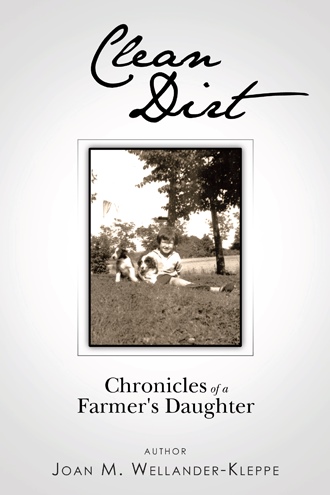
My parents were true pioneers who endured incredulous hardships as they began married life in 1908 on virgin farmland in central Wisconsin. This 138-acre parcel of land, a wedding gift from my dad’s father, had never been ‘worked’, and was accessible only via a muddy path—referred to as a ‘lane’ where even a horse-and-buggy could become mired.
The pristine land had to be cleared of boulders and trees, and stumps dynamited to make the rich soil tillable. Fences had to be built to define parcels for planting and/or grazing. Livestock, both cows and horses, had to be bought; a barn erected to house them; and machine sheds built to store the horse-drawn equipment. Other buildings, such as a silo, corn crib, granary, smokehouse, blacksmithing shop, and chicken barns, also were priorities in construction—second only to a house, of course.
The barn was always first on the list because farmers considered that structure to be most important. It was the hub of dairy farm income, a facility that housed the cows whose milk represented the farmers’ livelihood. (The volume of milk was what showed up in the bank account.) It also was used to store the hay and grain to feed the cows and horses (the latter which served as transportation in those days, as well as moving machinery in the field for plowing, planting, fertilizing, cultivating, and harvesting.)
Two other factors were vital in establishing a residence for both man and beast: a source of clean drinking water which meant digging a well, and a road to travel to and from the farm, which meant digging deep into the money sock, usually in the hands of a lending institution.
In those days, a “water witch” (dowser) was sometimes called upon to ‘divine’ a source of water with the use of a tree branch wielded between the diviner’s two hands. If it forcefully bent downward, it meant an underground water source was detected. (Hearing this mysterious story as a tot, I tried it with a willow branch—with disappointing results. I found nothing, not even a mud puddle!)
As to the construction of a road, Pa was always proud that he was responsible for striking a deal with the County to build a road leading from the Federal highway (Route 41) to the farm property. The legalities of the deal elude my memory, but I know it was actuated with a handshake that validated my father’s ‘word as his bond’. That was one of the moral ethics I have lived by: what you promise, good or bad, big or small, you keep your word—or, as my mother interjected, ‘unless you’ve broken a leg, or DIED!”
Everything I needed to meet life’s challenges, I learned from my parents—a list of traits to live up to: morality, honesty, tenacity, patience, tolerance, humility, pride, a zest for life, a thirst for knowledge, common sense, and a sense of humor.
It was a ‘package deal’. And, in that package, I found an innate love of music. Although I never came close to being a serious musician performance-wise, I have enjoyed its therapeutic effect, whether I am performing or just listening. It is a God-given gift.
As to the paradoxical title “Clean Dirt”, it applies to Mother Nature’s packaging of many foods found on the farm, from the apples, purple plums, and cherries on the trees, to the chaff alighting on your hair or clothes (especially when loading hay), to the mud on your hands from planting a garden, to the elderberries, raspberries, currants, and chokecherries on bushes. Closer to the ground are strawberries, peppers, and tomatoes; in the ground are carrots, scallions, and celery—all of which I have plucked for a tasty treat with just a cleansing swipe across my apron. I have even picked red clover blossoms to suck the sweet nectar out of the tiny tubes, becoming a kind of human hummingbird.
My parents were years ahead of the times with organic produce. They used no pesticides on any of the crops in the fields or in our garden. No growth hormones were given to any of the animals shipped to market, or those for our personal use, including: geese, Mallard and Muscovy ducks, Guinea hens, and varieties of chickens. Believe me, one’s olfactory organs affirmed the use of n-a-t-u-r-a-l fertilizer. That reminds me of the old joke repeated by Walter, Lil’s husband.
He’d ask my mother, “What do you use on your strawberries?” She’d respond, “Sugar and cream”; he’d say, “I use manure.”
Formats

Book Details
About the Book
The book is a collection of non-fiction humorous and serious events in the lives of a family whose roots are traced back to the 1700's emanating in Switzerland and flourishing in the U.S.A. These families produced writers, teachers, and various contributions to the medical profession - always with music as an avocation, and they were as handsome as they were intelligent.
About the Author
The author was born and raised on a Wisconsin dairy farm, the youngest of George and Susan Steiner’s four daughters, Joan resolved at an early age to learn as much as possible about their methods in tending the livestock and crops. She was equally interested in housekeeping, beyond just setting the table, but learning the arts of cooking, baking, needlework, and etching on glass.