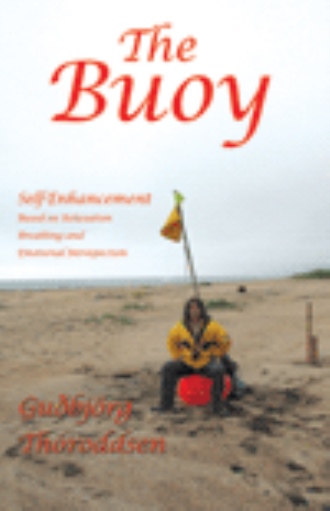
The Buoy
Self-Enhancement Based on Relaxation Breathing and Emotional Introspection
by
Book Cover & Preview Text
“Apart from problems that are biological in origin, I cannot think of a single psychological difficulty- from anxiety and depression, to fear of intimacy or of success, to alcohol or drug abuse, to underachievement at school or at work, to spouse battering or child molestation, to sexual dysfunction or emotional immaturity to suicide or crimes of violence-that is not traceable to poor self-esteem. Of all the judgements we pass, none is as important as the one we pass on ourselves. Positive self-esteem is a cardinal requirement of a fulfilling life..”
(Nathaniel Branden. How to raise your self-esteem. Page 5. Bantam books, paperback 1988)
It is my choice to start this section which is aimed at those who want to implement the easy methods of the Buoy for self-improvement, with those words of Nathaniel Branden.
I name this method „the Buoy“, because buoys show sailors a safe route, and are for them essential signs. A buoy-watch has to be manned in all weathers, and sailors need to get safely to harbor. The methods of the Buoy are signposts for everyone‘s happiness on sea or land, and that is why the name is optimal. Another reason for the naming is also that my nickname is Bauja which is Icelandic for the buoy.
The Buoy utilizes the healing powers of the body/mind, by using diaphragm breathing (relaxation breathing). In its simplicity the ways of the Buoy aim at having the individual “cure” himself on his/her own grounds. In relaxation the mind gets a reprieve to sort out, feelings situations and experiences. In this healing capacity, which is a gift to us all from nature itself, help is found for those psychological problems which are not directly caused by physical reasons.
The Buoy assumes that all people are inherently good, that love is the foundation we all build upon, and that it is natural for all to seek happiness and pleasure. The Buoy is a self-enhancement based on inner strength, on love.
The Buoy is a method which is entirely “homemade”, I have used it myself in my own reconstruction, and I know its ways from the inside. It has been useful to me, and is by now a proven method after many years of being taught in the schools. The pupils that have learned the ways of the Buoy are now several thousands. The miracles I have seen when utilizing these methods are numerous.
The Buoy places a heavy emphasis on that, that the healing process is autonomous in almost every way, and therefore made to last. Nobody should feel as if somebody is barging into their private space and bossing them around. The Buoy has the keys to the doors leading to individual houses, where each and everyone is ones own master, and maker of ones own fortune. Inside the Buoy does not reign, it only gives advice. The house owners decide for themselves, whether to use them or not! This way of thinking is the precondition for the effectiveness of the Buoy.
The method is easy, after the six steps of the Buoy, when:
We start to realize our feelings/emotions more.
We start to think objectively about feelings/emotions, i.e. we have made them palpable, and as a consequence we can throw them about, or save them away or even forget about them!
We can seek relaxation breathing; reach the control station for the way we feel.
We are conscious about our breathing whether we are breathing up into the ribcage or down into the abdomen in relaxation.
we have realized that the fundamentals are:
1. to love and honor ourselves.
2. to think positively and in a solution oriented way.
3. to travel the path of love instead of the roads of fear and refusal, then the things simply start to happen.
The healing of the body starts and a search for balance and wellbeing commences. Most people will then consciously or subconsciously start processing their emotions and feelings, and self-reconstruction starts. Subconsciously, because if we are lucky, the subconscious will handle the reconstruction and the processing for the most part, but all we have to do is to make sure that the correct tools and methods are available. The Buoy gives you the keys, but each and everyone works for him-/herself in the reconstruction.
That is why it is important that the temporal order and the methods of the Buoy are correct, and each step is as important, not least the repetition: “the smile,.. eyes,... voice,... wheel,.. veil,.. breathing.”
Usually and if everything is normal, self-assurance and wellbeing of those utilizing the methods of the Buoy will grow, but remember that each and everyone reaps as he/she sows, i.e. he will reap according to what his will, maturity and his circumstances offer at any given time.
With the constant repetitions of the Buoy, we can not avoid taking notice of how we feel and act. An education will seep in and stick somewhere in your mind even if today’s circumstances do not offer a full utilization of its methods. Anyway a solid basis in knowledge of emotions will be obtained, upon which one can always build in consequent work.
The Buoy is not a treatment; it is a method of introspection and self-work. It is a method in self-strengthening, where relaxation breathing is the main key to self-reconstructing. The peace of mind that comes with relaxation is a prerequisite of normal introspection, emotional work and self-reconstruction. I was given this key in the theatre where the actor uses this method in all his work.- I have reflected this upon our own feelings and daily life.
With the method of the Buoy, we gain the knowledge that we can control our own feelings and behavior. Once we are able to connect our feelings to how we breathe, and we know that our control centre is in our own abdomen in relaxation, and that we are not controlled by someone else, we start to gain strength!
Once we are reasonably capable of introspection and to process our own feelings, we will be able to pass difficulties and personal disasters more easily, and we have a better chance of emotional development.
Upon a traumatic incident our self-image can break, skew and weaken. It is important to know ways to re-build oneself, so that we will be able to participate in life again in a healthy way. Our self-image has to be solid, for it to be used as the strength it is supposed to be. Emotional work and introspection should be a natural part in all upbringings of our children.
The solution to our problems would then not be to run away into dangerous behavior and addiction. Into drinking, drugs, violence, eating disorder, religious fanatic-ism or that in our despair we think that suicide is the only way out.
It is a known fact that a person with a broken or skewed self-image is most susceptible to danger-seeking activities or suicide. We need to know that we make our own reality with our own feelings and behavior. The defense of the person, who has a frail self-esteem, can be strong and well hidden by the intricate masks of discomfort. Even we ourselves can have a hard time seeing our own defense, and to break through it. In that case we have closed our feelings in, instead of processing them. We have locked them in, deep inside ourselves. That gives rise to the danger of psychological illnesses like depression and anxiety disorder. A false self-assurance can be made out of a combination of, or distinguished by any “difficult” feeling, like anger, sadness, anxiety, guilt, manipulativeness, and feeling of rejection or even all of them.
We need to be able to sense our own and others behavior feel the subtext, i.e. the underlying feelings behind a given behavior or feelings.
Formats

Book Details
About the Book
The Buoy assumes that deep down everybody is good, and that all people draw upon a foundation of love for inner strength. The Buoy, therefore, is self-enhancement based on love.
Its purpose is to promote self-enhancement and self-knowledge, which are two of the most precious conditions anyone can attain. In order to achieve happiness, you need to first love, know, and honor yourself.
IN THIS BOOK, YOU’LL LEARN HOW TO:
- Control your emotions and behavior
- Use relaxation breathing and emotional processing to become stronger
- Discover the emotions that drive your feelings
- Solve your troubles instead of getting stuck
- Compare your experiences with others
- And much more!
About the Author
Guðbjörg Thóroddsen graduated from Icelandic Actors College, and worked as a stage actor. She received a teacher’s license from Icelandic Teachers College. Using the methods she describes in The Buoy, she helps social workers, educational professionals, troubled youth and others solve problems in a successful way. She resides in Iceland.