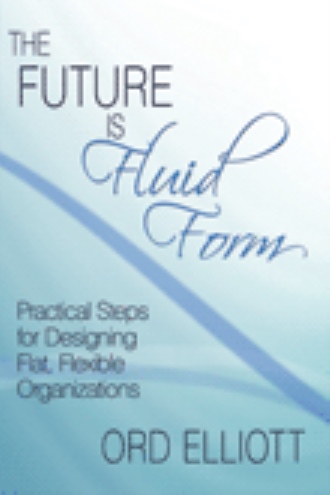
The Future is Fluid Form
Practical Steps for Designing Flat, Flexible Organizations
by
Book Cover & Preview Text
During the eighteenth century the Comanche—a Native American tribe of exceptional warriors and horsemen—became a dominant and powerful force in the Southern Plains. In terms of political and social organization, the Comanche did not operate within a hierarchical structure of command and control like most other tribes. Instead, they worked together assuming fluid roles in order to operate most efficiently. While individuals selected chiefs to guide them, no individual was obliged to accept tribal decisions. An individual merely adapted to his or her necessary role. As one historian wrote:
They selected leaders for war, though the authority of the war chief never extended beyond the war trail. Here the man rarely sought the office; the office sought the man, usually some intelligent, experienced, or lucky warrior … Hunter warriors cooperated like a pack of wolves, running behind a crafty leader. But failure, or even pure bad luck, quickly destroyed any war chief’s prestige and authority, and war leaders rose and fell continually … Each band had its own civil chief, almost always a powerful family head who had exhibited courage and wisdom in the hunt and in war … again, the office found the man. (From Comanches: The Destruction of a People by T. R. Fehrenbach, copyright © 1974 Used by permission of Alfred A. Knopf, a division of Random House, Inc.)
That was their culture. Consequently, the Comanche evolved into one of the most fierce and competitive tribes in North America, completely dominating the Texas plains. The successful philosophy that the Comanche utilized is a concept that is integral to revamping your business or organization—it is a concept that I call Fluid Form.
I want to show you how to guide your organization to be as fluid as the Comanche. I will teach you how to be a warrior, how to break out of command-and-control thinking, and how to dominate your marketplace like the Comanche ruled the plains.
How do you get the most out of your organization? How do you maximize productivity with the employees you have? How do you improve performance, effectiveness, and results?
The old approach—hierarchical command-and-control—doesn’t work any longer. For two decades, consultants have sought to create change in organizations through building cross-functional projects and processes under banners such as TQM, Process Re-engineering, and Six Sigma. It’s not that these approaches fail to garner results. It’s just that they aren’t successful enough.
The “old school” approach to cross-functionality symbolized by these methods often creates more turmoil than success. They don’t get the results people are looking for. People are disappointed in these approaches, and they don’t participate. Or they participate at different levels, so that an organization doesn’t get a critical mass of focus required in order to achieve the desired result.
Ultimately, if you’re a manager, the bottom line is your own success as it reflects the company’s success. When you’re in charge of an operation, an organization, or a unit—or even if you’re a consultant trying to help them improve—if the organization doesn’t produce great results, then you aren’t successful, either. In a competitive environment like this, companies cannot simply struggle along at a survival level. Instead, they don’t survive. The competition defeats them. Why? Because they didn’t get the product out in time. They missed the market window. They weren’t able to get the sustained commitment from all relevant parties in order to streamline processes and keep the organization competitive.
So how do you create an organization that is less bureaucratic, that gets more work done in a productive manner—that gets the results you want? The answer is Fluid Form.
To describe Fluid Form most simply, it’s the right people in the right place at the right time. The key benefits of Fluid Form are as follows:
- Creates robust cross-functional teams and reduces silos;
- Flattens organizations;
- Gets more accomplished by fewer people in less time; and
- Provides more flexibility in an enterprise.
Formats

Book Details
About the Book
Has your enterprise tried everything from Total Quality Management to Process Reengineering and Six Sigma, only to remain chained by functional silos and command-and-control hierarchy? Are you ready to put frustration and bureaucracy in the rearview mirror? In The Future is Fluid Form, author Ord Elliott discusses eight steps to building a more effective organization that breaks through the bureaucracy.
The fluid form organizational method relies on having the right people in the right place at the right time. It unlocks productivity, freedom, and high performance by removing the anchors that keep your enterprise from maximizing its investment in people and technology. It:
- Creates robust cross-functional teams and reduces silos
- Flattens organizations
- Gets more accomplished by fewer people in less time
- Provides more flexibility in an enterprise
About the Author
Ord Elliott has four decades of experience as an internal and external management consultant for companies such as Procter and Gamble, General Electric, Allied Signal, Shell Oil, Pacific Gas and Electric, Intel, Philips, Cisco Systems, and numerous Silicon Valley start-ups. Visit him online at www.TheFutureIsFluidForm.com.