
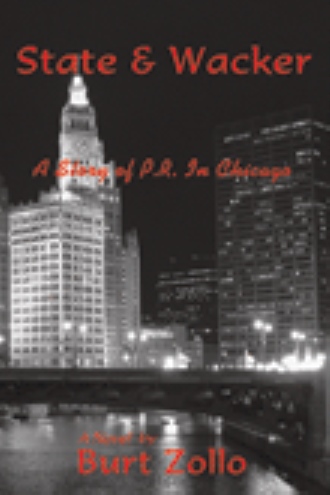
State & Wacker
A Story of P.R. In Chicago
by
Book Cover & Preview Text
Chapter 1 “You OK, Billy?” PR man Lyle Kopp knocked on the door of the guest bathroom of the Presidential Suite of Chicago’s stately Blackstone hotel. The star of his publicity stunt to announce the World Series of Pool, Billy Mastroni, was getting into his tuxedo. He’d been dressing for 25 minutes. “Any minute,” Mastroni said. Kopp roamed around the huge suite. It was a bonus he obtained free—for one week—from his friend, Bill Burns, the hotel’s long-time manager. In return, Kopp named the Blackstone the World Series’ official hotel. When Mastroni finally emerged, Kopp was not disappointed. Mastroni was dressed exactly as the punctilious PR man prescribed. A freshly pressed tuxedo. The familiar Mastroni red bow tie (available at selected department stores). A starched white shirt. Highly polished, black Italian-made shoes. “I timed you,” Kopp said. “You set a new world’s record. It took you 29 minutes to dress.” “So?” Mastroni said. “You’ll knock ‘em dead,” Kopp said. “Sounds good to me,” Mastroni said, automatically delivering his favorite one-liner, staring at Kopp. “I hear you split from your wife.” Kopp knew Billy liked to banter. “You heard right,” Kopp said. “I heard what she said,” Billy continued, “about you know what. I didn’t let it pass. I said it was a phony charge. I don’t let my friends get mugged.” Kopp said, “You’re a good friend.” Kopp believed seventy-five-year-old Billy Mastroni looked little different than when his skills at pool tables across the country amazed and amused the sport’s aficionados. They ranged from barnstorming professionals to homeowners whose pool tables graced recreation rooms and basements. Although he no longer competed in tournaments, Kopp knew Mastroni remained the smallest body and biggest name in the world of pool. As Kopp wrote in his handouts, Mastroni won every major pool tournament more times than any competitor. “I arranged for your movies to be shown during the World Series,” Kopp said. Billy asked, “Including the one that won the Academy Award?” “They’ll be playing all week,” Kopp said, “with plugs for the World Series.” “Your uncle going to be here?” Mastroni asked. “He wouldn’t miss it,” Kopp said. “It’s still his baby. He conceived and dubbed it nine years ago—only now he’s doing what he always wanted to do.” “Running your opera company,” Mastroni said. From his earliest days at Nettlehorst Grammar School, Lyle Kopp knew his legendary uncle, Raymond Kopp, Chicago’s best press agent, always had been an opera addict. Lyle was the first person his uncle telephoned when he was named executive director of the Chicago City Opera. He immediately bestowed on his nephew—who worked for him after he graduated from Northwestern’s Medill School of Journalism—his agency and its ten retainer accounts who, with his uncle’s blessing, was bought out by George Humphrey & Associates, Chicago’s largest PR firm. Lyle returned the favor: he immediately bestowed on his uncle the check he received from George Humphrey. Lyle still was amazed his uncle easily relinquished what he’d worked all his life to achieve: a thriving PR firm. Only his uncle called his enterprise a “publicity shop.” While he thought “public relations” was descriptive, he feared it might be considered deceptive, not as humble as he preferred. He didn’t resent the variety of names his practice had achieved; he simply didn’t want to appear, as he explained, “too grand.” He said, “Publicity is what I do. I don’t know about the other so-called PR firms.” BCA, the Billiard Congress of America, the sport’s ruling body, sponsor of the World Series of Pool, was Lyle Kopp’s highest-paying client. As senior vice president of George Humphrey & Associates, he was supervisor of those ten accounts, boss of three service executives, one full-time writer, four secretaries. During the World Series, he was hands-on, full throttle, available 24-hours-a-day. Since his divorce, Kopp’s life became his children and his work: public relations, PR, which he thought the most maligned, least understood creative practice. At its best, he thought, PR changed people’s minds; at its worst, PR bred suspicion. Today, Kopp was focused solely on his publicity stunt, held the day before the start of the weeklong World Series, to herald pool’s #1 annual attraction. The stunt’s site was the east side of Chicago’s Michigan Avenue on a large and shadowed plaza next to the ornate, Gothic-like Tribune Tower at its north end, the Mies-inspired United of America building at the other end. Reporters and photographers from the dailies and wire and feature services plus writers and camera people from Chicago radio and TV stations were in full force. Kopp watched Mastroni wave to a few old-timers in the gathering crowd. With the same edgy, cock-of-the-walk swagger that kept his idol, Frank Sinatra, popular, Mastroni approached the antique Brunswick pool table Kopp had placed in the plaza’s center, with due consideration given photographers who would be shooting under the bright June sun. Behind the pool table was a large banner announcing the 1962 World Series of Pool including a list of past champions who would compete or, like Mastroni, hold master classes, a recent Lyle Kopp innovation. He studied Mastroni, who—slowly, carefully, with his own strange grimaces, blinks and shoulder hitches, now known as Mastroni gestures— spotted balls on various parts of the table’s green felt surface for one of his favorite and most photogenic tricks. As he prepared to bend his short, narrow body over the table, sighting the cue ball, bringing his signature stick back, a noisy, magnetic commotion erupted at the east end of the plaza. It pulled most of the crowd and media away from Kopp’s staged happening. He waited for gunfire. All he could think of was unexpected violence, an attempted assassination of some local bigwig who wandered towards the crowd and was attacked by a crazed gunman. Since President Kennedy’s assassination three months ago, anything was possible. What else could wreck Kopp’s meticulously planned production? He saw client and old friend Jack Banks, the pragmatic and caustic executive director of the BCA, standing where the now-departed TV crews had been prepared to shoot. Kopp called to Banks, “keep Mastroni here. I’ll get the press. Tell Mastroni we’ll take him to lunch. Tell him we’ll buy him all the Wrigley Building martinis he can drink if he sticks around.” Kopp followed the dashing press across the plaza. He knifed his way through the jovial crowd. He heard the beat of a drum and the call of a clarinet—or was it an oboe?—suggesting wild dances with filmy veils over naked breasts. No wonder the laughter, the growing excitement, the burlesque-like calls coming from the mostly male audience. Swirling on a covered stool, rolling her hips in gross imitation of the belly dancer she wasn’t, was mostly uncovered, heavily made up Mable Brensky, wearing a revealing Egyptian costume, smiling, enjoying the lascivious encouragement she was receiving. Behind her and the two musicians was a banner announcing, “Just opened—Little Egypt Restaurant,” with a Rush street address. Kopp knew the stomach-roller as one of Chicago’s most immodest models, a voluptuous exhibitionist who loved to expose her fabulous body. She caught Kopp’s eye; she winked. Over the years, he’d hired her to do a variety of assignments, from a conventional, out-of-the cake explosion to a stag-party gig. Then it hit him. He understood even if she didn’t. Brensky was part of a stunt that hitchhiked on Kopp’s stunt, probably devised by Larry Sideman—called “Lucky Larry” by the targeted and the envious who refused to admit Sideman’s dirty tricks displayed a s
Formats

Book Details
About the Book
In this remarkable second novel by Burt Zollo, we meet Lyle Kopp, a public relations man in Chicago during the Sixties. P.R., at this time, is still a relatively new, undefined profession, and Kopp is one of the pioneers in shaping the public perception of P.R., which is, after all, all about shaping public perceptions. Kopp’s world is one of publicity stunts, politics, romance, family, ambition, and friendships real and forced. It’s a story of a profession never before explored so intimately and insightfully in fiction, and the story of a family man, who balances a home life in suburbia with a work life in the city.
State & Wacker is also very much the story of Chicago, which happens to be Zollo’s hometown. His Kopp is a savvy guy, balancing the art and science of his growing field, while struggling with the awareness of the power of persuading public opinion on behalf of his clients. Even the name “Public relations” is not free from his scrutiny, and this level of consideration gives this novel its depth: “While he thought `public relations’ was descriptive,” Zollo writes, “he feared it might be considered deceptive, not as humble as he preferred. He didn’t resent the variety of names his practice had achieved; he simply didn’t want to appear, as he explained, `too grand.’” Public relations, Kopp felt, was “the most maligned, least understood creative practice. At its best, he thought, P.R. changed people’s minds; at its worst, P.R. bred suspicion.” Walking that line between being influential and manipulative is where this novel lives.
About the Author
Burt Zollo is the author of the acclaimed novel of World War II, Prisoners (Academy Chicago Publishers), a true story based on his experience as part of the U.S. Army overhead cadre at a POW camp near Le Mans, France. His first book, The Dollars & Sense of Public Relations (McGraw Hill), is considered by many as one of the most authoritative books ever written on the subject and has been adopted as a textbook by numerous colleges and universities. Zollo is been a prolific writer of fiction and non-fiction, contributing articles, essays and short stories to magazines and journals, including Playboy for which he served as one of the original writers. He enjoyed an illustrious career in public relations, first serving as director of public relations for Esquire and Coronet magazines and Coronet Films. Zollo spent the bulk of his P.R.career as a partner in the Public Relations Board and President of Public Relations Network/International and Public Relations Sports Network. A Chicago native, Zollo is a graduate of the Medill School of Journalism at Northwestern University. The grandfather of seven and father of three, he lives in the Chicago area with his wife.