
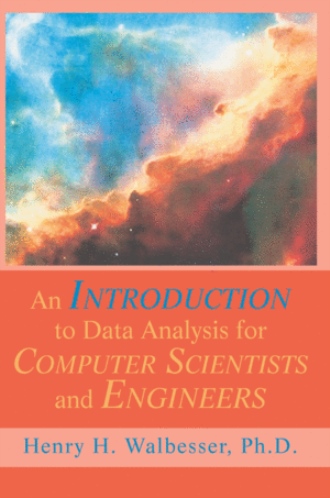
An Introduction to Data Analysis for Computer Scientists and Engineers
by
Book Cover & Preview Text
Formats

Book Details
About the Book
New graphical forms such as the star, weathervane, facial, and anatomical glyphs as well as an Andrews plot, the Tukey line, and the box plot with whiskers are included. Data density and lie factor algorithms are developed for the examination of graphical displays. New tabular forms are developed including the extended five number summary table and the stem and leaf table.
Appropriate conditions for selecting among the arithmetic, harmonic, geometric, trimmed, and Winsorized means as well as the median and broadened median. Measures of dispersion are developed as companions to the measures of location including a standard deviation for the median. Curve fitting models are examined for both monotonic and non-monotonic data sets with the goal of minimizing the magnitude of the residuals.
The analysis of variance for studies with unequal sample sizes in the treatment levels is developed as well as the analysis of variance for repeated subjects studies. Algorithms for testing the homogeneity of variance and the linearity of regression are illustrated as part of the development of the analysis of covariance.
About the Author
Dr. Walbesser is currently a professor of computer science at Baylor University. His area of specialization is data analysis in univariate and multivariate environments that occur in human computer interaction studies. Most of his 44-year career was spent at the University of Maryland.