
Betsy Boerhave's Diary
by
Book Cover & Preview Text
Formats

Book Details
About the Book
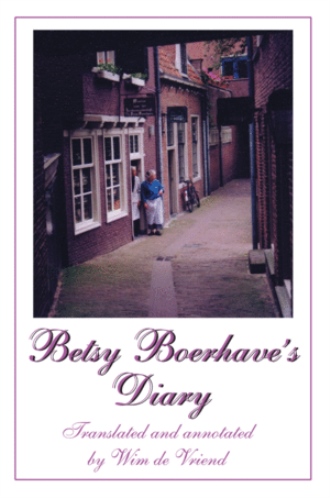
Duck through a gate and into a little alley in the center of the ancient Dutch city of Utrecht, and you will come to the tiniest grocery store you've ever seen-a grocery museum, actually. During renovations in 1974, a workman found a rusty tin can with some old papers under the shop floor.
It was reported that the tin can contained diaries kept by Elizabeth (Betsy) Boerhave, the shop's owner, from 1874 until 1891. The Museum Board published the diaries, with considerable success. Now, almost thirty years later, Betsy Boerhave's Diary has been translated for the American reader.
The address of Betsy's shop is Hoogt 6, Utrecht.
Literally, Hoogt means "height" or "high place."
For ease of reading, many names of people and streets in the diary have been translated into English, but it was thought that maintaining the Hoogt 6 address would make it easier to find Betsy's little shop. No doubt, many readers visiting the Netherlands will want to see it, and while in Utrecht, they may want to visit other nearby locations such as the picturesque village of Breukelen, where Betsy's "little cheese farmer" lived.
About the Author
In 1874, when her diary starts, Betsy Boerhave is 35. She and her husband Willem Boerhave (41) live in the center of the ancient Dutch city of Utrecht, where they run a small grocery store. Their six children range from Annie (16), extremely interested in a boy from the neighborhood, to Swannie, the baby (6). Betsy?s diary ends in 1891, after her youngest has married and moved away. We have learned that Betsy Boerhave was a bright, opinionated and good-looking lady (she broke a few hearts along the way); she eloped at 18, she dearly loved her family and worked very hard; she was practical, charitable, pious, and not averse to a few jokes. We have met many real, interesting people. We have experienced joy, tragedy, faith, love, and fun. Many of the stories are surprising; many of Betsy?s comments on life ring as true today as they did then. And when her diaries come to an end she has developed into an accomplished writer. Born in 1941, Wim de Vriend spent the first half of his life in the Netherlands, the second half in the United States. He has studied and translated from seven languages, although he admits most of that knowledge is of little use in America. He has been a freelance writer and photographer, a researcher, advertising executive, government planner, executive chef and restaurant owner. He has written extensively about small-town politics, about failed economic development schemes, and about modern witch hunts. While visiting his family in the Netherlands he discovered Betsy?s diaries, which had been published some twenty years before, by the foundation that manages Betsy?s little store as a museum. Enchanted by the diary and by the illustrations, apparently done by one of Betsy?s granddaughters, he decided to make the work available to English-speaking readers.