
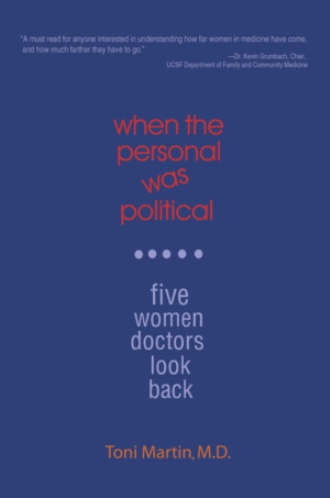
WHEN THE PERSONAL WAS POLITICAL
Five Women Doctors Look Back
by
Book Cover & Preview Text
INTRODUCTION When I joined the freshman class at the University of California at San Francisco School of Medicine in 1973, I was surprised and delighted to learn that we women had captured 40 of the 146 spots in the class. At the time, this number was a record for UCSF and represented one of the highest percentages of women medical students in the country. In the year 2006, UCSF is still in the forefront of female admissions, with 60 percent women in the entering class, compared to 50 percent nationwide. According to the American Medical Association, 27 percent of physicians today are women, compared to 8 percent in 1970. Our class also had ten percent minorities and an average age of twenty-six, very old in those days when most students started their medical studies right after college. Some of our older students were returning Vietnam medics and Peace Corps volunteers. The darker, older, female students were lumped together under the heading “non-traditional” students. We represented the aftershock of three political earthquakes: the civil rights movement, the feminist movement and the Vietnam War. Even those among us who had not marched or protested and yearned to shed the “nontraditional” label knew that our presence in that class was related to forces beyond our individual endeavors. We shared a new collective consciousness. Several years ago, I returned to my alma mater, on the volunteer clinical faculty. For a few hours each month, I served as a facilitator for a small group of students in the introductory clinical course, Foundations of Patient Care. I met with the same six medical students from their first week of school to the end of the second year. One of the explicit purposes of the group was to allow for the kind of emotional processing of experience that was discouraged when I was in medical school. The women students in my groups were at ease, lounging in class. No one had told them that they didn’t belong there. They offered their opinions freely. They were not afraid that their “feminine” side would count against them. Neither were the men. When I began to teach, I realized that my classmates and I are part of a unique generation of women doctors, sandwiched between the individual women pioneers and the women students of today who grew up with mothers in professional roles other than teaching or nursing. The pioneers were the scouts in the field of medicine and we were the landing party. This is the story of how we established our beachhead and held on. We could never let down our guard, because we knew we were seen as an invading force. Today women students travel to medical school unarmed, on a passport of achievement, just like the men. In the 1960s, when each medical school class had only a handful of women, the strategy was to be “one of the boys.” Frances Conley, the Stanford neurosurgeon who wrote Walking Out on the Boys¬ trained a decade before I did. She was typical of her era. She did not identify with other women (there weren’t any in neurosurgery, anyway). In order to survive, she convinced herself that she was just like a man. She writes, “While I was friendly with my female classmates, we never formed true collegial relationships. We never learned to work together and support each other. I have maintained no contact with them outside of class reunions. Through subtle, unconscious social pressure, it seemed more important to be regarded as ‘one of the boys’ than to be seen running around with a bunch of women.” By and large, women of my generation did not want to be stereotyped by gender either. We did not view the difficulties of medical training through a pink lens. Yet as daughters of the women’s movement, we understood from the beginning that gender could not be ignored. We took for granted that we would work together and we enjoyed the company of other women. We bonded like war buddies under the stress of medical school. Like Conley, we were intent on proving how tough we were, that we could make it in the man’s world of medicine. Unlike Conley, who chose not to have children, we hoped to combine the roles of mother and doctor. Perhaps because there were so many of us, we did not think of ourselves as different from other women our age. Yes, we wanted to be doctors, but as feminists we wanted everything the men had, including the families. We agreed with the author Anne Roiphe: “Feminists want good families, too. They don’t want to live in dry dead places where the held hand, the shared joke, the unexpected touch never occurs.” In our youth, we did not have the imagination or the temerity to transform the workplace, only the will to persevere. We felt on probation, despite our greater numbers. Our job was to fit in, no matter what. It would be almost two decades before Anita Hill would stand up in 1991 and bring sexual harassment to the nation’s attention. Our “in-between generation” was sensitized to women’s issues, but confused about what our “rights” might be. One of my former classmates commented during Hill’s testimony that recognizing sexual harassment for what it was, rather than just “the way things are,” would have been a step up for us. In San Francisco, the early seventies were a time of accelerated change. The medical school class before us had pressured the administration to adopt a pass-fail system by refusing to sign their names on tests. In the street, it was the height of the sexual revolution, and the wild gay bath scene set the standard for sexual self-expression. In politics, many of us endorsed “revolutionary” rhetoric and believed that we needed to develop skills to serve the community. When we closeted ourselves for intensive study, we assumed that the world of our college years, protests and free love and experiments in communal living, would be waiting for us when we emerged. We were wrong. By the end of our training, Reagan was president, rumors of a sexually-transmitted plague were widespread, and the MBA was the degree of the hour. Lifestyle sections in the newspapers featured women who had chosen to stay home to raise their children. The backlash to feminism had begun. Then, to our surprise, we turned out to be “women doctors.” A “woman doctor” is a fine and honorable thing, but it is not the same as “a doctor.” Sir William Osler, the Canadian physician who pioneered the system of bedside clinical teaching at the turn of the twentieth century, used to tease his women students by saying, “Humankind might be divided into three groups—men, women, and women physicians.” A hundred years later, we are still a distinct species. Well-meaning patients have asked me, “What do you want to be called?” as though there is a separate “Ms. Doctor” title for me. Historically, organized medicine in the U.S. excluded women, first from medical schools (many nineteenth-century women trained in Europe) and later from internships and residencies. In 1925, three-quarters of residencies approved by the American Medical Association would not consider women applicants. Without hospital training, women could not obtain the hospital privileges necessary for private practice. So women doctors founded public dispensaries for the care of women and children. Most women in medicine stayed on a separate, more public health–oriented track and did not threaten the higher-earning men. Although the feminist movement provided the impetus for the women in our class to apply to medical school, and on some level, we assumed that a larger presence of women in medicine would lead to a more collaborative model for doctor-patient communication, we did not seek a separate female track. Our goal was a profession where the gender of the provider did not matter, and all doctors treated all people with respect. We did not consider ourselves particularly “nurturing” just because we were women, and no one else did either. In fact, our ambition was considered “masculine.”
Formats

Book Details
About the Book
When the Personal was Political is the first social history of the post-feminist generation of women doctors, told through the story of five women who met in the freshman class of UCSF medical school in 1973, formed a study group for mutual support, and maintained their friendships for thirty years, weathering motherhood and managed care. Feminism opened the door, and they walked through, clueless but committed. They were a unique group, sandwiched between the individual women pioneers of previous decades who were proud to "think like men" and the women students of today who take access to professional school for granted. The pioneers were the scouts in the male-dominated profession; this generation was the landing party. The book raises the question, "What does it mean to be a 'woman doctor' if 'a doctor' is a man?" Despite the greater numbers of women in medicine today, women medical students still face choices (pediatrics or surgery?) where gender matters. Dr. Martin's thoughtful analysis combines an insider perspective and a lively writing style.
About the Author
Dr. Toni Martin, a board certified internist and author of How To Survive Medical School, has practiced medicine in Oakland and Berkeley for over 25 years. Her medical essays have appeared in the East Bay Express, Hippocrates Magazine, Health Affairs and The Threepenny Review.