
The School Of The Lambs
The Dark Sayings Of The Wise
by
Book Cover & Preview Text
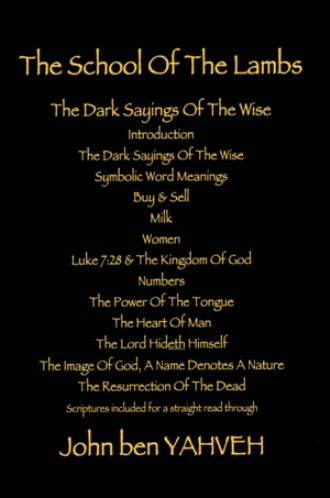
Introduction With this book I have thought long and hard how I should write this introduction. There have been millions of books written about the bible and Christ. This book is to investigate the depths of the word of God and Jesus Christ. The man around whose birth our calendar’s based upon. Jesus never traveled very far from where he was born, he never wrote a book, yet his thoughts and sayings were so profound that they changed the fabric of western civilization. The bible, a book that has a lot of symbolism and metaphors some of it is enigmatic and creates as many questions as it answers. It is often vague inviting the reader to look deeper. Often one setting of scripture can have several implications. The bible is open to interpretation due to the way it is written in parables and proverbs, speaking differently to each individual. Due to it’s symbolic and metaphoric language it has spawned many different belief systems and versions of Judaism and Christianity. In light of the problems in the Mid-east I believe the bible has a real relevance for today. Especially in light of the Jewish persecution that has happened though out history and the hatred the nation of Israel receives from many different nations today makes the bible very believable. The people of Israel play the major role in all events in the bible. In this book I categorize many things for you. I’m going to list some possible meanings of some symbolic words in the bible, being mindful of this symbolism offers a better understanding of the mystical prophetic books of Revelation, Isaiah, Ezekiel, Daniel, and Zechariah. This is primarily a book of bible studies. In each lesson, I have in italics the prevailing theme I’m trying to convey. If you read just the italics, it would give you a shorthand preview. Often times I will give no commentary on every scripture because it speaks for itself, yet try to follow ‘the thread’ I’m weaving. Here’s my disclaimer; I am a layman and I am not affiliated with any church or religious organization or any schools. The ‘School of the Lambs’ is a product of my imagination. It is not an organization, or an institute. Should someone say ‘it’s here or there’ don’t believe it. The School of the Lambs exists only in this book. The two bible teachers I learned under have both died, each had his own church both were leader/teachers of independent local assemblies, yet they did fellowship with others. I have a passion for bible study and history. I got very interested in scripture at the age of twenty and have been interested in various doctrines of different sect’s ever since. In this book I will be using the King James Version of the bible. All is debatable. None of these ideas are written in stone. These are my personal beliefs, my testimony of Jesus Christ. I have no academic credentials nor is this an academic document. I am a nobody and I rather like being a nobody therefore I’m writing in pseudonym. The reason I chose such a bold pen name, John ben YAHVEH is because I believe everyone who seeks the truth and Spirit of God are the sons and daughters of God. The School of the Prophets: My book is to show a method of biblical study that developed in a bible school called ‘The School of the Prophets’. It began in Topeka, Kansas in 1901. The school’s premise was that you could only use the Bible to interpret the bible, that the bible is its own dictionary. They began ‘comparing scripture to scripture.’ To find as many scriptures pertaining to one subject and then come to some conclusions. I’ve had the privilege of studying under two independent teachers that had been influenced by this ‘School of the Prophets’. The Threshing Floor: The ‘Threshing Floor’ was developed in the School of the Prophets. The threshing floor is a debate forum, where anyone could bring a doctrine or biblical belief but had to have scriptures to defend their position. If someone could disprove the theory it was rejected. Everyone had to speak ‘subject to question’. They debated the word of God with the desire of achieving a deeper understanding of what difficult text meant. In a natural context a threshing floor is a place where wheat is threshed, separating the wheat grain from the stock, usually by walking on it. A threshing floor is usually in a ‘windy’ place where the workers would then put wheat in a sheet and throw it up in the air and allow the wind to blow away the lighter chaff away allowing the heavier wheat to fall back into the sheet. This is ‘a type’ or a similitude of what the teachers and students where doing in the School of the Prophets. Discussing and debating the things in the word of God, throwing ideas and revelations ‘into the wind’ and seeing what had enough substance to fall back into the sheet. The ‘style’ of study I have learned is ‘to rightly divide the word of truth’. 2 Timothy 2:15 Study to shew thyself approved unto God, a workman that needeth not to be ashamed, rightly dividing the word of truth. This style of study, rightly dividing the word of truth is to search the bible by subject, word comparison, passages that are similar, interpretation of parables, proverbs and similitude. To compare strands of scripture that are similar to one another. This type of bible study is puzzle like; this style of study takes a lot of seeking, comparing and contemplating. Good bible software makes this easy and fun. In the book ‘The Small Sects of America’ by Elmer T. Clark, he writes about the School of the Prophets ‘ with its headquarters at Louisville, Kentucky, claims as many as five hundred churches. These feature somewhat unique services. A member propounds a doctrine and changeling any members to ‘cross’ him, thus opening a free-for-all discussion which may continue for hours.’1 In a way the School of the Prophets were doing what the Rabbis in the Jewish Talmud did. Jacob Neusner writes in his foreword in Abraham Cohen’s book ‘Everyman’s Talmud’ ‘The Talmud is open-ended and invites you in for discussion. The main trait of the Talmud is its argumentative character, its argument, back and forth.’2 This process of scriptural ‘threshing’ in the style of the School of the Prophets has been practiced in many different independent churches in the USA for over one hundred years and it has produced some impressive biblical understandings. Those, whose doctrine has been on the ‘threshing floor’ in a sense, have mingled their wine. Wine, meaning doctrine. Proverbs 9:1 Wisdom hath builded her house, she hath hewn out her seven pillars: 2 She hath killed her beasts; she hath mingled her wine; she hath also furnished her table. ‘Wisdom’ hath mingled her ‘wine’. How? By being ‘in the multitude of counselors’ where there is safety as seen in our next scripture. Proverbs 11:14 Where no counsel is, the people fall: but in the multitude of counsellors there is safety. Where no counsel is the people fall! Listening to the belief’s and ideas of others (within the Judaic-Christian traditions & scholarship) is needful to have ‘mingled wine’. I as a Christian study rabbinic Literature, much is over my head but there are many good books for the general reader. Jewish biblical scholarship is of course superb. This being ‘in the multitude of ‘counselors’, is a safety net from falling into the ‘make no sense rules’ that is typical of fundamentalism. One of fundamentalism’s traits is they make things that are trivial to the average person, such as dress standards, observance of certain days and rituals to be a matter of morals or ethics. Thus these things become their own private interpretation. It tends to isolate them from normal society. They become overtly judgmental of others, this can breed intolerance and lack of compassion. Private interpretation is a big no-no in the bible, we must listen to the opinions and interpretations of others then form our own opinions according to knowledge. 2 Peter 1:20 Knowing this first, that no prophecy of the scripture is
Formats

Book Details
About the Book
ben YAHVEH’s book demonstrates a method of Biblical study which involves word study and comparison of similar strands of scripture. He also gives demonstrations of how to do subject studies. The author’s contention being that the bible is it’s own dictionary. ben YAHVEH’s concept of ‘ wisdom hath mingled her wine’ captures the full essence of the wisdom seeker. The book gives twelve short, concise bible lessons that have stunning depth. Subject Studies: 1. The Dark Sayings Of The Wise 2. Symbolic Word Meanings 3. Buy & Sell 4. Milk 5. Women 6. Luke 7:28 & The Kingdom of God 7. Numbers 8. The Power Of The Tongue 9. The Heart Of Man 10. The Lord Hideth Himself 11. The Image Of God, A Name Denotes A Nature 12. The Resurrection Of The Dead
About the Author
John ben YAHVEH is a pseudonym, the author has been a student of the bible for 33years. He was fortunate in that he had two elderly biblical scholars to mentor him for fifteen years. ben YAHVEH has written eight hundred and eighty bible lessons. This book gives twelve samples.