An Anatomy of Skepticism
by
Book Cover & Preview Text
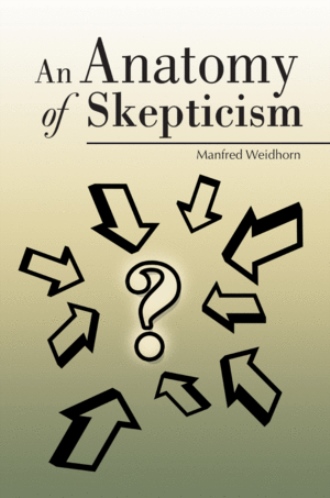
I V – Skepticism Is Not Atheism An important clarification of skepticism needs to be made. Often associated with hostility to religion, skepticism is seen as one of two sides in the modern culture war. That is, strictly speaking, incorrect. The polar opposite of monotheism is atheism, not skepticism. Believers attribute everything to an omnipotent, omniscient God, while the atheists deny the existence of such a God. In common parlance the atheist view is called “skeptical” because it evinces doubt about the traditional view. In point of fact, true skepticism represents a third school of thought, which holds that one is unable to decide whether or not an interventionist God exists. It is the belief that, in the absence of definitive evidence, statements about reality are mere theories and that, so far, all the evidence has indeed been tentative. The universe being extremely complex and life appearing blatantly absurd, a skeptic finds it equally dubious to believe that a God exists and that a God does not exist. She awaits further evidence. Atheists are consequently too dogmatic. Indeed, communist states mandated atheism; it is impossible to visualize a state mandating skepticism without putting itself in jeopardy. The very words “believer” and “atheist” may be misleading. While people speak of three clear categories—believer (or theist), agnostic (or skeptic), atheist—one might introduce into the discussion another category of thinker, the agnostic/atheist. Such a person (a) is normally agnostic but, when confronted with pushing believers and missionaries, turns atheist, almost out of spite; and (b) is atheist about the bizarre ethical monotheist versions of God, alleged to be omnipotent and omnibenevolent, but agnostic about the existence of some higher being whose personality and agenda are unknown but who has some creative power. To an atheist, who is an anti-religious ideologue, the skeptic’s suspension of both belief and disbelief looks cowardly or indecisive. Yet, unlike atheism, skepticism cannot by its nature be adversarial, assertive, conclusive. Skeptics cannot, by definition, be sure of their position. Instead of taking sides, skeptics prefer to observe in awe the clash between the immovable and the irresistible. That is, just as the debate over euthanasia is about the sanctity of life vs. the quality of life, so is the struggle over abortion a clash between two grand Western principles: the sanctity of life vs. individual autonomy. Skeptics have no easy answers. Like democracy as defined by Winston Churchill, skepticism, however unattractive it may seem to some, is merely less untenable than all other philosophies. That is its only claim to validity. That sense of uncertainty, of tentativeness, of tolerance, and modesty is what gives a uniqueness and, yes, beauty to true skepticism. The great controversies—body and soul, nominalist and realist, nature and nurture, conservative and liberal, God or no God—are fascinating precisely because they are controversial, meaning insoluble. Just as some people enjoy numerous viewings of a great movie or World Series game, so do skeptics enjoy going through the great arguments time and again, without expecting, pining for, or needing a resolution. * * * This book is not meant to recapitulate the ideas put forward, often eloquently, by the holy (or is it unholy?) triumvirate of Sextus, Montaigne, and Hume. Neither is it a systematic treatise on skepticism, nor a scholarly chronological survey, nor the bearer of any grand new theory. Nor is it a work of philosophy, at any rate of formal, technical philosophy. It is rather a survey of the state of knowledge in some non-scientific disciplines, and especially in the highways and byways of daily life--a survey which reveals widespread uncertainty behind the mask of certitude. The survey will periodically confront two major themes, two ways in which convictions are undermined: (a) The slipperiness of all assumptions, especially as that bears on cause-and-effect assertions; (b) the problem is not so much the non-existence of truth as the virtual impossibility of finding it (which is not as trivial a distinction as it might seem). All of the observations in it are of necessity tentative. The writer looks for answers everywhere and finds none anywhere. The book does not arise from a determination to espouse an a priori dogmatic skepticism but from an earnest quest for some sliver of certitude. It treats skepticism not as a gleeful beginning of inquiry but as an inevitable and sometimes desolating conclusion. All the chapters on religion, politics, history, psychology, and language are on what we do not and cannot know. By “psychology” I do not mean lab rats or Jungian theory but the anomalies and riddles of everyday existence--how certain universal human psychological quirks make doubt inevitable. The chapters on literature are not on literary theory (in that lair lies the dreaded monster Deconstructionism!) but on how literary works dramatize the skeptical conclusion. This book is called “an anatomy” rather than “the anatomy” because, notwithstanding the faith of monks vowed to silence, there is always more to be said. To any one individual eventually comes the moment when “the rest is silence,” but for the human species the conversation never ends.
Formats


Book Details
About the Book
Every thoughtful person must ask, "What do I know?" The two most explosive fields, religion and politics, are notably filled with strident and conflicting claims. Close analysis in clear language reveals that no one knows what he or she is talking about. Because of the challenge of unexamined assumptions, of unclear cause-and-effect relationships, and of the rarity of reliable sources, a person who wants to be open-minded cannot avoid adopting skepticism as the least embarrassing philosophy. Some discoveries made in this book:
*Reason appears to prove nothing
*Intuition is probably a delusion
*Facts are slippery
*Religious people yearn for suicide
*Why socialism cannot work
*Where conservatives screwed up badly (as they admit)
*The equation STAR+2R+R3=GPS explains the cultural history of the world
*Shakespeare was a skeptic
*Dante's curious insight into love
*Passing the Magic Johnson test
*Tom De Lay does not realize that relativism is as American as apple pie
*Hamlet, who never existed, is more real than you or I.
Here is a sample observation: "People believe in God because the Bible tells all about him, and they believe in the Bible because God wrote or inspired it. This is a classic case of the Fallacy of Circular Reasoning."
This book of thoughtful, insightful essays is beautifully written and well balanced. Neither liberal nor conservative, Manfred Weidhorn is a straight shooter who calls the truth. Anyone who loves fine writing should purchase this book. --The Queens Bar Bulletin
The author radiates infectious, provocative fun as he makes the case for skepticism….[He] rambunctiously engages… all the suffocating lint of daily life. Weidhorn is a believer in always thinking hard and openly. Skepticism is not the truth; it is merely less untenable than other philosophies purveying absolute truth. He presents a persuasive argument for “both/and” instead of “either/or.”…[He] offers a lively, thought-provoking journey,…an old-fashioned intellectual search for truth. --Kirkus Discoveries
About the Author
Manfred Weidhorn has degrees from Columbia University and the University of Wisconsin. Guterman Professor of English at Yeshiva University. Author of 13 books and nearly 100 essays. Recipient of Farrow Award for Excellence in Churchill Studies; Emmett Award for Best Essay; commendations for various other books.