
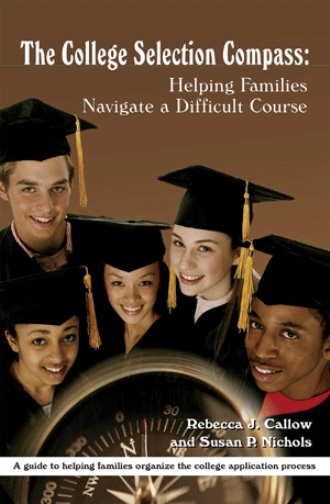
The College Selection Compass: Helping Families Navigate a Difficult Course
by
Book Cover & Preview Text
As we’ve suggested before, each time you meet, review what you have already accomplished, check on any deadlines that might be looming, and figure out what else you want to accomplish in the time you have together. If your teen hasn’t drawn up a list of potential colleges to look at (online or in person), try at least to get started on a group of potential schools. The guidance counselor may also have created a list for your teen or mentioned some choices that are worth exploring. This is an excellent time to begin taking a hard look at the kinds of schools in which your son or daughter is interested. Most students are still unsure of their future career paths, so it is certainly wise to explore several different types of schools. Remember that academics, location, size, financial aid options, and extracurricular interests should all be considered for each school on the list. Looking at a small liberal arts college in a rural area is not a good use of your time if your daughter is a devoted artist who wants to live in the city. On the other hand, a large university with huge Division I athletic programs may not be a realistic choice for your son who quarterbacks his small-town football team. Many high school athletes, even those who are recruited, try out or start to play their sport at the college they are attending only to find out that the athletic commitment is overwhelming, their athletic abilities don’t meet the coach’s expectations, they get injured, or they simply do not enjoy the team schedule or dynamics. Even with a coach’s assurance, sometimes the student-athlete doesn’t find the sport or the expectations to be what he or she has assumed they would be. An athlete must assume that college sports all too frequently take more time than high school sports. Remember that almost all athletes who play college sports do so because they are extremely skilled at them. They are probably used to starting each game and playing significant roles in team victories. It can be difficult for high school athletes to make the transition from high school sports to college competition, so do not fall into the trap of choosing a school specifically because of one coach or one sport. Counselors and coaches often use the “broken leg theory”: would you still like the college if you broke your leg and couldn’t play your sport? Keep that point in mind when looking at extracurricular programs in the colleges. You are still looking at colleges in general, so don’t let one program or coach sway your decisions yet. For the student who has a specific academic passion and skill, there are professors at many colleges who specialize in one subject or another, and matching the student and professor to academic interests is an ideal way to connect with a school. A well-known ornithologist in Ohio teaches at a small college, but he draws students from various sections of the country who spend parts of each academic year as well as the summers working on papers, field work, presentations, and grants, enriching their educations far beyond a typical classroom course. An environmentalist at one of the state schools in Oregon has pioneered some findings on climate change. Her students share her long-term vision of a more “green” America, and she’s always on the lookout for new students who are eager to study with her. It is clear that the academic piece of college applications is supremely important. Specific academic skills, interests, and passions can augment the typical college application and enrich any student’s college experience. Don’t hesitate to explore the possibility of connecting with a particular department or professor at colleges. Sit in on a class, make an appointment with a professor, or work with a special high school teacher to find the colleges that offer special academic interests and highly qualified professors. Just like coaches and advisors, professors may have an in with college admissions offices, and their support of a candidate can be surprisingly important. Teens need to celebrate their accomplishments and interests and not be afraid to establish multiple connections at any of the colleges they are considering. The relationships they cultivate during the college search process will enrich their experiences and help them make decisions when the time comes. Be sure, however, to keep your options open at this point. You don’t want to cross any types of schools off your list simply because you don’t like the name or the size; instead, you need to locate schools that will fulfill your son or daughter’s academic needs and abilities as well as other aspects particular to each individual. You can always add or delete schools from your list at any time, so don’t be shy about looking at schools that could be a good fit. This is where online searching can be a great asset. It’s impersonal enough that you won’t feel you’re asking a “stupid question” when you look for information. It is, however, an excellent way to discover things about schools, from academic achievements and school statistics to sports teams, choir schedules, and on campus clubs. You can acquire e-mails through online campus services, too, so your teen could e-mail a professor regarding a certain course of study, a coach concerning a team, or an advisor about a club. The responses your teen receives may reveal a great deal about a certain school and its personnel. Often, a college connection through e-mail will result in the coach, professor, or advisor referring you to students, assistant coaches, or teaching assistants to enrich your knowledge and bring more answers to your questions. A number of colleges now have times when you can go online and ask students there any questions that you may have. This is another way your teen can find out interesting facts about a college that he or she might not have felt comfortable asking in a large tour group or with parents present. It’s also important to remember that there are things we think are important about colleges, and there are things our teens think are important about colleges; many of those concerns may be very different, so don’t hesitate to do your own looking online. Most teens, simply because of their age, interest level, and experience, may not take as much advantage of the virtual college tour as they might. You as a parent can take the same virtual college tour and discover a plethora of information your teen may not have found. Presumably, you know much of what interests your teen, so if the school has a highly renowned math department and your daughter has finished her high school math requirements with no thought of visiting higher math, then let that part of the tour go and click to another department or course of study you think might interest her. You may also want to research graduation and transfer statistics and perhaps even new construction on campus. One of our daughters was very taken with a campus she visited, but she loves working in libraries, and this outstanding school had a surprisingly antiquated library. The college that she eventually chose has a brand new library. Now she spends many hours nestled into her favorite upstairs corner while still finding other areas that are ideal for group work. No one thing should draw a student to a campus, but parents and students alike should be sure to see the value of academic departments and extracurricular programs, and the physical buildings (including any new construction or plans) should be noted by both students and parents. Things as mundane as distances from airports, bus depots, and railway stations are amazingly easy to determine and will be helpful for all students and their families. Public transportation, via subway in city areas or shuttle buses on more rural campuses, is important for most students. Some campuses even sponsor bike programs where any student can use a specific kind and color of bike to travel from one area to another.
Formats

Book Details
About the Book
The College Selection Compass is a step-by-step guidebook designed to help parents and their teens as they begin their exploration of the often complex college world filled with major decisions, a multitude of information, and overwhelming campus visits.
Educator Rebecca Callow and college admissions coordinator Susan Nichols draw upon their professional backgrounds as they share the eye-opening results from their personal interviews with over fifteen hundred college students from forty-eight states and various ethnic backgrounds who were anxious to recount their college search experiences. Parents and their teens will not only gain insight on how to effectively plan ahead and organize the college search process, they will also benefit from tips on how to communicate openly during what can be a stressful period for everyone involved. Future college freshmen and their families will learn specifically about the:
• Various ways to research colleges
• Social and psychological issues that accompany the process
• Methods to help stay organized
• Techniques to create individual resumes and cover letters
The College Selection Compass will help ensure that future college students possess the practical tools and in-depth knowledge so that they eventually find a school that maximizes their true potential.
About the Author
Rebecca Callow began her education career at the secondary level and has worked with teenagers in coaching and advisory capacities for the last twenty-five years.
Susan Nichols has been involved in the college admissions process for over twenty years as a volunteer interviewer and local and national college admissions coordinator.