
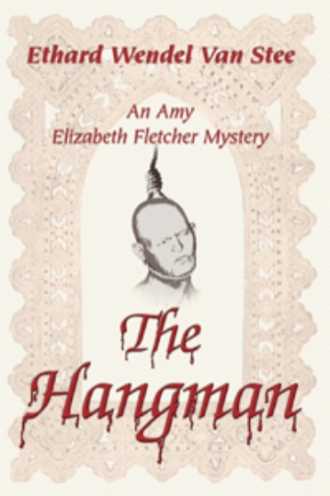
The Hangman
An Amy Elizabeth Fletcher Mystery
by
Book Cover & Preview Text
Rabbi Moses de Leon Toledo, Spain I send you greetings from Alasia de Lacy, Countess of Lincoln and Bishop Robert Grosseteste, with whose work you may be acquainted. I am Friar Roger Bacon of Lincolnshire. Word has reached this island of the discovery in Safed of certain ancient documents written in Aramaic that have come into your possession. It is my earnest desire to inspect these documents. I am fluent in many languages, including Aramaic, and would be grateful for your permission to join you in Toledo for discussions and study. Friar Roger Bacon Lincoln ~~ “Thomas,” said the friar. “In a few months I hope to set sail for Spain where I will study ancient scrolls newly discovered in the Holy Land. In my absence you shall journey to Belgium where I have enrolled you in the Ghent-Bruges School of Manuscript Illumination. I expect that we both shall return home at about the same time at which point we shall embark on the next phase of our intellectual journey.” Twenty-three weeks later Bacon journeyed to Hull. There he boarded the cog Henrik and sailed to London where he found space in a cramped cabin aboard the Portuguese merchant ship Isabella. After a total of thirty-nine days at sea he stepped onto the wharf at Lisbon. The subsequent journey overland from Lisbon to the “City of Three Cultures” took eight days. Following the rabbi’s instructions, Bacon made his way past the narrow streets of the Jewish Quarter to the Toledo School of Translators. Bacon presented his letter of introduction to the rabbi at the same moment Thomas of Lincoln presented his to the master of the Ghent-Bruges School. The master looked down at the stripling and observed, “You are young. Can you draw? The art of illumination is nothing more than the embellishment of drawing.” “Yes, sir,” said Thomas. “I can draw.” “Show me,” he said, as he offered the boy a pointed strip of lead. Thomas looked puzzled. “This is a plummet, boy,” said the master. “I have only drawn with charcoal, sir.” “Thomas, have you ever seen an illuminated manuscript?” “No, sir.” “Over there, Thomas. See that book? Open it.” The boy gingerly placed his hands on the oaken boards. “The leaves are of parchment, Thomas. The boards protect the membranes and allow the book to be handled. What you see inside is the product of this studio.” Brilliant images leapt from the pages into the boy’s imagination. Meticulously executed drawings bordered Latin script arranged in neat rows across the pages. “Drawing, Boy. It’s all about drawing. Do you read?” “A little. I have been attending school.” “Can you read the text?” “I can make out that it is from the Bible. Psalms, maybe?” “Good lad. This book is a Psalter, a book of Psalms for use in the Mass. I will teach you to be an artist and scribe,” he continued. “You will be expected to attend classes in the mornings where you will continue your education, especially reading and writing. An illuminator and scribe must be literate.” “Yes, sir,” he responded, but his thoughts were of the piece of lead. “A plummet, sir. You called this a ‘plummet’.” “Indeed. Now that you have seen the pages of the Psalter, explain to me how you would execute an illumination with a blunt stick of charcoal.” “I couldn’t, sir.” “Precisely. Go to the table by the window where you will find paper. . . . Now drag the tip of the plummet across it.” Thomas’s eyes grew wide as he inscribed a delicate gray line. “Now you know what a plummet is for. In a few weeks I will instruct you in the use of the quill and ink to transcribe the text.” ~~ The rabbi conducted Bacon to the reading room of the translators’ school. Papyri, scrolls, and codices filled floor-to-ceiling racks. The rabbi took down a box and placed it on the table. “I believe these are what you came to see,” he said. “The first of them was discovered wrapped around fish from a market in Safed. By the grace of God the purchaser was a scholar who immediately recognized their importance.” Bacon’s eyes grew intense as he scanned the smudged pages. “The scholar, our colleague Ibrahim bin Rodha, made inquiries and tracked their origin to a cave where he discovered twenty-seven folios of mystical writings in Aramaic. The language used is similar to that found in other documents from 200 to 300 A.D. Handle them with care. They are a thousand years old.” Bacon translated. And then God descended to a place where stood a tree, that there before my eyes became two and cleaved the one part to the left and the other part to the right, whereupon the blessed trees were God and Antigod. And then I saw the tree become Antigod burst forth with crimson fire. The flames licked wildly as God now bathed in pale blue light spread its branches in beatification. The tree become God rose. The tree become Antigod sank into the earth, sucked down to the netherworld screaming curses as these visions moved, one to the infinity of thou shalt and one to the dungeon of thou shalt not. Bacon motioned for the rabbi to join him. “Yours is the first hand to translate these pages, Brother Roger. What do you find?” “I grow uneasy, Rabbi. This has a Zoroastrian stink about it. The fourth folio seems to have a signature on it, perhaps that of the author. How do you read it?” “It appears to be Paul of Samosata,” he said. “I agree,” said Bacon. “The old heretic of Antioch must have translated it.” “And if Paul transcribed this, how would it have made its way to a cave in Safed?” “The route of Alexander, Rabbi. Now, in order to have survived a thousand years in the cave, the folios must have been stored in some vessel.” “That is correct, Brother Roger. The finder brought them to us in those two amphorae over there.” “Did you look for a potter’s mark?” “No, but we shall do so right now.” The two men carried an amphora to a table under good light. Barely legible black figures were painted around the circumference. On the bottom were letters that translated to ATX. “The Antiochian potter’s mark,” said Bacon.
Formats

Book Details
About the Book
"Sleuth Amy Elizabeth Fletcher, ahead of her time in forensic criminal investigation in late Victorian England, takes the reader through the minute and rich details of each fascinating case. You are not likely to forget this unique cast of characters and crimes. The author's meticulous attention to detail and his incredible knowledge of the science and day-to-day life during the era in which he writes, shine through his beautiful prose. I highly recommend!"
- Charlotte Hughes, NYT Bestselling Author of Night Kills.
About the Author
Ethard Wendel Van Stee teaches creative writing in The Learning Exchange program of the University of South Carolina Beaufort and gives special lectures on Oedipus and 5th-century Athens at the local community college. He has been director of the Beaufort Writers organization for ten years. His website address is www.ethardvanstee.com.