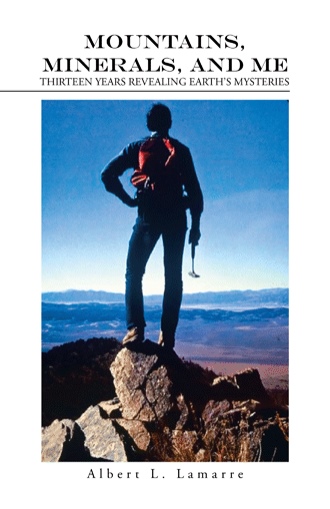
Mountains, Minerals, and Me
Thirteen Years Revealing Earth’s Mysteries
by
Book Cover & Preview Text
For the last three years I had spent about 80 percent of my time “on the road.” Even though that was a long time to be away from home, it was an enjoyable and heady time for me. Having no personal commitments back in Denver to tie me down, I was free to learn about and experience new places and people and investigate a wide variety of geologic settings. Most of the places and geologic environments were new to me, and I soaked up everything I could about them; my learning curve was incredibly steep. Being constantly bombarded by new experiences, I loved every minute of these adventures. Looking back on it, I realize I had subscribed to a philosophy summarized by Glen Heggstad in his book, One More Day Everywhere: “When it comes to adventure travel, you can’t take a wrong turn.”
I did not know it at the time, of course, but June 1976 was the start of what became the highlight of my exploration career, my first love, if you will. I began a long and wonderful association with the Thompson Creek molybdenum project about thirty miles southwest of Challis, Idaho. Cyprus Mines Corporation of Los Angeles was seeking a joint-venture partner on this molybdenum property where they had extensively explored the surface and underground. Having excavated 8,600 feet of underground mine workings on two levels and drilled numerous diamond drill holes, Cyprus had outlined 110 million tons of ore averaging 0.152 percent molybdenite. This was quite large tonnage of respectable ore grade, and we all hoped there was more ore to be found. My job was to lead an exploration program to determine if Noranda should form a partnership with Cyprus to mine the deposit. So, on June 1, I flew to Missoula, Montana, and then drove south through Montana’s beautiful Bitterroot Valley to Salmon and Challis in the rugged central Idaho mountains.
Glenn Gierczcki―a summer geology student hired by the Denver office―and I rented a cabin at Torrey’s Cabins right on the Salmon River near Clayton, Idaho, the closest community to Thompson Creek. Phil and Val Johnson, a nice older couple, were the proprietors and they enjoyed our company as much as we enjoyed theirs. Clayton was mostly just a wide spot in the road, but Challis, about thirty miles downriver with a population of around 1,200, was the ranching supply center for the area and the county seat of Custer County. Interestingly, a Custer County can also be found in five other western states. That Custer person sure got around.
Sadly, in 1983, Challis took the brunt of a magnitude 7.3 earthquake that killed a first- and second-grader as they walked to school. They were hit by debris falling from a building. The earthquake was named the Borah Peak earthquake because its epicenter was near this 12,662-foot peak in the nearby Lost River Range. After the earthquake the peak was about eight inches taller than it had been. This earthquake was the strongest ever felt in that state, and sidewalks in faraway Boise could be seen rippling during the event. For those interested in seeing vivid examples of geologic features, the twenty-one-mile-long fault scarp created by the rupture is clearly visible along Highway 93 at the base of the Lost River Range. This impressive fault scarp varies from nearly six to sixteen feet in height.
The strongest earthquake I have experienced is the 1989 Loma Prieta earthquake which was centered about forty miles from where we lived in Pleasanton, California. Loma Prieta’s magnitude was 6.9 on the Richter scale, and because it displaced the Earth’s crust by about five feet, its vibration caused the window shades to rattle soundly at my place of work a few miles east of Pleasanton. My wife Janet stood with little Meaghan and a friend of hers beneath the door jam in our house watching the entryway chandelier sway back and forth for twenty seconds. She did not share my enthusiasm for this kind of geology in action! The famous nineteenth-century geologist and charter member of the U.S. Geological Survey, G.K. Gilbert, said, “It is the natural and legitimate ambition of a properly constituted geologist to see a glacier, witness an eruption and feel an earthquake”. I have done all three and loved it. Whereas many people would have been frightened, I was enthralled by these examples of Earth’s might.
At Thompson Creek we began a major exploration program with Centennial Development Company as the contractor performing underground mining work for us, and Boyles Brothers Drilling Company providing core drilling services. By the end of the year we drilled 10,091 feet in five holes cored from the surface and nine holes cored from underground. We kept Centennial Development Company very busy (writing this reminds me of Geoff Snow’s effective use of humor while instructing me in good writing. He once told me that “very” is a useless word; when you’re writing, you should cross out “very” and write in “damn”, and then cross out “damn”) digging underground workings to provide access for the drill rigs. During that year Glenn and I busily split and geologically logged drill core, supervised the excavation of underground workings, geologically mapped those workings, and generally tried to unravel the complexities of Thompson Creek geology. With a profusion of head scratching we were giving the rocks an opportunity to speak to us.
I developed work plans and provided daily direction to the work crews to ensure that exploration was carried out effectively and efficiently. Being responsible for the work of four Centennial Development Company miners, four Boyles Brothers Drilling Company drillers, a bulldozer operator, and eventually, three geologic field assistants, was a challenge. This was the largest number of people I had ever supervised, and through trial and error I learned what worked and what didn’t. I seemed to have an innate sense that by treating people fairly and with respect I could get the most out of them.
The mine portal (opening to the underground workings) was right beside our small field office and I always got a thrill when I walked through it into the heart of the orebody. Riding with the miners through the portal in their rubber-tired mucking (mining) machines was also exciting. But working with the miners was always fun. One of their favorite tricks to pull on a new, young geologist was to hand him a piece of concrete and ask him what kind of rock it was. The geologist had better get it right or he was in for a lot of ribbing. And the miners could be merciless about their teasing. I successfully passed that test―concrete is a man-made product, not a rock. Early on, however, I did learn a valuable lesson from Geoff Snow about working underground: “When you’re talking to someone underground, don’t look at them directly in the face, because when you do, the beam from the mine light on your hard hat hits them right in the eyes”. That will brand you as a novice immediately.
Formats

Book Details
About the Book
Albert Lamarre never imagined that one day he would stare down the barrel of a shotgun pointed at him by a Texas rancher’s daughter. Yet, there he was—in the middle of nowhere—held captive by a woman who meant business. Simply put, Lamarre was in this predicament because of his desire to learn more about a rocky outcrop. After all, that is what geologists do. In his fascinating narrative, Lamarre shares details of his adventures during his thirteen-year career as a minerals exploration geologist. As he vividly recounts his first exposure to the geologic wonders of the western United States, the unforgettable characters he met along the way, and the beautiful landscapes in which he worked, Lamarre reveals how he grew from a wet-behind-the ears college graduate to a respected geologist who contributed to America’s natural resource base. From having his office bombed to being abandoned in the darkness of an underground mine to coming face-to-face with a rattlesnake, Lamarre leads others on an entertaining journey through a variety of experiences that highlight his rewarding career and life. Mountains, Minerals, and Me shares the adventures and perils of a young geologist who learns about himself while exploring the geologic wonders of the western United States.
About the Author
Albert L. Lamarre earned a bachelor’s degree from Dartmouth College in Earth Sciences and a master’s degree from the University of Western Ontario in Geology. Now retired, he and his wife, Janet, live in Dublin, California, when they are not exploring the world.