
Secrets of the Snake Charmer
Snakes in the 21st Century
by
Book Cover & Preview Text
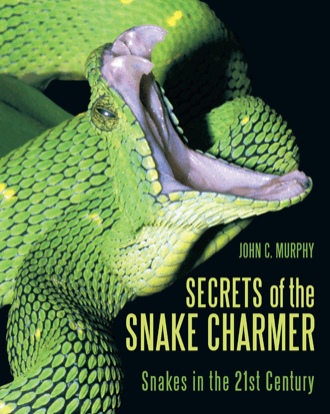
"The mind is primed to react emotionally to the sight of snakes, not just to fear them but to be aroused and absorbed in their details, to weave stories about them." Edward O. Wilson, 1984 On a dark, early morning in a small east African village in southern Tanganyika, an Eastern Green Mamba stalked a lizard in the upper branches of a large mango tree. Hunger stimulated the snake to hunt after shedding its skin. The lizard escaped, but the snake continued its search for food. The foraging mamba crawled down a branch onto the thatched roof of a hut where nine people slept. The six foot long snake burrowed its way through the thatching until it lost its hold on the dry leaves and fell onto a sleeping member of the family. Exactly what happened next is unclear but the following seems likely. One of the family members, partially awake, may have brushed the snake or grabbed it. The snake, fearing for its life, retaliated and struck the human. In the dim light the snake was barely visible, but other members of the family awoke and tried to rid themselves of the unwanted reptile, they were in turn bitten. Screams from the hut awoke other members of the village. Some of the men, believing they were under attack, grabbed weapons and emerged from their dwellings swinging large knives at their neighbors who were also confused and running around in the darkness. Eventually, order returned and the villagers gathered outside the mud dwelling where the screams had started. They dared not enter the hut, but a man emerged holding his throat before he crashed to the ground. The village shaman examined the body and diagnosed the cause of death as due to the bite of a mamba. At first light the hut was entered and the bodies of two men, three women and two young children were lying in contorted positions. Eight were dead; the only survivor was a baby. This story opens Alan Wykes’ book Snake Man, The Story of C. J. P. Ionides. According to Wykes, the village headman summoned Ionides, an East African snake catcher and game warden. Arriving at the village, Ionides quickly located, captured, and removed the snake from the village. Four years after Wykes’ book appeared, Ionides’ autobiography, Mambas and Man-Eaters, was published. Ionides recounted a story reported to have occurred in South Africa, where a Black Mamba (Dendroaspis polylepis) dropped out of a grass roof onto a sleeping family. The snake was said to have killed five people. But all of this supposedly happened before Ionides birth and Wykes therefore used considerable artistic license in crafting his story. Clearly, Edward Wilson’s statement is supported; the human mind is fascinated with snakes, and obsessed with crafting snake stories. Evolution has produced a rich diversity of life forms on planet Earth. Among these are primates and snakes; two groups of vertebrate animals that have unique and specialized adaptations, as well as a long and complex history of co-evolution on the African continent. Primates are large-brained, highly social, visually oriented mammals known for, communicating and interacting with each other in complex ways. Primates have forward facing eyes with lids that close when they sleep. Primates use parental care to help their genes succeed in the next generation, and much of what is learned during development and growth is used to survive well passed reproductive age. Primates are mostly plant-eaters, rarely are they carnivorous. They forage for food, using fingers guided by their eyes to collect and place small pieces of food in their mouths, grinding it into yet smaller pieces while lubricating the food with saliva. Food is needed frequently to maintain the high-energy requirements of the brain and other organs, as well as to retain that constant body temperature needed by all mammals. Snakes are small-brained, limbless-reptiles that depend upon vision to varying degrees, but rely most heavily upon molecules picked up on the surface of their tongues and analyzed by their brains. This chemical information is particularly important for the recognition of food and in locating mates. Snakes lack facial expressions and eyelids, their eyes are always open even when they sleep. Snakes, like all reptiles, differ from mammals in that they are partially solar powered, therefore snakes need only a fraction of the calories that a mammal of the same weight would require. Snakes swallow whole animals and have evolved mobile skull bones and elastic organs that allow their bodies to accommodate large prey. They lack the ability to bite off small pieces of large prey that can be readily digested, and instead saturate their prey with hydrochloric acid and enzymes that liquefy the food for digestion. Some species take prey that are equal to or greater than their own weight. Some larger snakes are capable of eating primates and even humans are not completely safe from being consumed by the largest of snakes. Snakes have evolved effective venoms made and stored in glands around the mouth for injection into prey through fangs or delivered into puncture wounds. Venom subdues the prey, renders it harmless, and may start digestion even before the prey has been swallowed. Not surprisingly, venom may also be used for defense when the snake encounters a potential predator. If Wilson is correct about the human brain being primed to react to snakes, other primates might be expected show the same trait. As a young teacher in the 1970’s this author foolishly accepted an unwanted baby squirrel monkey (Saimiri sciureus); it was caged in a classroom laboratory with numerous snakes and lizards. When a snake came within view the monkey’s reaction was violent and impossible to ignore. It screamed while racing back and forth in its cage and launched its body against the walls. The reaction was so emotional that the monkey’s cage was covered whenever a snake was in its line of sight. The monkey soon began to show the same reaction to anything snake-like in shape; rope, water-hoses, and electrical cords elicited similar behavior. I suspect this was the result of the monkey’s realization that live snakes were indeed living in its environment. But how did this juvenile monkey, presumably born and raised in the isolation of captivity and naïve to snakes, know that snakes were potentially dangerous? Fear of snakes had, and to a degree still does have, survival value for humans and other primates. Venom injection can rapidly lead to death or severe injury and simply avoiding snakes can be advantageous to any primate. So, if human brains are programmed to fear snakes why are we simultaneously fascinated by them? And, why do we love to obsess about snake stories?
Formats

Book Details
About the Book
Note that there is a companion website for this book and it can be seen at: http://secretsofthesnakecharmer.blogspot.com/ Humans and snakes have an intimate and ancient relationship that often revolves around either love or hate. Snakes can be seen as gods, spiritual messengers, symbols of fertility, and guardians of resources in virtually all cultures. But to those that fear them, snakes are seen as venomous creatures that cannot be trusted. In Secrets of the Snake Charmer, John Murphy, a research associate of the Division of Amphibians and Reptiles in the Field Museum of Natural History in Chicago, provides an in-depth, twenty-first century look at snakes utilizing the published research of other herpetologists as well as his own personal experiences and speculations. Murphy covers a wide range of topics such as the adaptability of snakes, the ways in which evolution has tinkered with snakes during the last 160 million years, and the impact snakes have on the ecological communities they live in. While sharing ideas about the origin of snakes, rattlesnake rattles, and spitting in cobras, Murphy presents an innovative portrayal of snakes that proves they co-evolve with their prey, predators, and parasites in order to fulfill a significant and novel role in the web of life.
About the Author
John C. Murphy's main interests are in amphibian and reptile diversity and conservation. He is currently working on Trinidad and Tobago amphibians and reptiles, homalopsid snakes, and giant snakes. He has field experience with snakes in North America, the Neotropics, Southeast Asia, and Australia. Murphy is an avid natural history photographer. See his work at www.jcmnaturalhistory.com. He is a research associate of the Division of Amphibians and Reptiles, Field Museum of Natural History, Chicago.