
Rwanda, Where Souls Turn to Dust
My Journey from Exile to Legacy
by
Book Cover & Preview Text
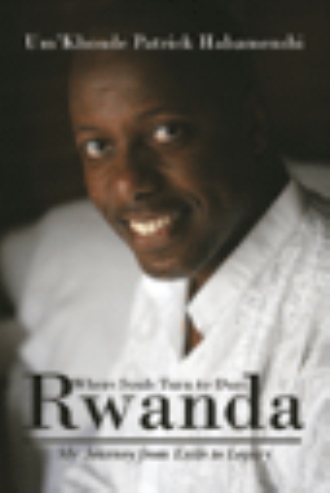
“We were up the whole night, scared of what might happen after the brutal death of the Rwandan president. The killings started in the wee hours of April 7, 1994. Mrs. Agathe Uwilingiyimana, the country’s prime minister, was one of the first to be murdered. We had heard her just moments before being interviewed on the radio, not knowing it would be the last time. The hundred nights that followed were horrible. We sat there powerless, listening to the radio, watching the brutal, uncensored images of our people being killed on live television.” “I had forced myself not to cry since the horrors started, even when I thought that all my family had perished in the Genocide, but when I heard her beloved voice, I couldn’t hold my tears any longer. I fell on my knees in that phone booth, near the bench where I’d been assaulted by my comrades six months earlier, and broke into unstoppable tears mixed with laughter! My family had survived the tragedy that would eventually steal one million of our loved ones from us.” “I fell in love with Toronto the moment I saw it, with its majestic skyscrapers competing with the CN Tower to see which will touch the sky first, and Lake Ontario waving at me like Lake Kivu of my native land used to do. And I immediately felt at home the moment I set foot on the ground and merged into a metropolitan crowd of people of all colours and all the races of the planet. No more wars, no more Tutsis, no more Hutus, just a harmonious world waiting to embrace me and heal me from all the pain and all the losses.” “The interview was very brief. At the end, the interviewer uttered a simple phrase that marked the biggest professional turn in my life: “Come back tomorrow, and bring steel-toed boots.” I remember looking at the old pair of steel-toed boots that had obviously known better days, thinking that at that moment, they were more valuable than my education!” “Walking on the streets of Kigali after so many years was awkward. I recognized all the streets and landmarks of my old city, but I felt like a complete stranger. Post-genocide Kigali was a fast-paced city, a city that looked like it was desperately trying to run away as fast as it could from its darkest hours. There were colourful billboards everywhere announcing new business opportunities, the streets were filled with new car models, new houses and new schools were built. It was almost as though the new Rwanda was busy erasing the world that existed before the Genocide. But the signs were there, ugly and bare: buildings with bullet holes, broken bridges, houses with no doors and no windows, mass graves in every neighbourhood. Because of the land mines, you had to walk very carefully and avoid freshly turned ground. Survivors seemed lost in the midst of it all, with practically no one there to help them cope with their losses and integrate them into the new Rwanda. They were so easy to spot in the crowd, with their physical and psychological scars impossible to ignore.” “Long Walk to Freedom literally changed my life and set it on its present course. Mandela’s story helped me find some type of closure. The most important thing I learned from his amazing journey is that Mandela chose to forgive the people who harmed him and his country, so his country could move one. If Mandela could still believe in his country after all the harm that was done to his people, his years as a fugitive, the 27 years in prison that practically destroyed his family, who was I to make excuses for not taking part in reconstructing my broken community?” “[My 11 years old godson Cedric’s] tragic death brought to the surface something I had felt deep in my heart without ever expressing it out loud: an overwhelming feeling of guilt! I felt guilty to still be alive when so many had died, guilty to have been able to start a new life when so many were struggling to break free from the horrors of 1994, and guilty to not have been there for Cedric throughout his illness.” “When I decided to go back and live in Rwanda, I applied for a lecturer’s position at the National University of Rwanda in Butare, a charming small city two hours away from Kigali. I was disheartened by the conditions they had to study in. The students had to come early in the morning just to get a chair, as there weren’t enough chairs and the university couldn’t afford to buy more. One day, one of the students asked me if they could borrow my books to make photocopies. The library had been ransacked during the war, and the university didn’t have the means to buy new volumes.” “Many people say that it is my “Mr. Clean” reputation that made Kagame promote me to the agriculture portfolio in October 2003, just two days after my thirty-fifth birthday. I was overwhelmed: I was the youngest member of government and I was going to be in charge of the biggest economic ministry in the country!” “Ironically, my biggest challenges during my tenure as minister of agriculture were not the chronic diseases plaguing and debilitating our livestock or the harsh elements that made it barely possible for an average Rwandan farmer to feed his family. No. My biggest fights were fought in another arena: politics. From the first moment I set foot in that ministry, the ruling party, my own party, showed me that Rwanda was still clutched in the claws of the Evil that had destroyed Rwanda less than 10 years earlier.” “Knowing now where this road led, would I still have walked it? The answer came to me so simple, so clear. Yes, I would. Even if I didn’t know how this was going to end, at least I would have held on to my principles and stood on the right side of history to the end.” “Honourable President, Honourable Judges, this is the trial of my life, the negation of everything I am and everything I ever stood for! I have never betrayed my country. I served it with all the knowledge and all the integrity I had, to the best of my abilities. I do not ask the court for any special consideration or to pity me. What I am asking today is simply that justice be upheld. Thank you, Honourable President, thank you, Honourable Judges” “As I walked across the tarmac to the plane, I could see the presidential jet parked by the VIP gate, a luxurious symbol of a deceitful system I wished I had never known. When our plane took off, I felt empty and started crying. The other passengers were looking at me, wondering if it was really the former minister, the famous—or infamous, for some—Patrick, sitting next to them. I didn’t care that people saw me crying. This was my life and mine alone. I had given my country all I had, and I was left with nothing but nightmares and tears. I didn’t even think about the life that awaited the 37-year-old me. I could only think of the 37 years of my life that had led me to this empty feeling.” "This idea frightened them the same way it frightened previous regimes; and like previous regimes, they tried to ascertain their own worth by robbing me of my value. I am every Rwandan who dreams of a better future. By persecuting me, they expressed as much hatred for themselves as for me as I am their own flesh and blood whether they want it or not." "At the same time, recollection liberated me in ways I never imagined possible before embarking on this trip down memory lane. It might sound strange saying it now, but I have finally forgiven Paul Kagame and his entourage for everything they subjected me to during my last years in Rwanda. I have also forgiven my colleagues for sitting idly while my life was torn apart." “My Legacy is a poem ready to be written, a song ready to be chanted, a conversation ready to be held, a project ready to be developed. My legacy will be marked by tragedies I will report, injustices I will stop, abuses I will expose and Evil I will defeat.”
Formats

Book Details
About the Book
The author, Um’Khonde Patrick Habamenshi, was appointed Minister of Agriculture in Rwanda in October 2003, two days after his thirty-fifth birthday. It started as a dream but rapidly became a nightmare marked by constant threats, insults, and unfounded accusations. He resigned in May 2005 and sought refuge in the Canadian Embassy in Kigali. The following year was a slow downward spiral to the same hell that decimated Rwanda in 1994, a hell of injustice and senseless persecution.
The experience left him broken beyond words. He was left with the demons and ghosts of his broken country and with tortured experiences that would surely destroy him if he succumbed to them.
Rwanda, Where Souls Turn to Dust is the remarkable story of his healing path to rebuilding his mind, body and spirit. He had to move away from the negative things that had been dominating his life, the loss of his loved ones, and the loss of his previous dreams. He rebuilt his life from the ashes of his old life in Rwanda, a life free of hatred, free of prejudice, and free of fears.
About the Author
Um’Khonde Patrick Habamenshi was born in Gisenyi, Rwanda. In 2008, he created Behind Dogon Doors, a social enterprise helping individuals and organizations build a lasting legacy. Through his organization, Habamenshi uses the lessons he learnt in his own life to help others understand their true worth and the value they bring to the world. Habamenshi now lives in Toronto, Canada. Visit his website at www.rightyourlegacy.ca All my life I had been driven by the belief that there is always a better tomorrow after the storm. Now, I wasn’t sure anymore. After five years living in post-genocide Rwanda, my idealism and optimism seemed all too childish and naïve, my dreams a sad bundle of pipe dreams, chimerical projections of a mind that refused to see what the world really looked like. What if Evil was to always triumph over Good? What if I was to simply accept that I was just an odd “ethnic” piece mistakenly placed in the colourless puzzle of life? The refugee syndrome, that cruel realization that I belonged neither where I came from nor where I now was, affected me so acutely, it almost hurt to breathe. I was broken to a point I had not realized. I was left to myself to deal with my demons and my ghosts; a pervasive enemy roamed within me, slowly and surely killing me in a way the enemy without had failed. Although I had not collapsed before my tormentors in Rwanda, I now found myself slowly sinking into a deep and bottomless hole.