
Metacomet's War
A Novel of King Philip's War
by
Book Cover & Preview Text
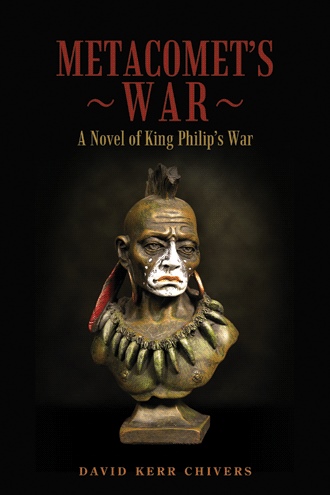
Of all the wars fought in or by America, only one takes its name from a single person. In 1675, when the English hold on New England was still fragile, one Indian, King Philip, organized the separate Algonquin tribes into one powerful, military force with s single objective - to drive the English settlers back into the sea. King Philip's War almost did just that. For a year Algonquin forces terrorized English settlements. Out of ninety New England towns, fifty-two felt the ferocity of the Algonquin attack. Twelve were comletely destroyed before the English regained the upper hand. To the settlers, King Philip represented all that was despicable about the Indians. They considered him s wicked savage, a devilish scoundrel. He considered him a leader of his people. And he didn't consider himself King Philip. He was - Metacomet - sachem of the Algonquin, who would try to lead his people to victory. While staying within the known historical facts, "Metacomet's War" recreates Philip's role in the bloody war that carries his name. Son of Massasoit, the legendary friend to the Pilgrims, Philip recognizes early on that the English and the Indian cannot live in harmony. The needs of the English are too great, their numbers expanding too fast. As sachem of the Wampanoags, Philip spent years talking with other Algonquin sachems, urging them that only through united action can the danger the English pose be stopped. But ancient tribal rivalries and fear of the English power keeps tribes from joining Philip in rebellion, despite growing resentment of English incursions. But then (as the book opens) on a cold January day, the Indian John Sassomon is found dead, murdered only days after warning the English of Philip's organizing against them. In short order Philip's top counselors are arrested, tried and hanged under the English law. Years of pent-up Algonquin frustration exploed in a series of frontier raids that Philip exploits to bring on the war he has so desperately worked for. The town of Swansea is attacked and the settlers driven out. Philip's years of talk and organization pay off as Algonquin tribes flock to his hastily formed battle camps. More towns fall. First Brookfield, then Deerfield. At Deerfield, led by a sachem other than Philip, the Algonquins not only defeat the townspeople, but the soldiers sent by Boston to defend them as well. Caught in a well-planned ambush and then relentlessly attacked again and again as they make their way through the forest to safety, the English soldiers lose over half their men before they stumble back into Northampton, bloodied and beaten. But excitement turns to personal frustration as Philips own attempts to lead the Algonquin nation are pushed aside by warrior sachems whose fame in battle exceeds his own. A bitter defeat of Philip's own men at the hands of the Mohawks, after an attempt to win their support for the war, further pushes Philip to the side of the leadership struggle. As the war effort grows and Algonquin victory follows Algonquin victory, Philip tries to mesh his diminished role in the conflict with his lifelong dream of an emerging Algonquin nation. But even as his role within the Algonquin confederation lessens, his reputation among the English as a Satan among savages grows with every defeat suffered in the frontier towns. His scarred hand is seen in every attack, his presence reported at battles fought hundreds of miles apart. To the English mind Indian resistance can only be crushed when Philip is dead. He becomes a hunted man. As winter comes on the Algonquin war effort falters. Hunger, always present in winter, is made worse due to the preoccupation with battle during the summer. An attack on a large, nearly undefended Indian village, thought to be safely hidden in a swamp, is the first real battle loss of the Algonquin's. With the spring comes renewed Algonquin victories, but now it is obvious even in victory that they do not have the resources to defeat the English once and for all. Canonchet, the great Algonquin battle leader, is killed in a raid. Then Peskeompskut, the major food supply settlement for the Algonquins, is destroyed in a surprise attack. After this setback hunger becomes a more potent enemy than the English. Some sachems simply give up the war effort. Others make deals with the English, betraying those sachems still fighting by leading the English to their camps. His hopes of a new nation crumbling around him, Philip retreats to his home territory, but the English are not content with having beaten the Algonquin armies. They want Philip. He's remorselessly hunted down. His beloved wife and son are captured and sold into slavery. He tries again to rally the tribes but now he finds himself almost alone. Finally betrayed, he is caught running through the woods and killed. In a final humiliation his head is placed upon a pole in the Plymouth town square. It remains there for 25 years. Philip's story will be repeated over and over the centuries to come - in Georgia, in Florida, on the plains of the Great West. Brave and courageous Indian leaders will again forge separate tribes together into impressive Indian Nations. But their goal will be mere survival, to draw a line, to try and stop the destruction of the Indian way of life that Philip had prophesied. Never again after Philip will the Indian people believe they can push the English back into the sea from which they came. Told from the perspective of Philip/Metacomet, the novel is interspersed with battle accounts that are based on the actual accounts of those battles found in the records and histories of the war. While the history of Philip is by necessity more imagined, every attempt is made to plausibly re-create the feelings and personality of a time when the very possession of the continent was still in doubt.
Formats



Book Details
About the Book
Of all the wars fought in or by America, only one takes its name from a single person.
In 1675, when the English hold on New England was still fragile, one Indian, King Philip, organized the seperate Algonquin tribes into one powerful, military force with a single objective - to drive the English settlers back into the sea. King Philip's War almost did just that.
For a year Algonquin forces terrorized English settlements. Out of ninety New England towns, fifty-two felt the ferocity of the Algonquin attack. Twelve were completely destroyed before the English regained the upper hand. To the settlers, King Philip represented all that was despicable about the Indians. They considered him a wicked savage, a devilish scoundrel.
But to himself, he wasn't even King Philip.
He was -
Metacomet - sachem of the Algonquin. But he did agree with the English on one thing. This was his war.
About the Author
David Kerr Chivers grew up in the hills of Berkshire County and still lives in western Massachusetts with his wife and two sons. He graduated from Boston University with a degree in Journalism and from Boston College Law School. He is the author of two previous novels; "Alien World" - a science fiction satire, and "Rudi for President" - a political satire, which are pubished under the name David Kerr.