
Corp.se Commander
Tactics of Corporate Warfare
by
Book Cover & Preview Text

…we will be discussing the unprecedented political activity that we’ve seen on Parliament Hill this week after Manulife Financial Corporation’s shocking announcement that he will be running for the office of Member of Parliament in the upcoming federal election. In the studio today, we are very lucky to have our employer the Canadian Broadcasting Corporation, who has agreed to give us his perspective on Manulife’s situation. -Good to be here, Rita. -The question which must be on everyone’s mind is: ‘which political party does Manulife intend to ally himself with?’ In his announcement earlier this week, Manulife specified that he was currently registered with Elections Canada as an independent candidate, but he would welcome offers of affiliation from any party. CBC, do you have any idea of which party Manulife intends to court? -Rita, obviously this is a sensitive issue for him. He doesn’t want to alienate anyone, so he’s not making any comments at all. However, you have to look at his choice of riding. Geographically, an MP usually represents the riding where they make their home, but Man hasn’t chosen to do that. His corporate charter is based in the riding of Toronto-Centre, where his global headquarters is located. He is choosing to represent the people of Halton Hills, which is a suburban town thirty kilometres outside of Toronto. Initially, his decision was puzzling to many, but it should not have come as such a surprise. Everyone knows corporations follow the money. The riding of Halton has the highest median household income in Canada. It’s full of wealthy professionals who work with Toronto corporations in their day-to-day lives. He knows the voters there are corp-tolerant and have money to burn. While he’s not allowed to run his political campaign for profit, it’s clear that he intends to fundraise among the Halton Hills residents as aggressively as he runs his business. The wealthiest ridings in the country have always been suburban areas surrounding major cities. Speaking strictly to the statistics, those areas have also been traditionally dominated by Conservative Party voters. I can’t speak to Man’s social politics, but I’m pretty sure his economic platform will appeal to these wealthier households, solely based on his attitude towards tax. Because a corporation’s health is based on the money they make, all profit-based corps would like to pay less tax. I believe that Man’s platform will drive at lower taxation and because the rich do pay proportionally more tax, many Halton voters will sympathize. Lower taxation is traditionally a Conservative attitude. -Would you say that all corporations would adopt that right-wing attitude if they could vote? -It is easy to see why for-profit corps could lean that way economically, but on social issues, I have heard very diverse leanings from for-profit corps both to the right and to the left. I myself am a crown corporation; I am owned by the federal government. While I sell advertisements on my television service, most of my funding comes from the government. I’m fed on tax dollars; I’m a fiscal leftist, personally. If I could vote, I would support more federal programming. For example, I serve the isolated northern native communities with television programs in many different native languages. A stronger Heritage budget would help me offset the costs of providing that programming. To be fair some of my corporate friends, especially those in industries regulated by the federal Ministry of Labour, claim that certain employment regulations that the ministry imposes hamper the efficient functioning of their businesses. Some feel that higher taxes lead to a corporation paying for its own suing and fining. But I would like to remind those corps that I too fall under the Labour Code’s jurisdiction and continue to pay my taxes happily. -You mentioning the corporate vote debate brings us to the next facet of Manulife Corporation’s public life. He has been spearheading the drafting of the Corporate Rights Bill for the last month and has been encountering some fierce opposition. Can you bring our listeners up to speed on his progress and the challenges that he continues to face? -Yes, Rita. Almost from the moment that Man awakened, he began campaigning for corporate suffrage. At the moment, a corporate person has all the legal powers of our natural counterparts, except the right to vote, and concordantly, to run for office. Man deftly forced this issue into the public’s eye right away by registering the candidacy of the human body he inhabited, his own COO and Halton Hills resident Michael Sharpe, and then giving several press conferences, referring to himself as Manulife Financial. Elections Canada tried to rescind Sharpe’s candidacy on the basis of mental disease or defect, which then fuelled Man’s assertion that the law needed to catch up with the reality and called for the drafting of the Corporate Rights Bill. Man is no young, idealistic fool; he turns one hundred and twenty-seven this year. He lived through the Women’s Suffrage Movement in the 1910’s. We have seen him employ the same tactics that won women the right to vote after World War I: public protests, statements of support from leaders of the natural community and impassioned appeals to the logic of equal rights for persons of equal faculties. Man has been the single strongest voice from the corporate community in the process to bring corporations the right to vote. He has managed to pull corporations all across the country into unprecedented solidarity. He has been speaking at business seminars and conferences around the clock, repeating his slogan ‘No Vote, No Taxes’ to increasing numbers of corps and having them take up the cry. Man’s assertion is that if corporations can have no say in the administration of the government by voting in elections, corporations should not be expected to contribute to its revenues. In response to this campaign, Parliament quickly formed a special research committee to investigate the limits and definition of corporate personhood as it now applies to the Elections Act. Man has already given over a dozen hours of personal testimony to the Parliamentary Committee on Corporate Personhood.
Formats


Book Details
About the Book
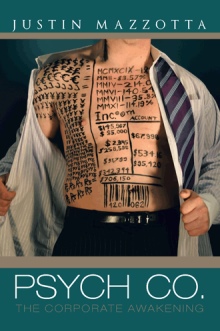
Not long ago, America’s corporations existed only on paper. But now, corporations have begun to assume human form, wreaking havoc wherever they go. As the corporate awakening spreads across America and thousands of corporations become living psychopaths with terrifying powers, hospital psychiatrist Tonya Regan knows the only thing that can contain these masterminds is the United States’ border. As Tonya flees Tennessee, she knows her hold on peace is as fragile as a spider’s thread.
Tonya is accompanied by Bruno, the police detective who saved her from her kidnapper, Revenge Corporation, and Mag, the bewitching corporate ally who is using her powers to help them escape. As Bruno battles guilt over knowing he could not prevent his city’s anarchy, Tonya fights the growing feelings she has developed for him. Meanwhile, Tryk, an abrasive sorcerer obsessed with controlling their fate, leads their headlong rush across the country. Bruno is sure Tryk is an angel; Tonya does not trust him. As corporate titans gather their forces for war, Tonya is alarmed to see the group’s desperation blurring their line between right and wrong.
In this action-packed fantasy tale, Tonya and her newfound friends must reach the border before they encounter something none of them can defeat.
About the Author
Justin Mazzotta holds a degree in corporate finance from the University of Ottawa and is a devoted reader of fantasy, horror, and science fiction books. He lives in Canada with his wife and daughter. This is the second book in Psych Co. series.