
depraved INDIFFERENCE: the Workers' Compensation System
by
Book Cover & Preview Text
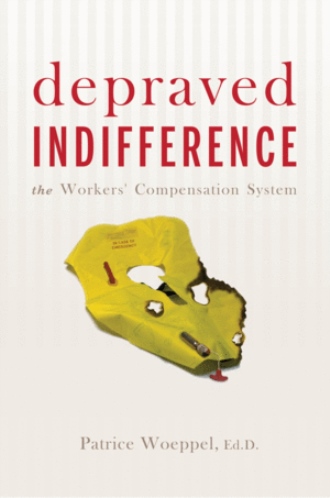
Every eight minutes in this country, someone dies from an occupational illness or injury. All across America, in every state, across industries and occupations, workers are being injured or killed on the job or exposed to toxic chemicals from which they are dying. In 2004, over 4.3 million workers were reported injured on the job. In the same year, over 5700 workers died from their injuries.1 An additional estimated 60,000 die each year from occupational illnesses: a national tragedy of pandemic proportions.2
For those who remain, whether they will fall into the nether world of workers’ compensation, never to restore their lives and their livelihoods again, will depend on the severity of the injury.
Most of us, myself included, thought workers’ compensation was there for us if we needed it. How wrong we were! Year after year, with the benign neglect or active collusion of state insurance departments, workers’ compensation allows the continuation of a system that kills and maims with impunity.
The title of this book refers to a workers’ compensation system in which worker deaths often cost an employer far less than correcting a health/safety hazard in the workplace; and a system in which the employer is immune from prosecution for the depraved indifference that results in severe injury, toxic exposure and death. New York State Penal Law 125.25 (2) defines murder in the second degree, an A-1 Felony, “…under circumstances evincing a depraved indifference to human life, he recklessly engages in conduct which creates a grave risk of death to another person, and thereby causes the death of another person;….”3
The stories in this book are the stories of ordinary people, except that it happened to them. The cushion of workers’ compensation they thought they had evaporated, leaving them to their own resources. Nay, worse! Not only was workers’ compensation not there to help, except to stuff the insurers’ pockets, but it added to the burden to be faced. It forced a battle for medical treatment and for wage compensation, for the very survival of the worker, or the bereaved family of the worker who died, at the same time that it accused the injured worker of faking it, the deceased worker of causing it.
With great hoopla, Congress passed legislation to get people on welfare back to work. At the same time, we push hundreds of thousands of injured and ill workers each year from work to welfare and poverty, to poor health with no health care, to broken lives, many never to be able to work or support their families again.
Our nation has turned its back on workers who believed in the system, believed the American dream – right up until the day it all turned upside down.
What has happened to our nation that has allowed corporations and insurers to throw away the lives, the health of so many without caring, without fear of exposure, without being held accountable? It’s called Workers’ Compensation: the system we thought was there to protect us if we were injured on the job.
Historically, the workers’ compensation system began in Germany in the 1880s. Workers’ compensation was an opportunity for Bismarck to quell the growing anger over worker injuries and deaths, and at the same time ensure Bismarck’s base of power after he had outlawed the trade unions and ordained other repressive “reforms.” The concept emigrated to Great Britain and was passed there in 1897. Great Britain, however, began the reform of its workers’ compensation system over 50 years ago, recognizing that workers’ compensation protected the employer from liability, and thus there was no incentive for employers to make the workplace safe.4
In 2002, Great Britain, twenty percent of the US workforce in size, had only four percent of the worker deaths recorded by US BLS in the same year (225 vs. 5,524).5
In the United States, the no-fault principle has been enshrined. And that is the core of the problem.
The no-fault principle disenfranchises workers from their Seventh Amendment rights to bring suit at common law for redress of grievances.6 Under workers’ compensation, the worker cannot sue his/her employer for injury or death. The quid pro quo is supposed to be swift and certain compensation and treatment in exchange for having given up the right to sue. What has happened over the years is that the freedom from lawsuit prevails, while worker medical treatment and wage compensation have been delayed and denied away. Thus there is no monetary disincentive for employers and insurers to not pay for the disease that cripples or the corporate negligence that injures or kills. It’s in the corporation’s best monetary interest not to pay. The longer the money stays in the insurer’s pockets and investment portfolio, the more desperate the worker’s situation becomes. Thus this system, ostensibly to protect workers, has continued to erode away workers’ rights and benefits, without anyone noticing, except employers and the workers’ compensation insurance industry that have brought about these changes and who profit from them mightily. “Starving them out” is the phrase used in the workers’ compensation insurance industry, according to a former insurance claims adjuster.7
Having lost the right to sue, workers have no leverage in the workers’ compensation system and thus there is no justice for injured, killed, and toxic chemical-exposed workers.
REFERENCES:
1. United States Department of Labor, Bureau of Labor Statistics, www.bls.gov.
2. Leigh, J. Paul; Markowitz, Steven; Fahs, Marianne; Landrigan, Philip. Costs of Occupational Injuries and Illnesses. University of Michigan Press, 2000.
3. New York State Penal Law, 125.25 (2) Murder in the second degree (A-1 Felony).
4. White, Lawrence. Human Debris: The Injured Worker in America. Seaview/Putnam, New York. 1983.
5. Thou Shalt Not Corporately Kill. The Economist, May 24, 2003, p. 59 and BLS data, cited in AFL-CIO, Death on the Job: The Toll of Neglect. A National and State-By-State Profile of Worker Safety and Health in the United States, 13th Edition, April 2004.
6. Bill of Rights, The first ten amendments to the Constitution of the United States, ratified December 15, 1791. Amendment VII, which reads: “In suits at common law, where the value in controversy shall exceed twenty dollars, the right of trial by jury shall be preserved, and no fact tried by a jury shall be otherwise re-examined in any Court of the United States, than according to the rules of common law.
7. Workers comp: Falling down on the job. Consumer Reports, February, 2000, p.29.
Formats

Book Details
About the Book
All across America's workplaces; workers are being injured, killed or exposed to toxic chemicals from which they are dying. An estimated 66,000 persons die each year from occupational illnesses and injuries in our country: An epidemic of monumental proportions. Almost a century after the introduction of Workers' Compensation; workers, their families, communities all pay the price for the devastating human and environmental consequences of this failure to hold corporations accountable for their actions.
The stories in Depraved Indifference are the stories of ordinary people. Discarded and forgotten by their employers, denied medical coverage by the workers' compensation insurers; many have been left to die, slowly and agonizingly, unnoticed by all but the ones who really care - their grieving families.
Depraved Indifference represents over five years of research and interviews. It lays bare a Workers' Compensation system that cavalierly exposes workers to severe injury, toxic exposure and death; while throwing the major cost unto the family and the taxpayer, without fear of lawsuit, prosecution or even public outcry. It is a call to action.
“Depraved Indifference by Patrice Woeppel is a well researched look at the failure of workers’ compensation laws to deliver the promise of fast, sure and adequate benefits based upon a no fault approach to compensating on-the-job injury and death. The author makes the case that miniscule benefits, the ability to starve out injured workers and their families, the lack of official oversight, the lack of meaningful penalties for violations and the lack of any criminal prosecution of employers for criminal acts of “depraved indifference” to human life, make for an unsafe workplace for millions of Americans. The numbers are staggering. It is an epidemic of death and economic destruction in the American workplace, unchecked by trial by jury to bring wrongdoers to the bar of justice.”-Mark L. Zientz, Esq.
Woeppel explains the problem and also lays out a solution
"… Depraved Indifference: The Workers' Compensation System is a scholarly look at the American workers' compensation laws and how they are unjust for today's world filled with high risk jobs and deadly chemicals that many must work with almost daily. With a suggested reform model presented, Woeppel explains the problem and also lays out a solution, giving Depraved Indifference a critical recommendation.”
-James Andrew, Midwest Book Review
“The workers’ compensation system does more to protect corporations than injured workers, according to this well-researched analysis that draws on a number of actual cases, including the author’s own experience after an injury while working in a hospital. The final chapter gives her prescription for reform.”
-Matt Witt, City University of New York, New Labor Forum, Vol. 18, No. 2: Spring, 2009.
“Depraved Indifference: The Workers’ Compensation System is the best book on workers’ compensation in thirty years.”
-Daniel M. Berman, Ph.D., author of Death On the Job: Occupational Health and Safety Struggles in the United States.
About the Author
Patrice Woeppel, Ed.D. has had a long career in hospital, health, and mental health administration, as well as serving on many state and community boards, and as a hospital board officer. Dr. Woeppel has been involved in many civil rights and human rights issues over the years.