
Brothers Kept Apart
Examining the Christian and Islamic religious barriers that have divided Christians and Muslims for over 1,300 years.
by
Book Cover & Preview Text
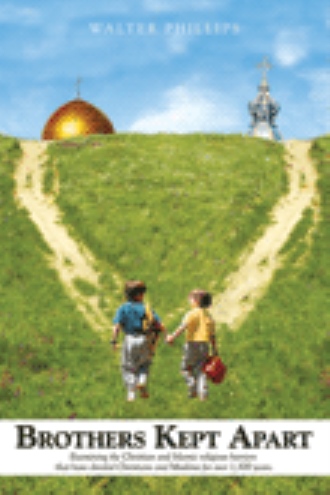
Christians and Muslims have been kept apart for over 1,300 years, because they were taught that irreconcilable differences exist between their religious beliefs. This has resulted in mutual distrust, persecution, and even wars. I was motivated to read the Qur’an by the events of September 11th, 2001. I wanted to know the teachings in the Qur’an that could convince Muslims to be willing to sacrifice their lives, in order to kill persons who did not appear to be associated with Islam or their conflict. My Christian tradition was the source of some anxiety, since I had been taught that “the Koran” was full of evil, and could cause the reader to be led astray. Even the name “Koran” sounded and appeared ominous. After convincing myself that my only motive for reading the book was to investigate its contents, I commenced reading with some trepidation. I was surprised to find that the Qur’an seemed so familiar, and after reading several different translations, I began to wonder whether Muslims who followed the Qur’an, were part of the community of believers, otherwise called the elect of God. This book is an examination of that thesis. The claim is admittedly shocking for some Christians, and had I heard of such an assertion by anyone before I read the Qur’an, I would have dismissed the claim and would have decided not to devote any effort investigating any evidence that the claimant might have provided. It is for this reason that I shall present what I understand the Qur’an teaches at this point in this book, in the hope that the reader will want to accompany me on this investigative journey. The Qur’an appears to teach that Muslims must believe that Jesus:
- was born of the virgin Mary;
- taught the Gospel;
- performed many miracles, including raising the dead;
- was crucified;
- was raised by God; and
- is the Messiah.
- believe in one God who is identified as the only Creator, and the God of Noah, Abraham, Isaac, Jacob, Moses, Job, Elisha, David, and the Old Testament Prophets;
- repent and believe in order to receive God’s forgiveness by grace;
- develop and cultivate a personal relationship with the God of Abraham;
- believe the Bible, and copy and distribute it to all nations of the earth without compensation;
- receive guidance from the Holy Spirit;
- resist the temptations from Satan; and
- avoid the condemnation of hell.
Formats

Book Details
About the Book
A comprehensive investigation of the Qur’an, Bible, Islam and Christianity, revealing harmony between the principal teachings of the Books, but disharmony between the religious traditions. Suppose the Qur’an taught that:
-
If you do not believe this, then you are welcome to join me on this investigative journey where we can examine the evidence honestly. This means that:
- Interpretations must be supported by the evidence;
- Interpretations must not damage the integrity of the evidence;
- Assumptions used in interpreting the evidence must be verified.
-
“In my opinion, the most important lesson from studying history is: never be afraid to re-examine the evidence in order to learn or verify the truth. We should never be afraid to critically examine claims of truth, for truth should be able to withstand rigorous scrutiny.”
- Walter Phillips BSc, BEng, MASc, MURP, CEng, MIStructE, MIHT, MAPM, MCSCE, MBAPE
About the Author
Walter Phillips has studied the Bible and early civilizations for the past thirty years, and the Qur’an for the past seven. He holds degrees in mathematics, structural engineering, environmental engineering, and land use planning. He has spent the past twenty years investigating evidence and designing solutions to problems.
-
“In my opinion, the most important lesson from studying history is: never be afraid to re-examine the evidence in order to learn or verify the truth. We should never be afraid to critically examine claims of truth, for truth should be able to withstand rigorous scrutiny.”
- Walter Phillips BSc, BEng, MASc, MURP, CEng, MIStructE, MIHT, MAPM, MCSCE, MBAPE